For Xinwei: The World She Opened, Softly Like a Dream
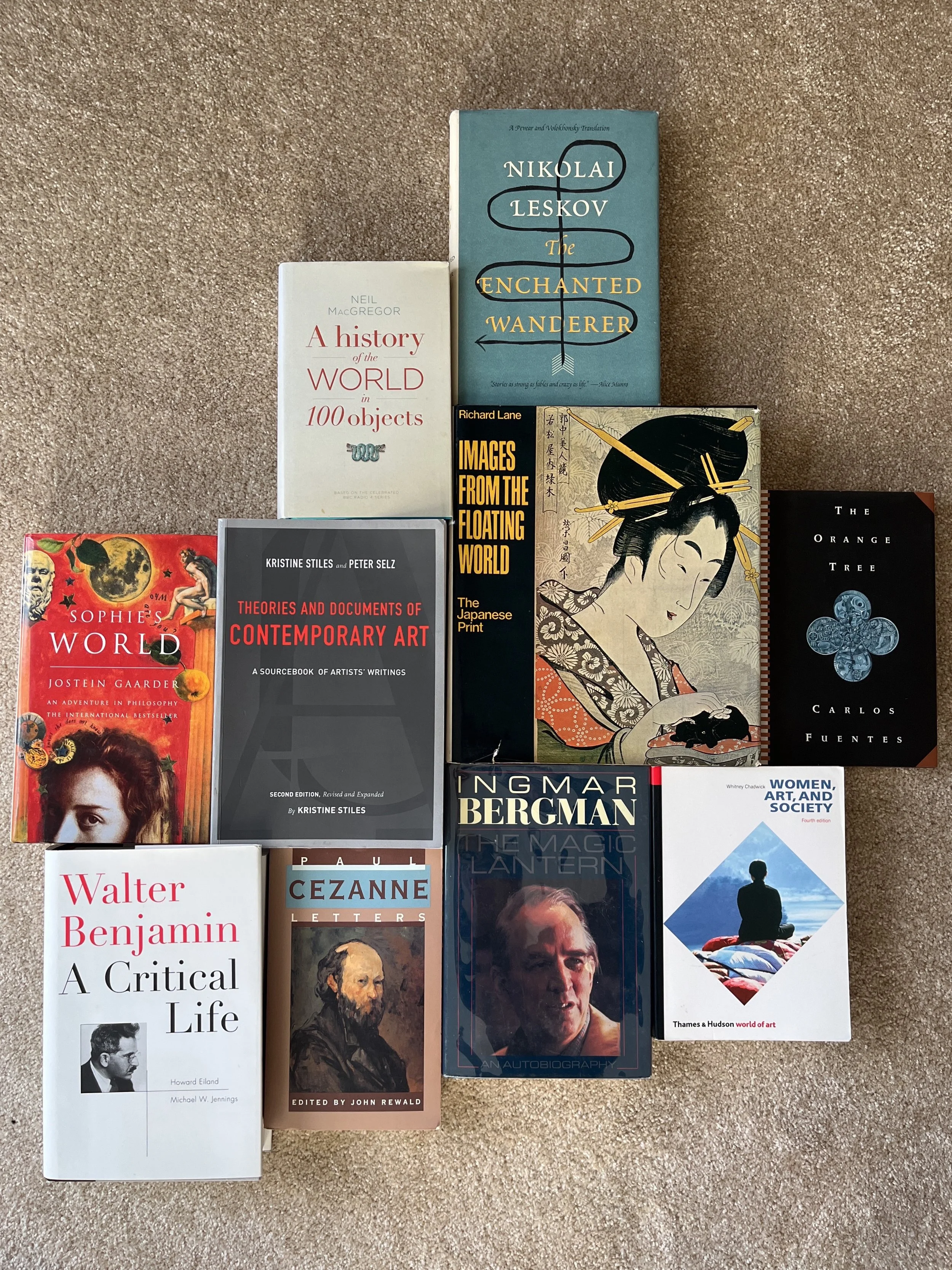
a photo from my study on the day I undertook this immersive project
There are moments when affection does not remain contained within the boundaries of the person toward whom it is directed. It expands outward, quietly, almost imperceptibly, until it begins to gather an entire world around itself.
When one loves a person deeply—in my case, Xinwei, my Chinese sister—there is often a quiet misunderstanding that follows in explanation. She is not my sister by blood. We are not bound by lineage or legal kinship. And yet the bond is, in every meaningful sense, deeper than anything biological description can hold. It belongs to another category entirely: chosen, lived, and sustained through a kind of recognition that precedes language. It is from within this form of closeness that this syllabus first began to take shape.
That closeness produces a certain epistemic desire. Not the desire to possess knowledge, and not even the desire to explain, but something closer to attentiveness: a wish to understand the textures of the world that shaped her, as though proximity to her cultural and aesthetic inheritance might bring one closer to a more complete form of seeing.
This movement is not translation. It is a discipline of proximity without collapse.
Over time, it began to converge with something already central to my intellectual life: a sustained investment in aesthetics not as decoration, but as structure. I have been drawn to how surfaces organize perception, how beauty shapes attention, and how form carries meaning where language reaches its limit. In my doctoral work, this concern has repeatedly surfaced through literature, film, and visual culture, particularly around questions of migration, identity, and cultural translation.
What follows is a continuation of that work, but also a reconfiguration of it.
It is not a university syllabus, though it borrows its architecture. It is not a reading list, though it contains one. It is a constructed field of curiosity: a way of arranging texts, films, lectures, and visual histories so that one can begin to inhabit a world before fully understanding it, and in doing so, let understanding arrive from within experience rather than before it.
At its center is a single, unstable question:
How does femininity survive through surface?
Not surface as superficiality, but surface as structure, strategy, and aesthetic intelligence.
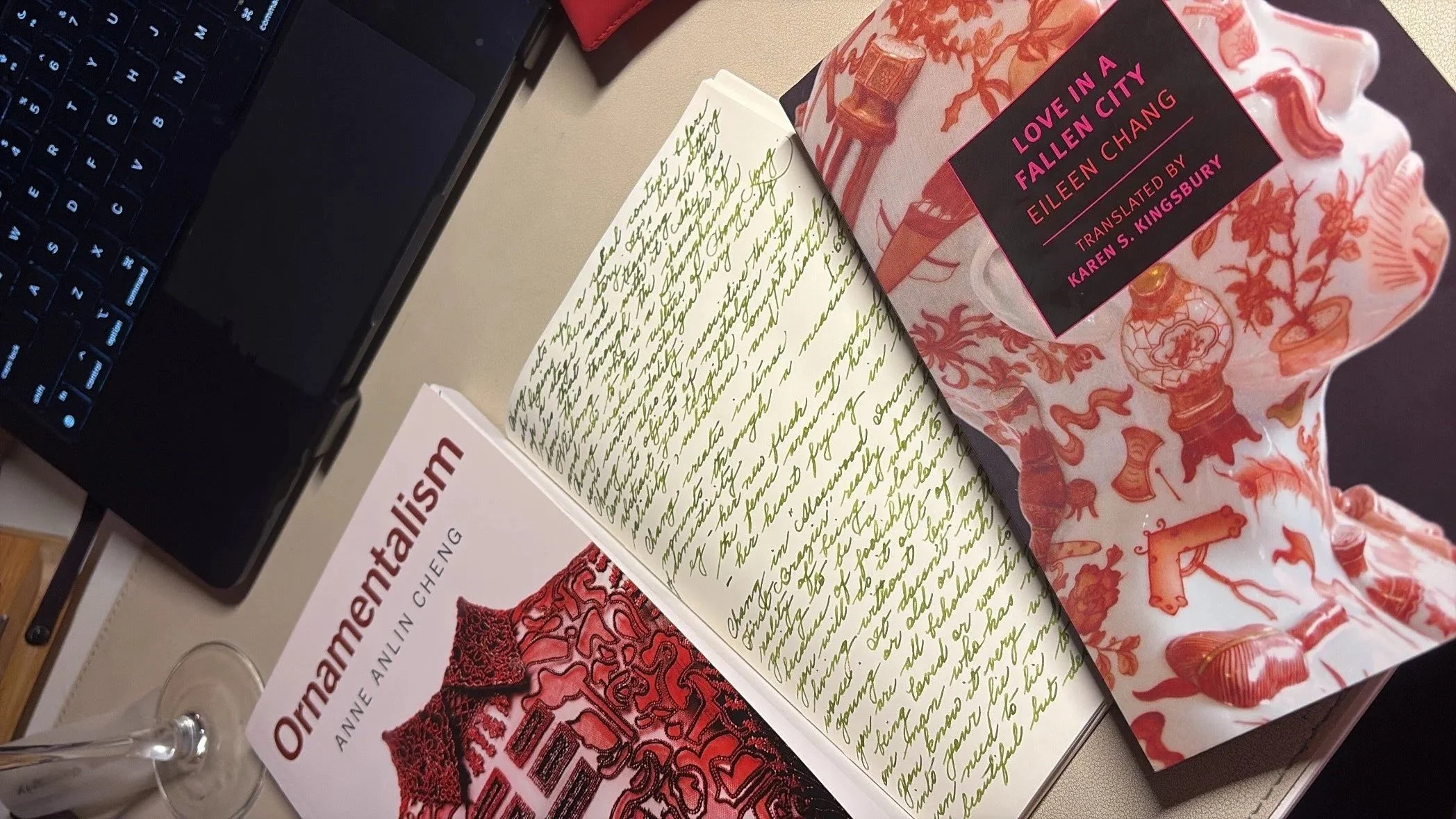
notes from my study
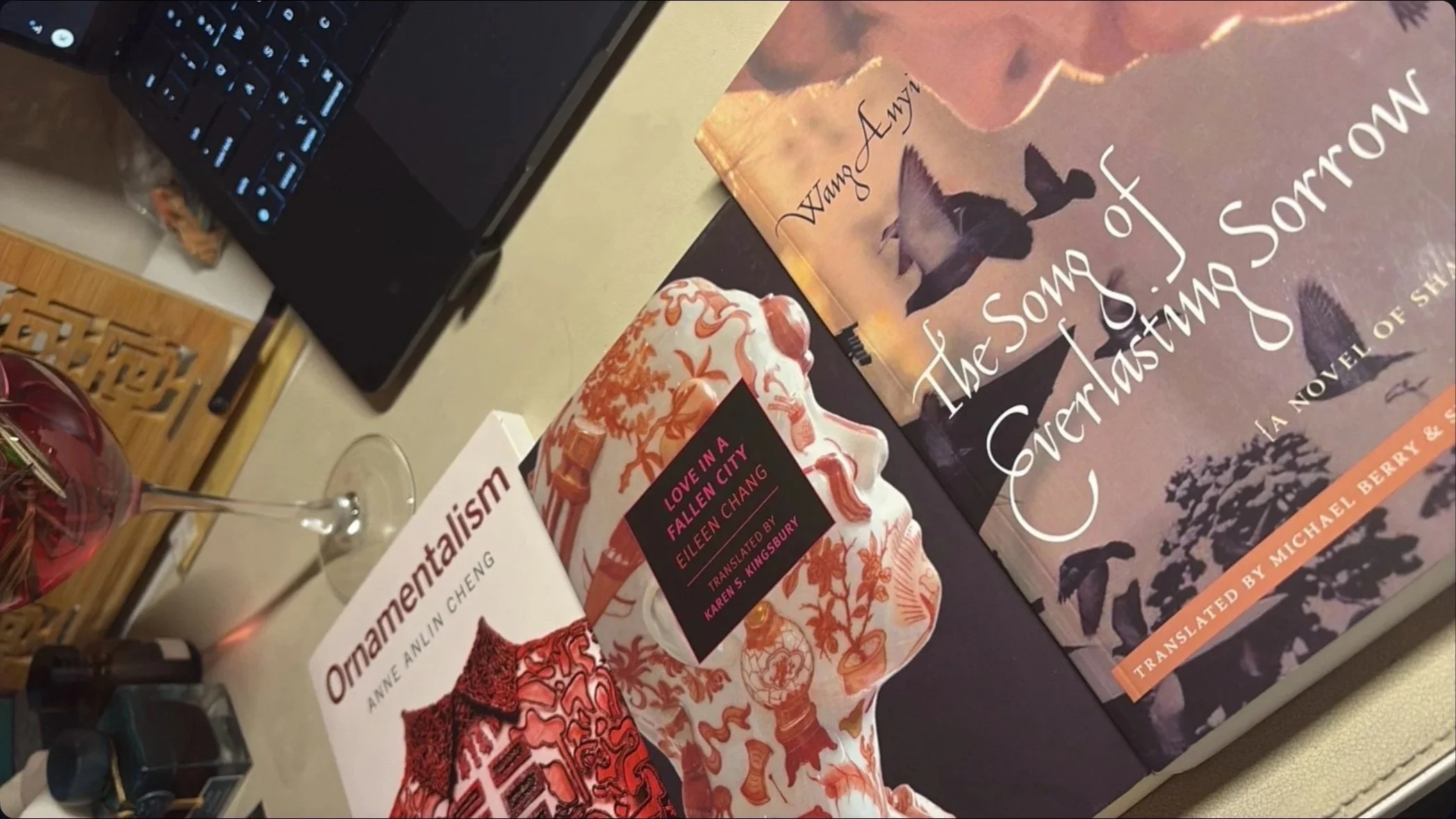
SURFACES OF SURVIVAL: A SYLLABUS ON CHINESE AESTHETICS, FEMININITY, AND VISUAL FORMI. FICTION — SHANGHAI, MEMORY, AND THE GRAMMAR OF SURFACE1. Eileen Chang — Love in a Fallen City
A novella collection set in wartime Shanghai and Hong Kong, where intimacy unfolds through gesture, clothing, and silence. Love is inseparable from survival, and emotional life is always mediated through performance and restraint.
Read alongside Anne Anlin Cheng and Antonia Finnane from the beginning.
2. Wang Anyi — The Song of Everlasting Sorrow
A sweeping historical novel following a woman’s life in Shanghai across decades of political transformation. Identity here is not interior essence but accumulation: objects, spaces, habits, and time itself.
Read after Chang + Cheng + Wu Hung Lectures 1–2.
II. THEORY — ORNAMENT, BEAUTY, AND PERCEPTION3. Anne Anlin Cheng — Ornamentalism
A foundational theoretical work arguing that Asian femininity has historically been constructed as ornament—visible, aestheticized, and structurally constrained. Ornament becomes both limitation and a mode of survival.
4. Antonia Finnane — Changing Clothes in China: Fashion, History, Nation
A history of Chinese dress from dynastic tradition through nationalist modernity, with the qipao as its central object. Fashion here is not frivolous: it is the site where the female body, national identity, and political transformation converge on the surface of a garment. The material and historical grounding for Cheng's theoretical argument.
Read in parallel with Ornamentalism.
5. Elaine Scarry — On Beauty and Being Just
A philosophical meditation on beauty as a force that reorganizes perception outward. Beauty is not passive; it trains ethical attention and expands the viewer’s relation to the world.
Read after initial immersion in Chang and Cheng.
III. ART HISTORY — STRUCTURE, MATERIAL, AND VISUAL LOGIC6. Lothar Ledderose — Ten Thousand Things: Module and Mass Production in Chinese Art
A study of Chinese art as modular system: meaning emerges through repetition and recombination of discrete units—a structural lens for understanding Chinese aesthetic production.
7. Michael Sullivan — The Arts of China
A broad historical overview of Chinese art across dynasties. Used as a navigational map rather than sequential reading.
8. Carol Michaelson — Chinese Art in Detail
A close-looking guide to individual artworks. Trains attention toward material specificity and visual patience.
9. Wu Hung — Lectures on Chinese Art (FREE)
A major theoretical reorientation of Chinese visual culture. Art is understood as a producer of historical time rather than a reflection of it.
Watch in order:
· Chinese Art and Dynastic Time — Part I
https://www.youtube.com/watch?v=AadA5IKhjbs
· Chinese Art and Dynastic Time — Part II
https://www.youtube.com/watch?v=pkG7gJZQs5Q
· In the Name of Art: Destruction and Reconstruction
https://www.youtube.com/watch?v=EnPEJ9xJkiE
Best placed after beginning Chang and Cheng, and before moving fully into Wang Anyi.
IV. FILM — SURFACE, RITUAL, AND TEMPORAL AESTHETICS 10. Hou Hsiao-hsien — Flowers of Shanghai
https://archive.org/details/989pa.com-.-flowers.of.-shanghai.-1998.-bd-1080-p.-x-264.-aac (FREE)
A visually dense courtesan world structured entirely through ritual, implication, and surface choreography.
11. Zhang Yimou — Raise the Red Lantern
https://archive.org/details/raise.-the.-red.-lantern.-1991.1080p (FREE)
A stylized household drama where hierarchy is expressed through architecture, repetition, and colour.
12. Wong Kar-wai — In the Mood for Love
https://www.bilibili.tv/en/video/2044432809 (FREE)
A study in restraint and emotional repetition. Desire is never completed, only circulated through gesture, costume, and space.
V. DRAMA — POWER, VISIBILITY, AND STRATEGIC LIFE13. The Story of Ming Lan
https://www.viki.com/tv/35895c-the-story-of-ming-lan?qId=0c316eef18a43c9f84c7ee7e23e2b62f#episodes (FREE)
Domestic intelligence as survival strategy within family hierarchy.
14. Empresses in the Palace
https://youtube.com/playlist?list=PLIx8QniXH-rElLyjzNMSOXSTbOKsDShyu&si=Y3JQAugSOp2r8GuV (FREE)
The imperial harem as a total system of visibility, where femininity is structured through competition, restraint, and encoded gesture.
15. Nirvana in Fire
https://www.viki.com/tv/22943c-nirvana-in-fire#episodes (FREE)
Political legitimacy constructed through narrative, reputation, and indirect action.
16. Ming Dynasty 1566
https://youtube.com/playlist?list=PLyED3III7lHMXbM4pd-YX6VW1JBkm4e0V&si=laV4RiTSN6SPwG2j (FREE)
Austere governance where ornament is stripped away, and institutional structure becomes visible in its bare form.
ORDER OF ENGAGEMENT (SUGGESTED RHYTHM, NOT RULE)Phase I — Entry· Love in a Fallen City (start)
· Ornamentalism (parallel)
· Changing Clothes in China (parallel with Ornamentalism)
· Flowers of Shanghai (parallel)
· Wu Hung Lecture 1
Phase II — Theoretical emergence· Continue Ornamentalism
· Wu Hung Lecture 2
· Raise the Red Lantern
Phase III — Expansion into duration· The Song of Everlasting Sorrow
· In the Mood for Love
· On Beauty and Being Just
Phase IV — Structural horizon· Wu Hung Lecture 3
· Ming Dynasty 1566
· Sullivan + Michaelson as reference
Always ongoing· The Story of Ming Lan
· Nirvana in Fire
CLOSING REFLECTION:
 ON INHABITING A WORLD
This project does not begin from understanding. It begins from curiosity that has not yet decided what it must become.
There is a way of thinking that arrives too quickly, that tries to resolve before it has learned how to stay inside what it encounters. This syllabus resists that impulse. It is built on the assumption that perception must sometimes precede comprehension—that one must inhabit a world as fully as possible before one can begin to interpret it, and that understanding is most meaningful when it emerges from within lived proximity rather than being imposed in advance.
What forms here is not a system but a crucible: a space where difference is not immediately resolved, but allowed to remain active long enough to be experienced as form.
The practice that emerges is closer to inhabitation than analysis. Reading becomes a way of living inside structures of meaning until they begin to reveal themselves from within. Watching becomes a mode of dwelling inside time, gesture, and surface. And understanding, when it arrives, does so slowly—almost as a consequence of having stayed rather than having concluded.
This is not a curriculum in the institutional sense.
It is a way of living with curiosity long enough for it to become a world.
And within that world, surfaces are not endpoints of perception, but thresholds through which life becomes legible while still remaining partially unknown.
Reading Access Note
Some materials in this syllabus are available through open-access lecture platforms, institutional archives, and licensed educational media.
Wu Hung’s lecture series is freely accessible online via institutional and museum-hosted platforms.
Most books listed are published academic or literary works distributed through publishers, libraries, and licensed digital collections. Full texts are generally not available in open-access form, but may be accessed through libraries, second-hand editions, or institutional ebook systems.
This syllabus is not structured around ease of access, but around sustained engagement with works as they circulate through academic, literary, and cultural institutions.
Viewing & Listening
Wu Hung Lectures — Available freely on YouTube via the National Gallery of Art and institutional channels.
Films — Hou Hsiao-hsien, Zhang Yimou, and Wong Kar-wai films are available via licensed streaming platforms, film archives, and institutional collections depending on region.
Television Dramas — The Story of Ming Lan, Empresses in the Palace, Nirvana in Fire, and Ming Dynasty 1566 are available via licensed streaming platforms (including Viki and official uploads where regionally available).
Note on Textual Use
This syllabus does not follow a formal academic citation system. It is structured as a reading environment rather than a scholarly apparatus.
Texts are engaged as sustained fields of attention across literature, theory, film, and visual culture rather than as discrete objects of reference.
The world does not end here. It continues in reading, in looking, and in the slow recognition of forms that return in different guises.
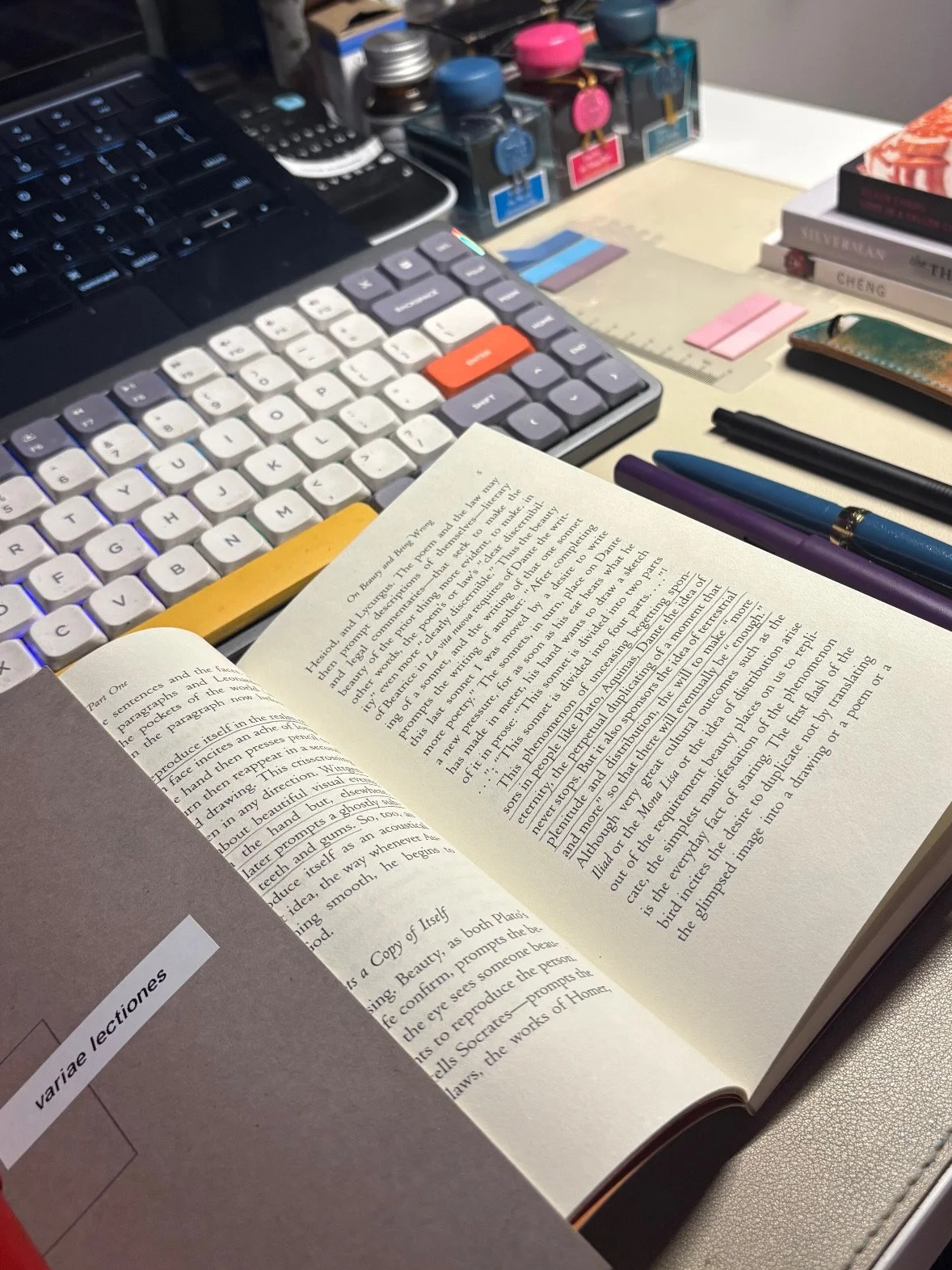
readings from my study
the systemization of flair: how contemporary football lost its unpredictability
Champions League quarter-final second leg at the Allianz Arena, April 15, 2026
I began as an AC Milan fan at ten years old. Not the Milan of today, diminished and searching, but the Milan that felt inevitable. That team moved as if certainty had been written into the geometry of its play. The Milan derbies of the early 2000s were legendary because they embodied something deeper than skill: two fundamentally different worldviews colliding. Under Carlo Ancelotti, Milan fielded what may have been the most exquisite defensive unit in football history. Paolo Maldini, Alessandro Nesta, Jaap Stam, and Cafu were not merely defenders. They were architects of negation, artists of precision. Yet Milan attacked with creativity: Shevchenko’s hunger, Kaká’s intelligence, Gattuso’s aggression, and the unpredictable brilliance of players whose gifts could not be fully systematized.
Across the city, Inter Milan offered a colder symmetry: Júlio César’s anticipatory calm, Maicon’s surging force, the austere authority of Lúcio and Walter Samuel, Javier Zanetti’s tireless constancy, Esteban Cambiasso’s geometric mind, the rupture of Dejan Stanković and Sulley Muntari, and Wesley Sneijder’s measured vision threading it all. At the center stood Zlatan Ibrahimović, not a striker, but an axis around whom everything converged. Each movement resolved into something sudden and exact. When these teams met, it felt like philosophy made flesh, two different answers to the eternal question of how to play the game.
In May 2007, at the San Siro, Milan demolished Manchester United 3-0 in the Champions League semi-final second leg. This match still exists in memory as Milan’s perfect game. Kaká opened the scoring. Clarence Seedorf and Filippo Inzaghi followed. Manchester United had won the first leg 3-2 and arrived in Milan with hope. They departed utterly dismantled. This was not a contest decided by marginal superiority. It was a masterclass, a demonstration of football as an art form. This kind of performance has become rarer, though not impossible to witness.
Over the past fifteen years, football has not declined in quality but transformed entirely in character. Excellence and unpredictability now exist in growing tension. Something significant has been lost, not in competition but in possibility itself.
The Erosion of Domestic Certainty
Somewhere over the past fifteen years, so gradually it was easy to miss, the game began to feel different. The domestic leagues that once defined European football have become structurally imbalanced. The Premier League, long celebrated as the most unpredictable arena in world sport, now operates within narrowing margins. While individual results still fluctuate, the distribution of resources increasingly predetermines which clubs can sustain excellence over time. Financial power exerts a quiet, cumulative pressure across seasons.
Manchester United’s trajectory is perhaps the most revealing. Under Sir Alex Ferguson, United represented something almost transcendent, not merely a team but an institution capable of transforming talent through system and philosophy. Ferguson could identify overlooked players and cultivate them into world-class competitors. His genius was organizational, an alchemy of continuity and control. Post-Ferguson, United has struggled not from lack of investment but from the absence of that coherence. Resources remain vast, but without a unifying structure, they dissipate rather than accumulate.
Serie A was reshaped by Calciopoli, while La Liga’s recent instability shows how fragile dominance can be when built on financial excess without a sustainable structure. Across leagues, the pattern is constrained possibility, a narrowing field of outcomes that makes sustained surprise harder.
The Closing of Space
When I watch modern football now, what strikes me first is compression. Space no longer appears as something given but something fought for, constructed, and rationed. The high press, intensified and systematized most visibly by Jürgen Klopp and adopted widely since, ensures that time on the ball is relentlessly contested. This escalation has moved space away from the open expanses where improvisation once thrived and into narrower corridors of rehearsed movement and pre-structured overloads.
This is a rational evolution. Coordinated pressing proved effective, so it became universal. The result is a more tactically intricate game, yet also more bound. Kaká in 2007 embodied improvisation. Jude Bellingham today operates within a finely tuned system of movement and timing. Both are brilliant, but the nature of their freedom differs fundamentally. Between them stands the era of Lionel Messi and Cristiano Ronaldo—two players who, for nearly fifteen years, made individual genius look systemic in its consistency. Their dominance was itself a kind of unpredictability: you knew they would decide matches, but never how, and that is how they came to be known outside of the space of football. That era has closed, and nothing has replaced it. Exceptions persist, of course. A Mohamed Salah dribble or a Lamine Yamal moment can still rupture the structure and remind us of raw individual genius.
Two Models, Two Philosophies
It is worth being precise about which forces have most shaped this transformation, because the standard account tends to flatten what are in fact two quite different things. Jürgen Klopp's pressing model and Pep Guardiola's possession model are regularly cited together as twin engines of modern football's evolution, but they represent fundamentally opposed philosophies—and their effects on the game have not been equivalent.
Klopp's football is aggressive and, crucially, risk-tolerant. The high press accepts that it might be beaten, that transitions will be chaotic, that the space behind the defensive line is a genuine vulnerability chosen in service of something more rewarding. It demands players capable of real individual decision-making under pressure, because the system does not insulate them from disorder—it throws them into it. There is something almost courageous in how Klopp-influenced football is played: the willingness to commit bodies forward, to accept the possibility of the counter, to treat the ball as something worth winning back rather than something never to be surrendered. This is how football should be played. It is also, almost by definition, difficult to replicate without the right players, which is part of what makes it honest.
Guardiola's model proceeds from a different logic entirely. Its animating principle is the elimination of risk through the elimination of uncertainty. The ball is controlled so completely that the opposition is denied not just space but time, not just time but the psychological experience of being in the game. Passing lanes are pre-structured, player movement is choreographed, and possession is treated as an end in itself rather than a means to something more dangerous. The result is often extraordinary in its precision. But it is a different kind of beauty: mathematical rather than spontaneous, one that impresses more than it moves. The deeper problem lies in what happens when this model propagates downward. What proliferates is not the quality that requires Guardiola and his particular players, but the caution. Across European football, teams now maintain possession by large margins as a strategy in itself. Lateral passing, reluctance to commit forward, an almost philosophical aversion to losing the ball: these have become the dominant aesthetic of the modern game, not from an ambition to attack, but from an ambition not to be attacked.
Uncertainty persists, but it emerges in narrower spaces and shorter intervals, no longer ambient but produced. What modern football has done is not to eliminate unpredictability, but to reorganize it—displacing it from the individual moment into the architecture of the system itself. What we experience as loss may, in part, be a shift in perception: unpredictability remains, but in forms less immediately legible to the spectator. Modern football has transformed into something more tactically conservative, redistributing unpredictability into transient events—moments of pressing collapse, transitional rupture, and micro-error that replace the sustained openness of earlier eras.
Risk, Commitment, and the Performance of Passion
Maldini’s sliding tackles were commitment made visible: a willingness to risk the body in service of the moment, and Nemanja Vidić, as Robin van Persie once said, would quite literally put his head where others feared to put their feet. That visceral spectacle has diminished. VAR has heightened scrutiny, rendering every challenge subject to retrospective precision. Tactical evolution plays a role as well. Pressing structures reduce the need for last-ditch defending, while possession systems minimize chaotic duels. Clubs, protecting increasingly valuable assets, have rationalized risk. A mistimed challenge is now not just an error but a potential financial liability.
Commitment still exists. It is expressed more in positional discipline and collective movement than in theatrical physical sacrifice. The loss, however, is perceptual. The immediacy of visible risk has given way to something quieter and more controlled.
The Athleticization of Football and What It Has Cost
A familiar defence of modern football is that the players are simply better—more athletic, more physically prepared, the product of a more sophisticated global talent pipeline. The first part is true in a narrow sense. Sprint data and physical output have increased. But athletic capacity and footballing intelligence are not the same quality, and the dominance of the former has come partly at the cost of the latter.
This is not a matter of individual decline but of structural priority. Modern club academies optimize for physical output because the tactical models that dominate the game demand exactly those qualities. When clubs scout and develop accordingly, they produce players shaped for athletic function within a pre-set system rather than for the kind of individual technical and cognitive development that produces genuine footballing intelligence. The talent is not absent. It is deprioritized before it can mature.
Players like Ronaldinho, Kaká, Robinho, and the young Adriano came up in environments—often literally the streets— where individual problem-solving was the only available tool, which also led to a lot of dribbling and freestyling. No tactical framework was handed to them, and they learned to read the game because reading the game was survival. The modern academy environment installs the system first and the individual second, producing players of real technical consistency and physical proficiency, but also a narrower football mind: one optimized for execution within a structure rather than for the improvisation the game once demanded and rewarded. Ajax is perhaps the clearest illustration. An academy that once was a petri dish for players to nurture genuine creative autonomy—whose understanding of space and movement was self-generated rather than installed—now increasingly produces positionally disciplined players who are excellent within pre-set structures and less equipped outside them. This is not a failure of talent. It is a failure of what talent is being asked to become.
European Competition: Diluted and Stratified
Real Madrid now embodies modern consolidation, the strategic concentration of elite talent. Kylian Mbappé joins Jude Bellingham, Vinícius Júnior, and Rodrygo in an attacking constellation that would once have seemed excessive. Emerging players like Arda Güler add further refinement, while managerial continuity under Carlo Ancelotti provides coherence. Even transfer speculation reflects this gravitational pull.
This consolidation has hollowed out European competition. The Champions League’s shift from a 32-team group stage to a 36-team league phase has weakened narrative coherence and multiplied matches, largely to generate revenue. The addition of the Conference League has further stratified the continent into clear hierarchies. The possibility of a passionate, well-organized underdog achieving genuine European success has grown rarer.
The Paradox at the Centre of Guardiola's Genius
There is a paradox worth naming in Guardiola's reputation as the game's great systems thinker. For all the geometric sophistication of his models, each has ultimately been organized around a single player. Barcelona was built for Messi. Manchester City, in its current configuration, is built around Erling Haaland. The system provides the structure; the singular axis provides the meaning. One would argue that this is also how Mourinho was utilizing Ibrahimovic, but the latter was a dynamic player who had the freedom to deploy his tactical intelligence as and when the game flow changed. Remove Messi from that Barcelona, and the architecture loses its rationale—the tiki-taka possession model was always, at some level, a delivery mechanism for the one player whose individual genius could unlock what the system alone could not.
Erling Haaland represents a different version of the same dependency, and a more revealing one, because the qualities he brings are almost exclusively physical. He is a finishing instrument of extraordinary precision, but the system has to do the thinking for him rather than with him. When the structure is disrupted—when City are pressed early, when transitions are chaotic, when the game does not proceed according to its pre-set logic—Haaland disappears from matches in a way that earlier elite strikers did not. Shevchenko, Inzaghi, Raúl, Totti: these were players who manufactured their own moments in open, less structured environments, whose intelligence was reactive rather than positional. They read the game and responded to what appeared. Haaland operates in clarity and executes within it. His intelligence is real but narrow, optimized for the particular conditions the system creates and considerably less equipped when those conditions break down. He is, in this sense, less a footballer than a function of the system—the logical endpoint of what happens when a tactical model systematically replaces individual intelligence with structural instruction.
2013: The Moment Everything Systematized
Around 2013, several forces converged. The high press became widely understood and replicated. Data analytics turned from novelty to standard. VAR discussions intensified. Before this, football retained a more spontaneous narrative and a greater degree of uncertainty. After systems proliferated and tactical philosophy at the top level grew increasingly homogenized. The Klopp-influenced pressing models meant elite teams began playing in fundamentally similar ways, even if surface styles differed. The idiosyncrasy of truly divergent approaches, Ancelotti’s Milan versus Mourinho’s Inter, became rarer. In 2026, Liverpool and Manchester City may look superficially different but operate within a narrowed tactical vocabulary.
A Moment of Refreshing Rupture
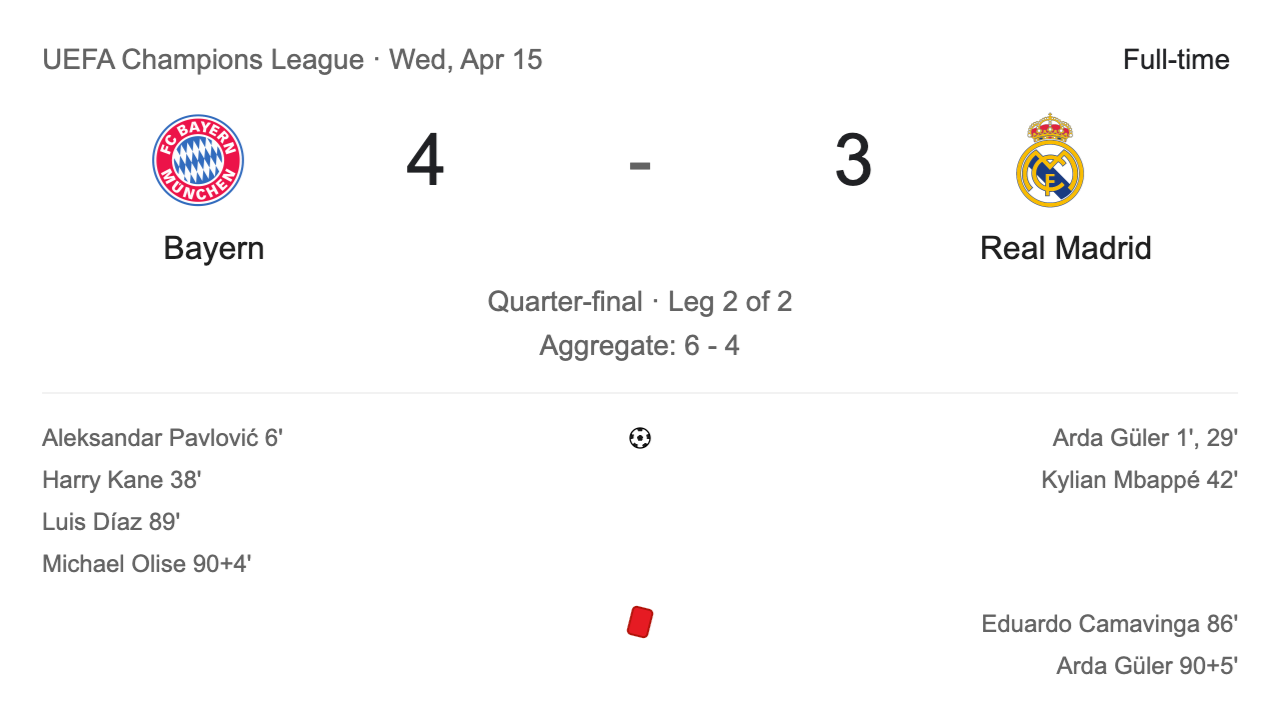
Two days ago, on April 15, Bayern Munich defeated Real Madrid 4-3 in the Champions League quarter-final second leg at the Allianz Arena. The aggregate score finished 6-4 in Bayern’s favor, a result that felt like a rare interruption in expectation. Bayern had not eliminated Real Madrid since 2012. The match delivered seven goals and constant drama. Arda Güler opened the scoring for Real Madrid with a clinical finish after a rare error from Manuel Neuer. He later added a superb free-kick. Kylian Mbappé equalized with a composed finish, and Vinícius Júnior continued to threaten with his pace and skill. Eduardo Camavinga received a red card in the closing stages, leaving Real Madrid with ten men.
Bayern responded with character. Aleksandar Pavlović and Harry Kane gave them the lead. Then came the late explosion. Luis Díaz struck in the 89th minute to restore Bayern’s advantage. In the fourth minute of added time, Michael Olise produced a moment of magic, curling home the winner. The Allianz Arena erupted. It emerged from volatility, from the accumulation of moments that could not be fully anticipated or contained. This is how football once more frequently felt: unresolved, unstable, and open until the final whistle.
It is worth being honest, though, about what this result does and does not prove. A 4-3 aggregate scoreline in a knockout tie is evidence that unpredictability persists—that no outcome is entirely predetermined, that individual moments can still rupture structural expectation. It does not disprove the larger argument. Bayern's breakthrough is striking precisely because it is exceptional, a deviation from the pattern rather than evidence against it. The structural forces that I have tried to describe: the consolidation of resources, the homogenization of tactical vocabulary, and the narrowing of what football asks its players to be, remain largely intact. The match was beautiful because it felt like something recovered, not something normal. Exceptions confirm rules. This was an exception. For once, unpredictability was not contained within narrow intervals but expanded to shape the match itself. The match did not restore what had been lost, but it offered a glimpse of it.
The Chessboard of Contemporary Football
Contemporary football possesses genuine brilliance. Athletes are fitter and more technically proficient than ever. The coordinated execution of complex tactical systems, eleven bodies moving in service of a strategic idea, is genuinely sophisticated. Pep Guardiola’s Manchester City, at their best, represent a mathematical kind of excellence. What we have witnessed, however, is the refinement of a particular skill set that players often enter the academy with, rather than the expansion of their overall game. Matches become increasingly managed, and players more specialized—excelling within defined roles, but less frequently required to improvise beyond them. The result can resemble a chessboard: movement is precise, coordinated, and purposeful, but bounded by structure much like chess pieces carefully navigating on a tightly controlled chessboard, thus lacking the free-play for tactical brilliance and courage that former players had the opportunity to exercise. Sophistication and emotional engagement are not the same. A well-executed system impresses. An unpredictable match, where anything might happen, moves us. Modern football often asks us to admire the former.
Football has not declined in quality; it has transformed in character, now more tactically sophisticated and systematically coherent. These are real achievements. But it has narrowed in spirit and lost something irreplaceable: creativity—which has the capacity to surprise—the space for unscripted individual expression, the visible physicality of commitment, and the narrative unpredictability that once generated deeper emotional stakes. In chasing perfection through system and data, we have gained precision at the cost of poetry.
Today, elite matches have often become elegant comparisons of execution: which team pressed more effectively? Which executed its system with more precision? The result can be impressive, even beautiful in its own right. But for those of us who remember nights like the 2007 San Siro demolition, the genuine possibility of divergent philosophies prevailing over one another, something vital feels missing. We watch a sport superior in almost every measurable way, yet we have lost something ineffable. Perhaps we cannot have both the poetry of unpredictability and the unambiguity of excellence at the highest level.
The Milan derbies were special not because the football was always technically superior, but because something genuine was at stake. Two genuinely different approaches collided, and either could prevail. That kind of openness, where excellence could take multiple forms, has been systematically reduced. Domestic leagues have lost it through the consolidation of power. European football has surrendered more of it through stratification.
Yet moments like Olise’s curling winner in the dying seconds—raw, unscripted, electric—prove that the game’s wild heart still beats. Perhaps that is all one can ask for now: not the restoration of what was, but the occasional, unrepeatable moment that escapes the structure entirely and reminds us what football once promised.
Bayern now advances to face Paris Saint-Germain in the Champions League semi-final, with the first leg on April 28th. In a season marked by the inevitability of the already powerful, for once, the outcome did not seem predetermined by structure, depth, or institutional weight. The match did not restore what has been lost or resurrect the Milan derbies, but it certainly displayed beauty and soul in moments of passion and pressure amid institutional excellence earned through cultivation, academy development, and system, rather than mere acquisition. It is not the same. It cannot be. But it is something. And in 2026, sometimes something is enough to hope for.
reliquary, record, residue
Record: The Practice
There is a kind of writing that happens not because one wants to but because one must. I have done this kind of writing for as long as I can remember, not to produce anything, not to think more clearly, but because the alternative is to have no container for what is happening inside. As a child, I wrote with pencils in spiral-bound notebooks and then discovered my love for fountain pens at the age of ten. By the time I was in my early twenties, I had graduated to the mesmeric world of inks, glassy papers, and fountain pens as objects of beauty. My journal has been where I go when the only way to exist is to write. It is a cleansing practice, sometimes a pathological one. It clarifies as much as it contains my cerebral and emotional effluence.
The journal itself is a Tomoe River 400- to 480- blank page A5 notebook. The paper is so thin and so receptive that fountain pen ink blooms on it with an almost indecent generosity. Sheening and shimmering inks become worded fireworks permanently frozen in time. At the moment I use five pens, each holding a different ink: Emerald of Chivor, which shifts between green and teal and throws gold and red shimmer depending on the light; Kyanite du Nepal, both from J. Herbin; Oxblood from Diamine; Alt Gold-Grün from Rohrer and Klingner; and Nitrogen from Organics Studio, a dark blue with a purple sheen that makes certain entries feel nocturnal even when written in daylight. The rotation is practical despite my desire to make it more intentional, as I need to keep the nibs from crusting, and so the visual texture of any given week is spontaneous and playful. It is much needed, as a lot of heaviness flows out of the conduit of my pen.
My writing has always been interior. Observations, yes, and the texture of days, but mostly what I write is how the world lands on me: how I see it, how it unsettles or steadies me, what it does to the inside of being alive. The entries are dated and continuous, written end to end, top to bottom, without spatial division or system. They accumulate rather than organize. This notebook is called Record. Every notebook that comes after is named the same.
Reliquary: The Folio
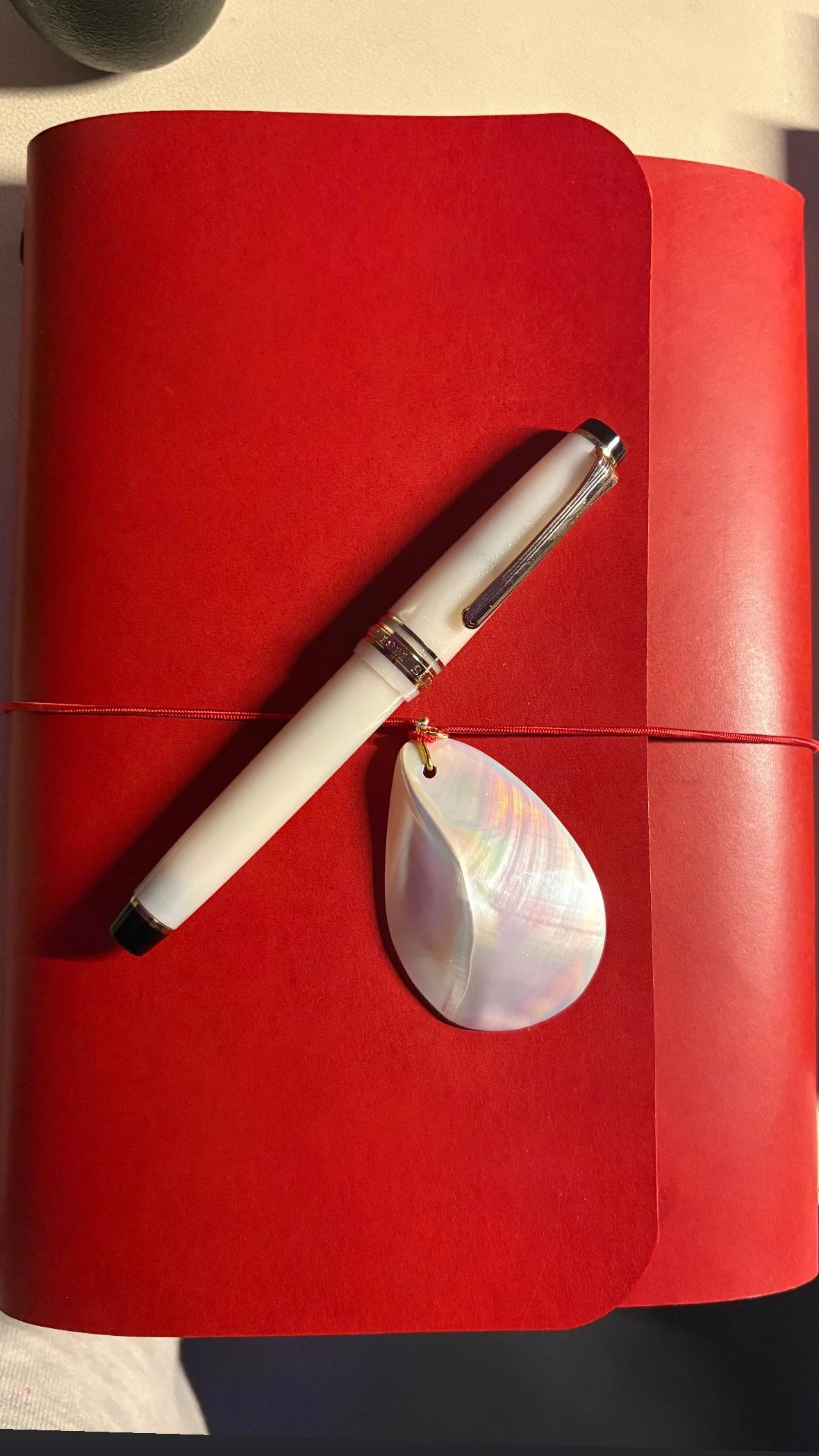
Over time, the soft covers of my journals began to fray and warp, and I realized that every Record needed a home worthy of what it holds. I wanted an object that was both functional and meditative in essence, carefully assembled by someone who has an eye for quality and detail. This is how I arrived at the folio from Sting & Snout Bindery. What drew me to it was an immediate and intuitive response to two colours that struck me with the force of something both visually arresting and emotionally inevitable: Langyao red (郎窑红) paired with a pearlescent white. Only later, once the folio was assembled, did the cultural and symbolic resonances reveal themselves, and they turned out to be extraordinarily coherent.
Langyao Red is one of China's most prized traditional glazes, named for the Lang Kiln, where it was first developed in the eighteenth century under Qing dynasty’s ceramic superintendent Lang Tingji. The uniqueness of this glaze is that it draws its colour from copper and is fired at temperatures approaching 1300°C. The conditions required are so exacting, atmosphere and heat held in precise, unforgiving balance, that successful pieces were genuinely rare. A folk saying of the era captures this perfectly: "If you want to become poor, try firing Langyao Red."
At its deepest, the colour is extraordinary: mirror-bright, jade-smooth, red as fresh blood. The glaze has a crystalline richness to it, luminous and saturated, like the arrested scarlet of newly congealed ox blood, almost violent in its radiance. The journal folio indeed would carry the distilled lifeblood of my experiences.
In Chinese tradition, red is the colour of yang energy: fire, vitality, the sun, a declaration of power and sincerity. It carries the characters for unwavering loyalty and devotion in its visual etymology. Mother-of-pearl belongs to an entirely different cosmological register: in Chinese lore, a symbol of immortality and power, but also of the lunar feminine, of the ocean’s interior, believed to harness the energy of the moon and the water, to heighten intuition and protect against darkness. But beyond their individual symbolisms, the two materials exist in a tension that is almost elemental.
The leather is warm and animalic, terrestrial, carrying the heat of a living creature, the hide of something that traversed the earth and grazed under the sun. The mother-of-pearl is cool and ethereal, formed in the lightless interior of a shell at the bottom of the sea, built up over time in iridescent layers of nacre that refract light rather than absorb it. One is the earth. The other is water. One is opaque, saturated, urgent; the other is luminous, shifting, impossible to fix. The vibrancy of the red is balanced softly by the luminosity of the white, passion held in tension with purity, excess with restraint, the material with the transcendent. Two things that should cancel each other out and instead make each other more fully themselves.
The red cord from which the charm is suspended is not incidental. It is a cord of connection in East-Asian lore: of fate, a quiet insistence that things are meant to find each other. My thoughts finding their way to paper, my friendships formed across continents and years and entirely improbable circumstances, and the experiences that have shaped me into the person who would choose, with great deliberateness, a crimson folio and a mother-of-pearl charm and call the whole object a reliquary.
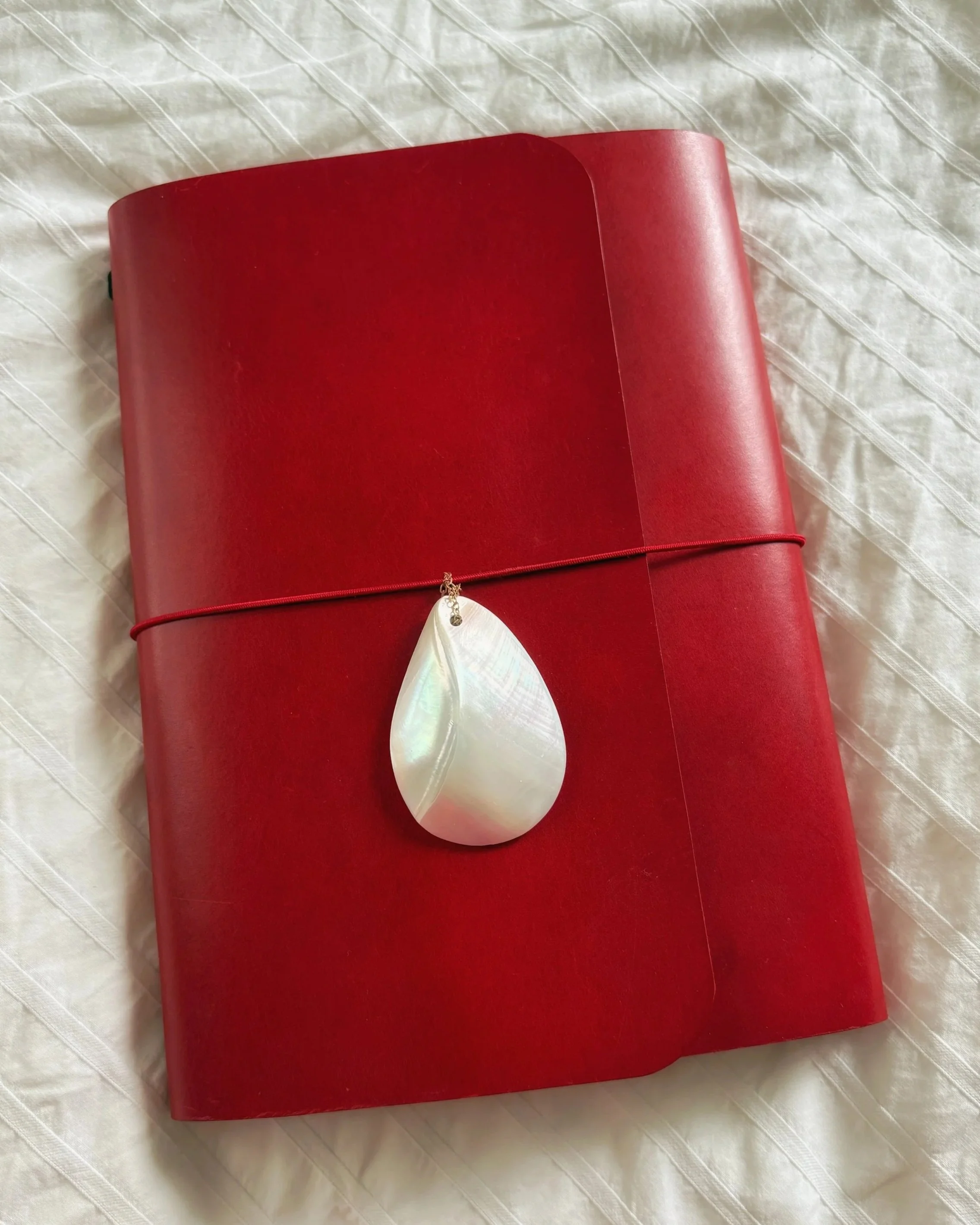
The leather’s provenance is Buttero from Conceria Walpier, a Tuscan tannery that produces calf leather through vegetable-tanning methods, and I chose it over Minerva Box deliberately. I wanted an understated, elegant calf leather, and Walpier’s Buttero is exactly that. Minerva Box, a superb leather that is used to make Hermès bags, produced by Badalassi Carlo, is softer and more malleable, with a slightly pebbled texture that I did not want, and its patina comes quickly, too quickly for what I wanted. I preferred the smooth, unbroken immensity of Buttero, which is stiffer and more structured, its patina earned over time through sustained handling, the way devotion accumulates rather than arrives. I wanted a folio that would become more itself gradually, that would carry the evidence of use without surrendering its original character. There is something in this that mirrors what I want from the practice it holds.
The charm I asked for specifically: mother-of-pearl rather than pearl, because mother-of-pearl has more complexity in its surface, more colour, more internal variation, more depth to visually savour. A pearl is singular and complete, but mother-of-pearl is iridescent, shifting, structurally intricate, allegorical, I think, of a life being lived well. I wanted the folio to read simultaneously as a classical Chinese relic and an Art Nouveau object, every element organic and warm, from the colour to the luminosity. The cover itself is a vast expanse of red, no embellishments, no tooling, nothing to interrupt it, and then, punctuating it like a considered pause in a sentence, the mother-of-pearl teardrop suspended from a red cord on a 14-karat gold-plated chain, which I sourced and clipped. The folio is named Reliquary: a word that arrived only after everything else was in place, and that named not just the object but the ritual of consolidating a life through writing and ephemera.
Residue: The Organizer
Because Record is so inward-oriented, because it is essentially me and how I see the world, I found myself wanting something that would remind me of how the world sees me. Something to pull me out of my own head when the writing had taken me too far inside it. This is how the organizer insert came to be what it is, and why it too earned a name: Residue. A reliquary within the Reliquary, a curated collection of objects that constitute the outside world pushing back.
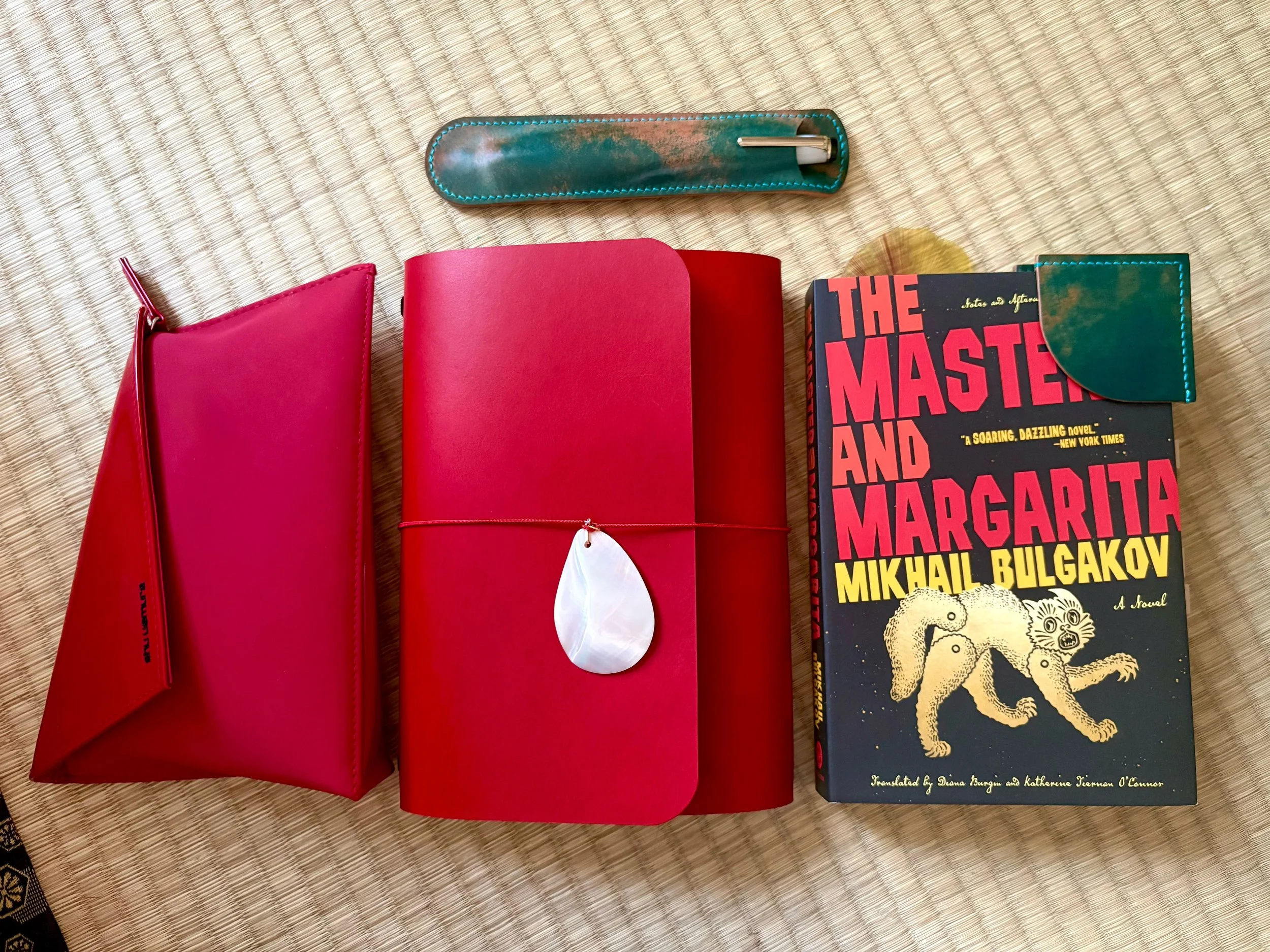
I filled it slowly, over time, with objects that each carry a specific weight. A piece of pink blotter paper and a Shitajiki, both functional, sit alongside things that are not functional at all and are more important for it. An origami crane given to me with a furoshiki I purchased in 2018 when I first arrived in Canada. Cranes are the motif I chose for the cover of the journal nested inside the folio, knowing that in Japanese folklore, they are a deeply rooted symbol of longevity, healing, and wish fulfilment. The convergence felt too right to be incidental.
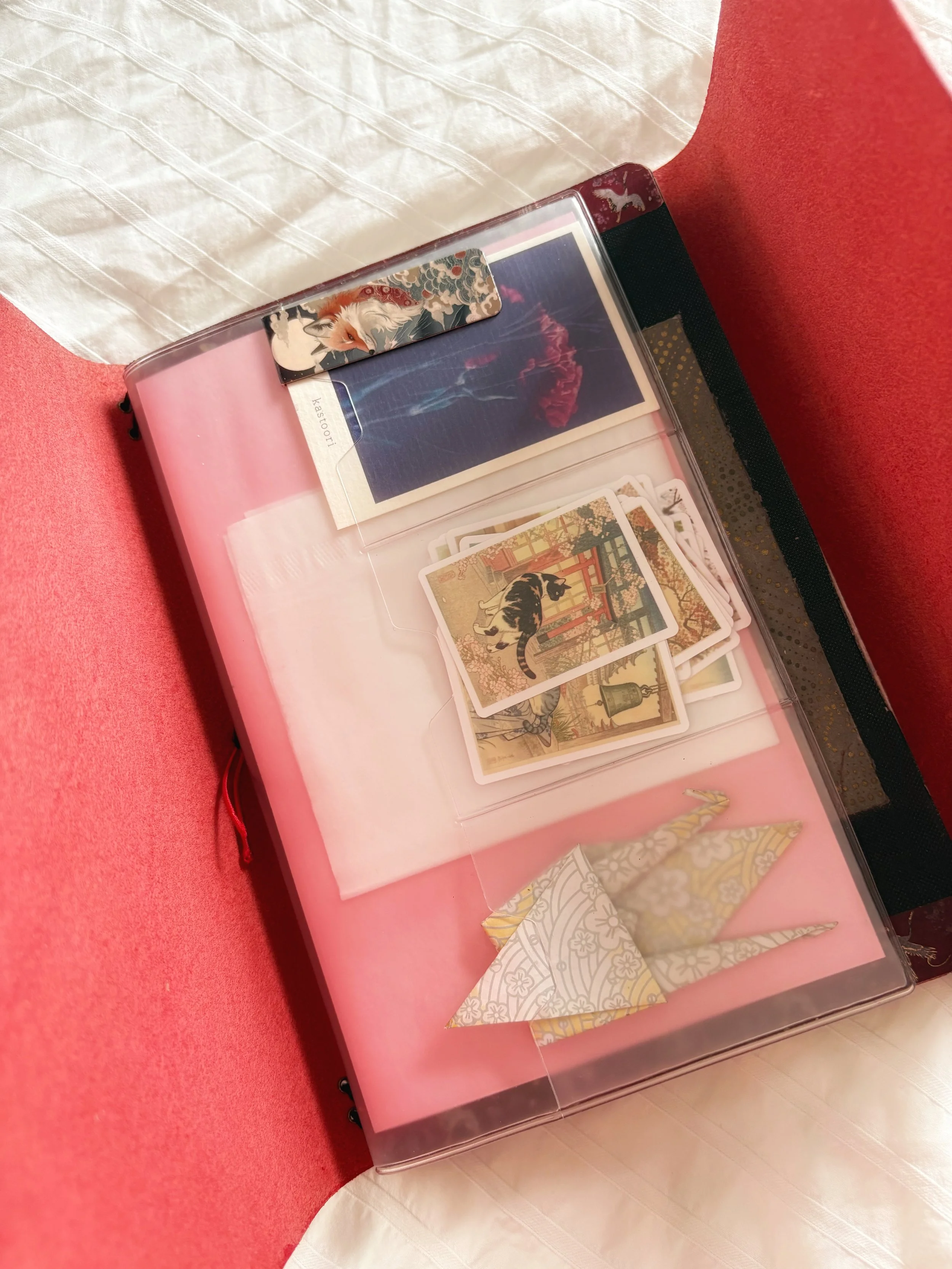
A visiting card from my curatorial years, whose cardstock color, thickness, width, and orientation I chose and watched being cut, designed in collaboration with a friend who was a visual designer. I had loved a photograph she had taken of a flower and wanted it as the face of the card. We have since fallen out of touch. The card remains.
A postcard of a scene from Tripoli Cancelled by Naeem Mohaiemen, who read my review of the film and wrote to me because he loved it. The postcard arrived in a yearly retrospective catalog book from the gallery representing him as a direct consequence of the writing, which means it is itself a form of record, the world responding to the witness. A museum ticket from the Bharat Kala Bhavan, where I went in 2023 to see Nicholas Roerich’s paintings, Roerich being one of my favourite artists, a painter whose work exists at the intersection of the spiritual and the elemental in a way I find quietly sustaining, whose painting of the Himalayas, tinged in pink and lavender, I wake up to every morning.
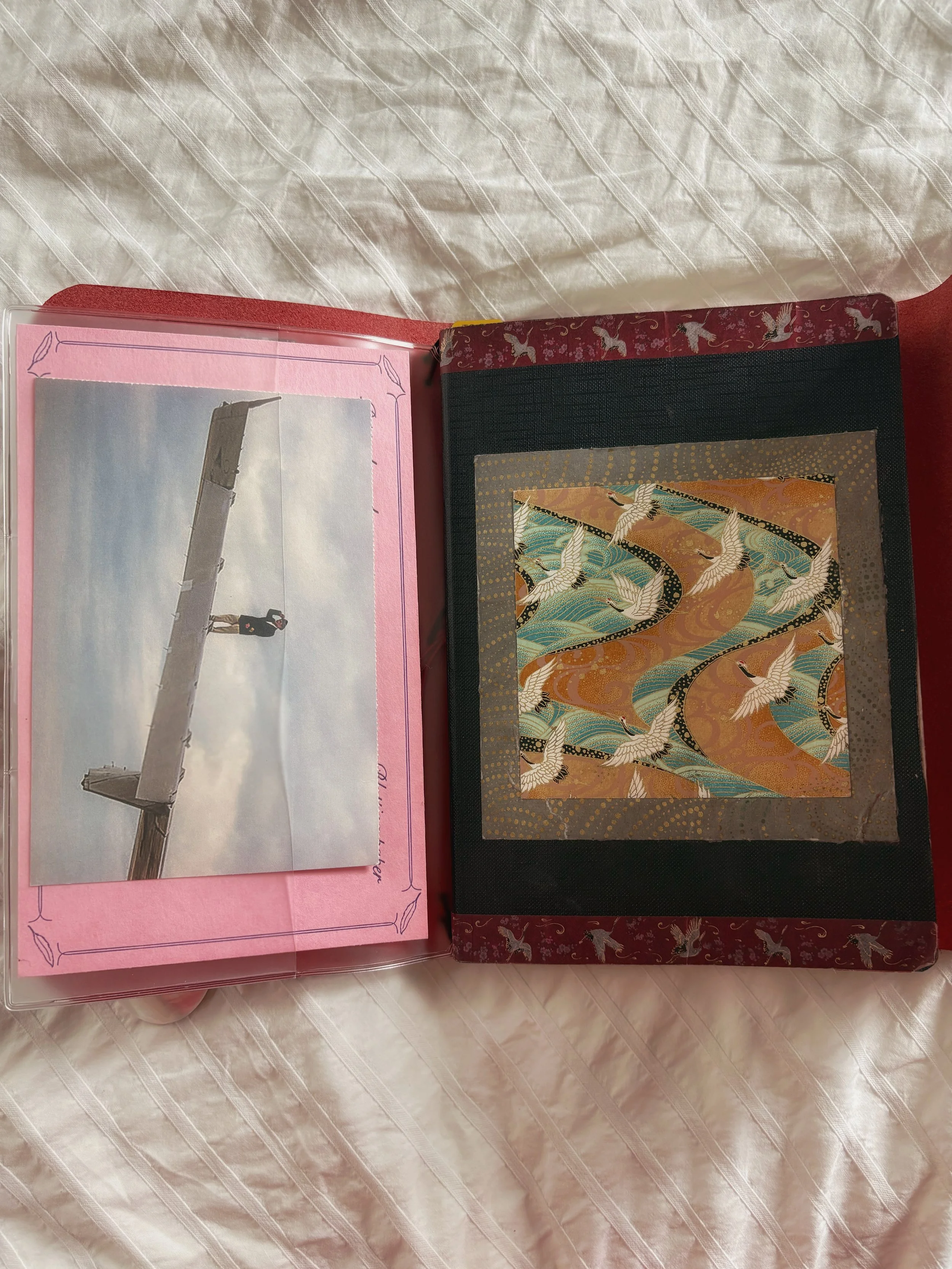
Then there are the things that are entirely about people. A polaroid of me with my first PhD friend, the only one who has remained equally constant inside and outside of academia, which is a rarer thing than it sounds. A photograph of me with a young man I met in December 2022, who became a younger brother almost immediately. A Christmas card from my Chinese sister, whom I met entirely by chance in my apartment complex in 2022 and with whom I became 高山流水, gāoshān iúshuǐ, high mountain and flowing water, with a speed that neither of us had anticipated. A postcard from a debonair classmate from my master’s years who shared my European Romantic sensibility so completely that the correspondence felt less like an exchange and more like recognition. And a letter written to me in Copperplate cursive by a friend I made when I was a teaching assistant at Ashoka University, juggling that role alongside my master’s degree, a letter that is, among other things, evidence that some friendships form in conditions of pressure and hold anyway.
These objects span India to Canada, different walks of life, and different points of arrival. They are the proof that the world orients itself toward me with affection, which is not always easy to remember when one is writing pathologically at two in the morning.
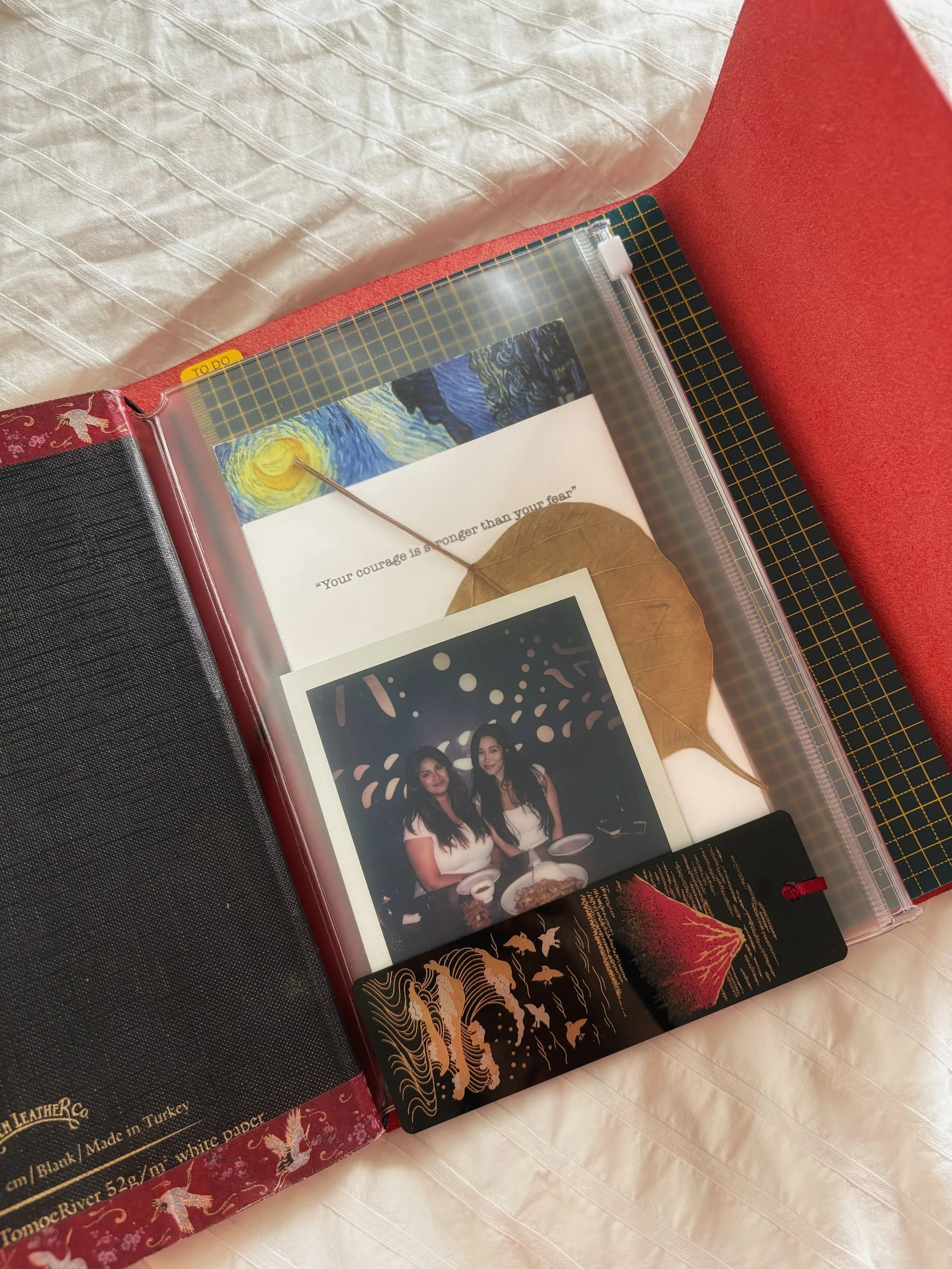
Among these objects is a pressed leaf from a Bodhi tree in Varanasi in 2023, itself grafted from the original under which the Buddha attained enlightenment. I knew its significance before I picked it up, which is why I picked up several. One I kept and another I carried back to Canada for my Chinese sister, my zhīyīn (知音), who is Buddhist. The leaf is not a religious object for me in any doctrinal sense. It is a relational one. It belongs in Residue because it is the most literal record I have of carrying something from one place to another for someone I love.
Finally, a black lacquer bookmark with shimmering ink depicting Mount Fuji, gifted by a Japanese friend I first met in Goa in December 2012, when he was an exchange student visiting India. He returned in 2017 and brought me the bookmark, amongst many other portable wonders of Japan. We have stayed in touch since. It marks my place in Record, between the written and the unwritten, between what has already been set down and what is still to come.
Resonance: The Summation
I had set out, at the beginning of all this, to construct a better writing system, something more intentional and architecturally considered than what I had before. After some experimentation and deliberation, I realized that no such construction was necessary. The 400-page tomes I had been filling all along for the last decade were already a perfect ecosystem of emotion, discharge, clarity, and creativity. It did not need to be improved upon. It needed only to be housed, honoured, and accompanied by the right objects.
This is what the Reliquary holds: a continuous interior record written in five inks on paper that takes the light differently depending on the hour, and a curated collection of objects that constitute the outside world pushing back. The writing goes inward. The objects bring me back out. Neither replaces the other. Neither is sufficient without the other. The Reliquary contains both, darkening slowly with use yet luminous from within, witness to my interior life and companion to its unfolding.
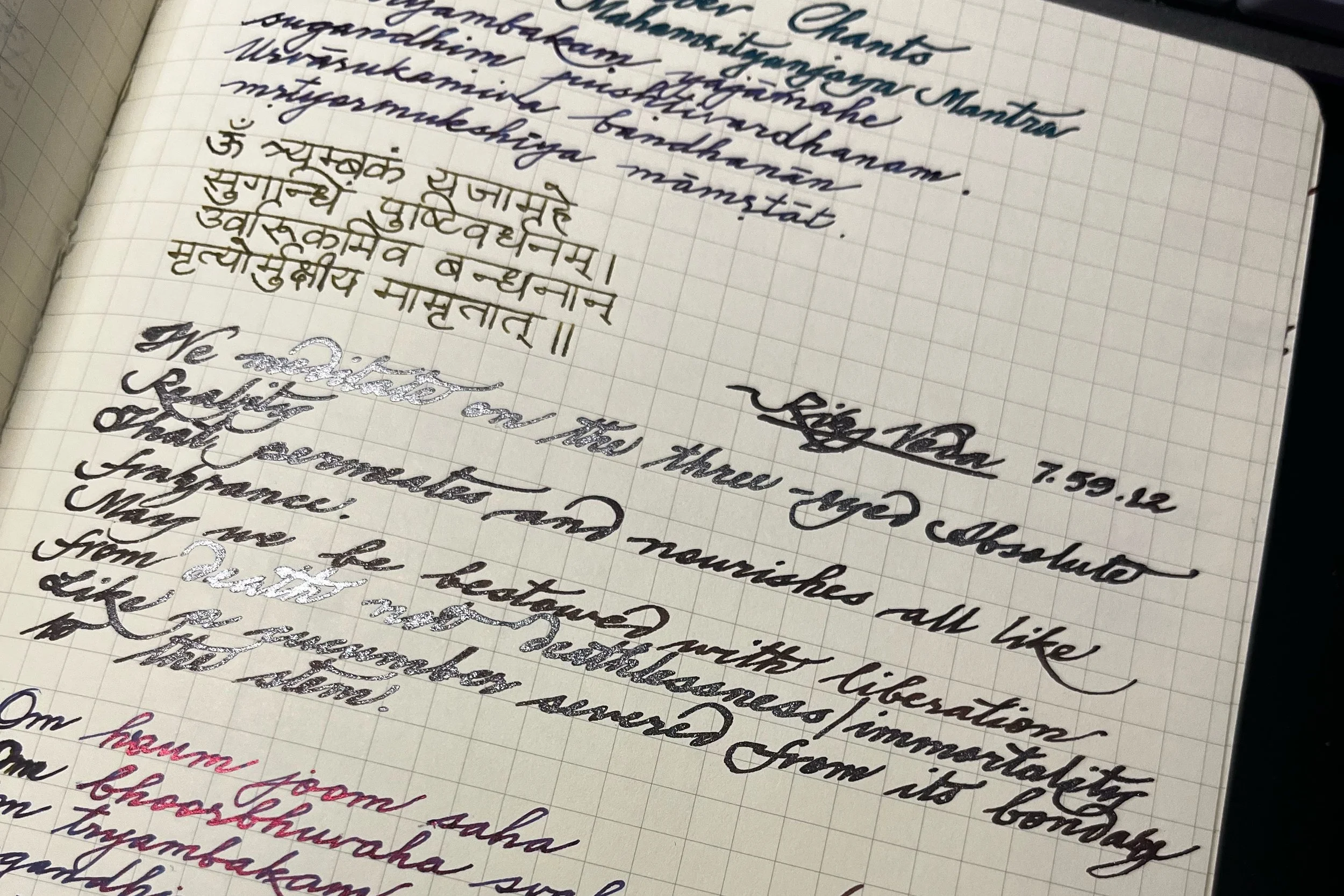
on nibs, paper, and the pleasures of ink
writings from my prayer journal
There is a particular kind of knowledge that accumulates slowly, almost without your noticing. It gathers through the unhurried ritual of sitting with a pen, testing how it moves against different papers, watching how ink dries and pools and shades. Fountain pens have been a daily instrument for me for about a decade now, and what began as an inclination toward a more deliberate mode of writing has become something closer to a quiet obsession with materiality itself: the resistance of a nib, the weight of a notebook, the way a wet ink forces you to slow down and mean what you write.
A friend recently asked me to help her choose her first serious fountain pen and paper, and I found myself writing her what can only be described as an essay. What follows is an expanded version of that, for anyone who is beginning to find their way into this particular world.
On Nibs: Wet and Dry, East and West
The first thing worth understanding is the distinction between wet and dry nibs, which is largely, though not exclusively, a distinction between Eastern and Western pen-making traditions. I say largely because there are exceptions, and because the more time you spend in this world, the more you realise that most of its rules are really just tendencies.
Japanese and Chinese nibs (Sailor being the most significant name here, alongside TWSBI, which is Taiwanese) tend toward precision: a finer, sharper line, and a wetter flow of ink. This is not incidental. East Asian writing traditions were shaped by brush ink calligraphy, where the quality of a stroke, its depth, its pressure, and its deliberate movement were the measure of both craft and character. That inheritance translates into the modern wet nib. It rewards slowness, and shows off ink in a way that a drier nib does not.
I prefer to pair wet nibs with wet inks as they dry more slowly and, in doing so, reveal more of themselves: shading, sheen, the subtle variation of tone across a single letter. J. Herbin's Emerald of Chivor displays a deep and serious teal to emerald green ink with a deep but vivid crimson sheen and gold shimmer. That ink is truly three-dimensional, and I always use an italic nib to truly demonstrate the beauty and abundance of the ink, but I digress. A wet ink forces a kind of intentionality, with your thoughts first, and then with your words on the page. You cannot rush it, and after a while, you stop wanting to.
Western nibs, Lamy (German) being the most familiar, operate quite differently. They are drier, offering more tactile feedback (what writers sometimes call "friction" or "tooth"), faster drying times, and a slightly bolder, more uniform line. I used Lamy exclusively during my years of note-taking in school, and it remains what I recommend for anyone who needs to write quickly and legibly across many pages. It is precise in a different register: practical, durable, and with the Safari line, particularly, something close to a luxury student pen, unpretentious and built to last. I still have mine. It is a Lamy Safari in dark lilac.
The wetness or dryness of a nib is, in the end, a matter of the nib slit's dimensions. That is the whole mystery, distilled.
On Paper: The Three Traditions
Paper matters more than most beginners expect, and I say this as someone who spent an embarrassing amount of time discovering it. A beautiful ink on the wrong paper becomes something else entirely: flatter, faster to dry, less itself. The three papers I return to most often each represent, I think, a distinct philosophy of writing.
Tomoe River (Japanese, 52 gsm) is the paper I have always used for journaling, and the one I am most reluctant to be objective about. It is extraordinarily thin, closer to bible paper than to what most people imagine when they think of a notebook page, and this thinness is precisely what makes it exceptional. The surface has an almost silky quality; the nib skates across it. More importantly, Tomoe River is unparalleled for showing off sheen and shading in fountain pen inks. A wet ink on Tomoe River will reveal colours and properties you may not have known it possessed. The trade-offs are real: slow drying times, some ghosting on the reverse of the page (you can see the writing through to the other side, which some people find distracting), a delicacy that can crinkle if exposed to moisture. The coating on the paper is what allows the ink to sit on the surface without being absorbed by the fibres. But one has to be careful with the natural oils of one's hands, which may damage the paper's quality of holding inks on the surface. I have never found any of this to be much of an impediment. For letter writing, ink testing, and the kind of journaling that wants to be beautiful, nothing comes close.
Clairefontaine Triomphe (French, 90 gsm) is what I would recommend for anyone who wants a luxurious writing experience that is also more forgiving. It has an almost glassy smoothness, not unlike Hahnemühle's photographic papers, and virtually no ghosting or bleed-through. It is the pinnacle of French papermaking, and the Triomphe line has a substantiality to it. It heralds a sense of occasion and makes it ideal for letter writing and calligraphy, but is equally wonderful for daily writing. Drying times are comparable to Tomoe River, which is perhaps its one indulgence. But it is a paper that makes you want to write well, and that counts for something.
Rhodia (French, 80 gsm, and owned by Clairefontaine) is the paper I used throughout my student years, and it remains the one I recommend most readily for those who want quality without the attendant considerations. It dries faster than the other two, shows less sheen and shading (it lacks the special coating of its sibling paper), and has more texture, but this is precisely what makes it practical for daily, high-volume writing. It is widely available, consistent, and honest. For inks that don't need to perform, your plain Diamine, your Rohrer & Klingner, your Noodler's Ink, Rhodia is the right paper and a very good one.
If I had to place them simply: Tomoe River for sheen and shading, Rhodia for daily use and budget, Clairefontaine for the pleasure of occasion.
A Note on Colour
One last thing, for those who find themselves becoming particular about such things, which tends to happen sooner than expected: the colour of paper matters. I prefer Tomoe River cream paper over white for most of my writing. It is a warmer shade, and it brings out certain inks differently. My Diamine Oxblood, my J. Herbin Emerald of Chivor come off as richer and more complex on cream. But Tomoe River's white paper has its own irreplaceability, as my Organic Studios Nitrogen ink, with its deep blue body and purple sheen, is simply more itself on white: the blue reads deeper, and the sheen is more pronounced.
These are small considerations, perhaps. But they are the kind that accumulate, quietly and without fanfare, into a writing practice that feels, over time, entirely one's own. There is a great deal that goes on in the world of paper, nibs, and inks, and I have come to believe that attending to all of it, rather than settling for the nearest available thing, is what makes the difference between writing as a habit and writing as something you actually look forward to.
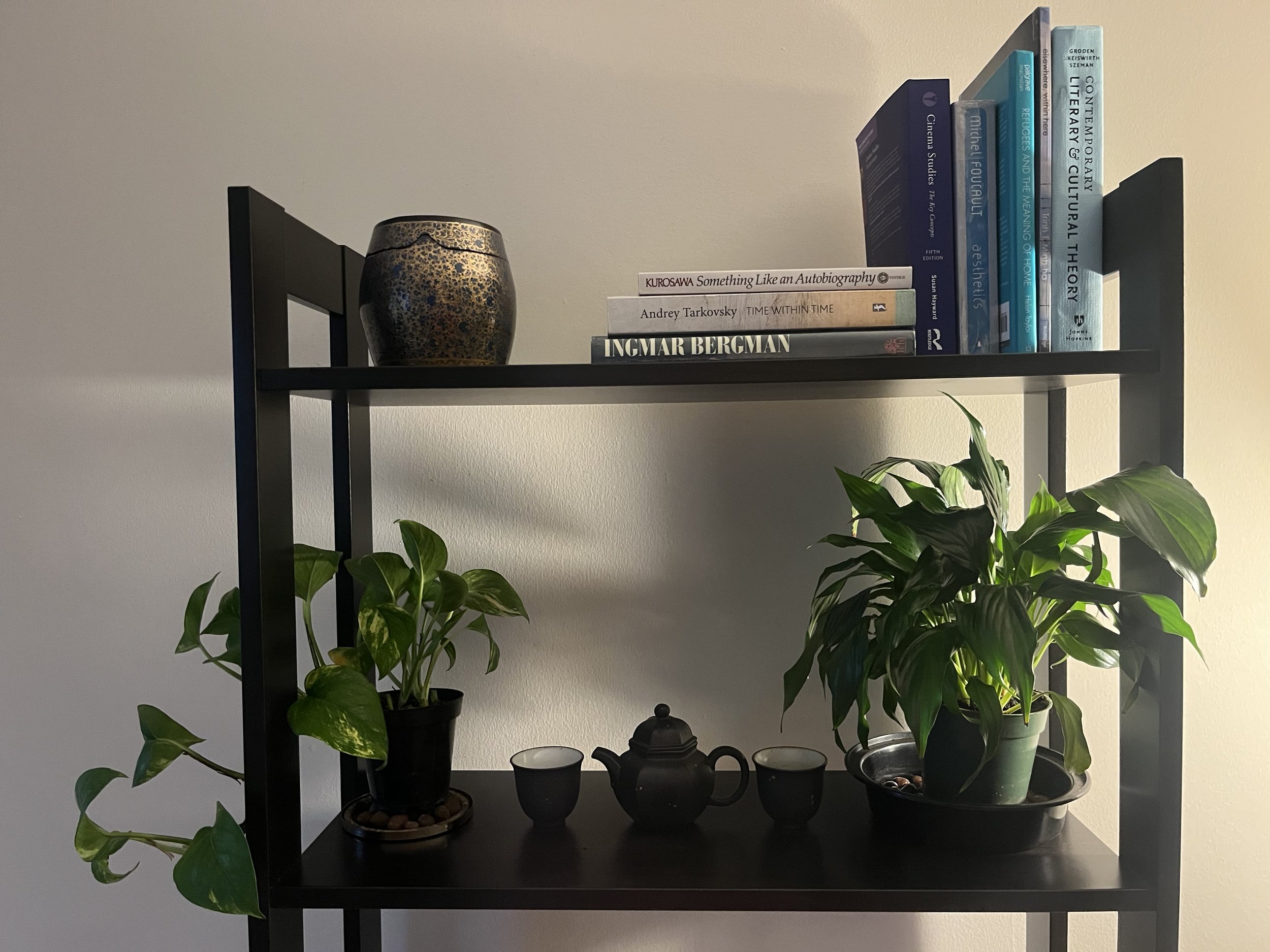
a brooding threnody to the disappearing joy of reading
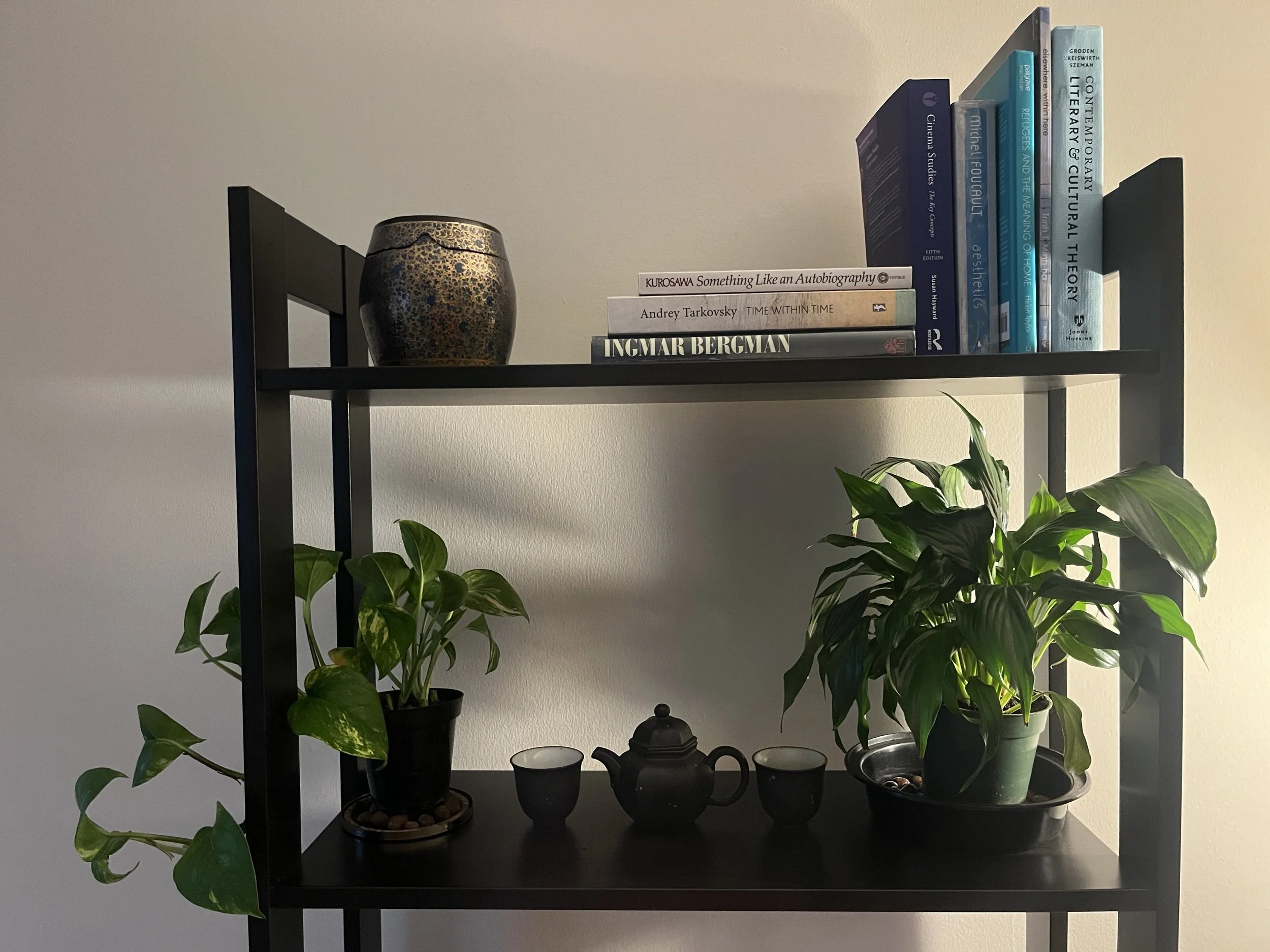
shelf from my study
I never particularly wanted to transition to e-readers, but I made the decision deliberately. Books are prohibitively expensive outside India, and they occupy physical space in ways that become burdensome over time. I often imagine the practical reality of moving apartments alone, hauling boxes of books into a rented truck, a strangely humbling task that strength training does not quite prepare one for.
Over the years, I have also grown wary of accumulating too many possessions. More objects inevitably require more time to organize, maintain, and eventually transport. There is a certain relief in minimizing this material weight. At the same time, I have never been entirely opposed to downloading digital copies of books and films, since accessibility and cost are real considerations. Yet I find myself confronted with a paradox. Even when texts are readily available on my devices, I struggle to engage with them meaningfully on a screen.
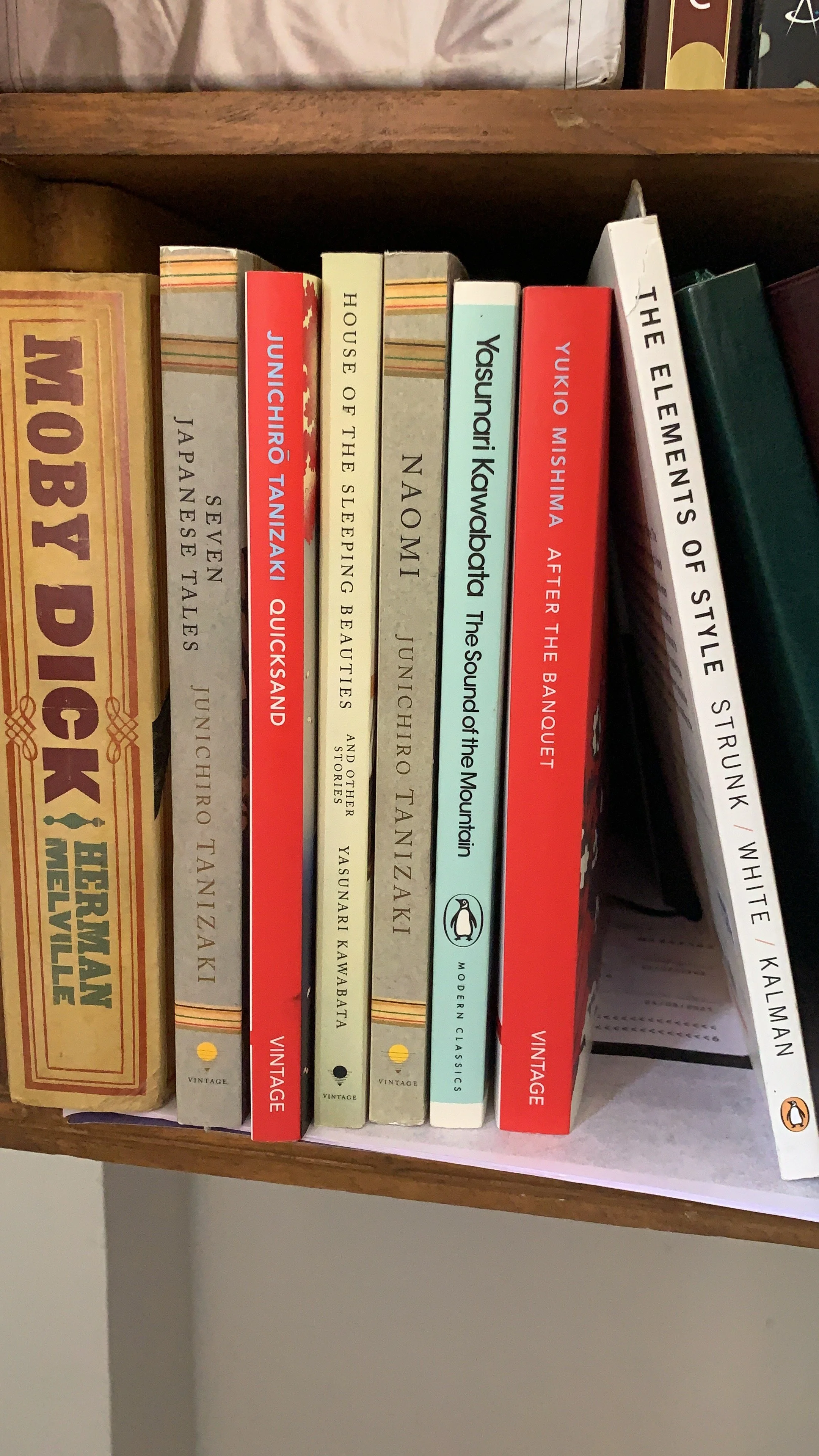
What I miss most is the tactile and spatial memory that physical books offer. With a printed book, I can see and feel my progress, the shifting balance of pages, the visual placement of passages, and the subtle cues that help anchor ideas in the mind. Even the faint scent of an older book contributes to the sense of inhabiting a tangible object. On a screen, each page feels uniform and almost interchangeable, and that loss of spatial orientation leaves me feeling slightly unmoored. Simple actions such as moving back and forth between sections also feel less intuitive, requiring several taps rather than a quick physical gesture.
At the same time, I remain aware that continuing to purchase and store large numbers of physical books may not be practical. The logistical demands are real. Yet this self-imposed restraint has had an unexpected consequence, a subtle diminishment of identity and joy. I want to experience books as sources of pleasure and companionship, not merely as instruments for acquiring knowledge.
The quiet violence academia can sometimes do to us becomes evident here. Reading becomes instrumentalized. Pages become units of intellectual productivity instead of spaces to dwell in. Once that shift happens, the body remembers. Books stop feeling like shelter and start feeling like work. It is therefore unsurprising that attention resists, as though protecting itself from turning every encounter with literature into another performance metric.
The deeper issue may not be about format alone but about identity. Physical books were never only objects for me. They functioned as visible evidence of a life of the mind. Shelves gradually became a kind of autobiography, marking phases of thought, curiosity, and transformation. When I deliberately stopped acquiring them, I also removed that visible mirror of who I am. E-readers are efficient but invisible. They do not sit in a room and quietly testify that this is a person who lives among ideas.
There is an irony in all this. I own multiple e-readers and have nonetheless ordered several physical books that will arrive tomorrow. Perhaps this is less a contradiction and more a small, temporary lifting of the restriction I placed on myself, an experiment to see whether the simple joy of reading can be recovered. I will likely continue relying on e-readers for practicality, but I hope to rediscover a way of reading that feels grounded, attentive, and quietly sustaining.