reliquary, record, residue
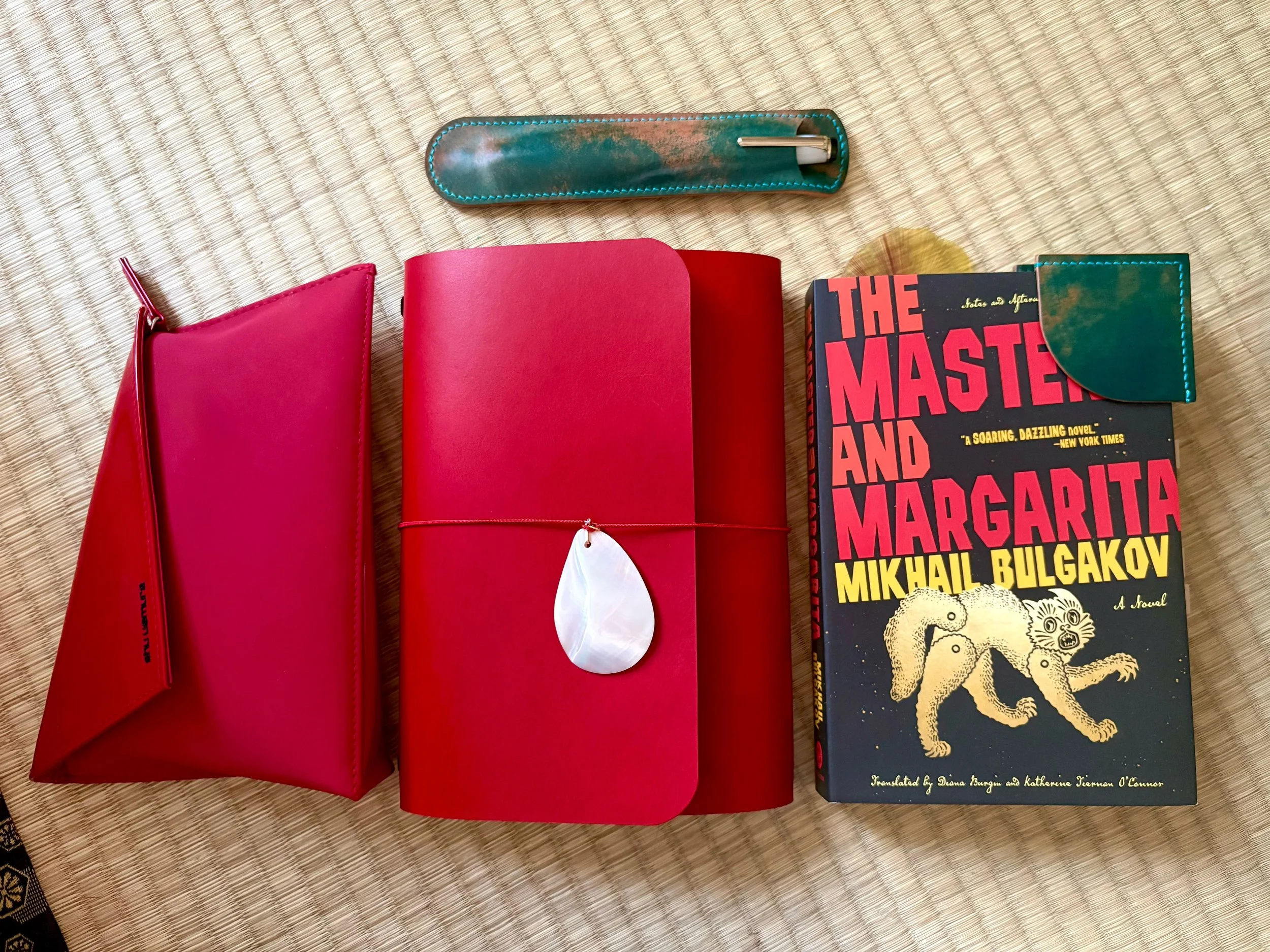
Record: The Practice
There is a kind of writing that happens not because one wants to but because one must. I have done this kind of writing for as long as I can remember, not to produce anything, not to think more clearly, but because the alternative is to have no container for what is happening inside. As a child, I wrote with pencils in spiral-bound notebooks and then discovered my love for fountain pens at the age of ten. By the time I was in my early twenties, I had graduated to the mesmeric world of inks, glassy papers, and fountain pens as objects of beauty. My journal has been where I go when the only way to exist is to write. It is a cleansing practice, sometimes a pathological one. It clarifies as much as it contains my cerebral and emotional effluence.
The journal itself is a Tomoe River 400- to 480- blank page A5 notebook. The paper is so thin and so receptive that fountain pen ink blooms on it with an almost indecent generosity. Sheening and shimmering inks become worded fireworks permanently frozen in time. At the moment I use five pens, each holding a different ink: Emerald of Chivor, which shifts between green and teal and throws gold and red shimmer depending on the light; Kyanite du Nepal, both from J. Herbin; Oxblood from Diamine; Alt Gold-Grün from Rohrer and Klingner; and Nitrogen from Organics Studio, a dark blue with a purple sheen that makes certain entries feel nocturnal even when written in daylight. The rotation is practical despite my desire to make it more intentional, as I need to keep the nibs from crusting, and so the visual texture of any given week is spontaneous and playful. It is much needed, as a lot of heaviness flows out of the conduit of my pen.
My writing has always been interior. Observations, yes, and the texture of days, but mostly what I write is how the world lands on me: how I see it, how it unsettles or steadies me, what it does to the inside of being alive. The entries are dated and continuous, written end to end, top to bottom, without spatial division or system. They accumulate rather than organize. This notebook is called Record. Every notebook that comes after is named the same.
Reliquary: The Folio
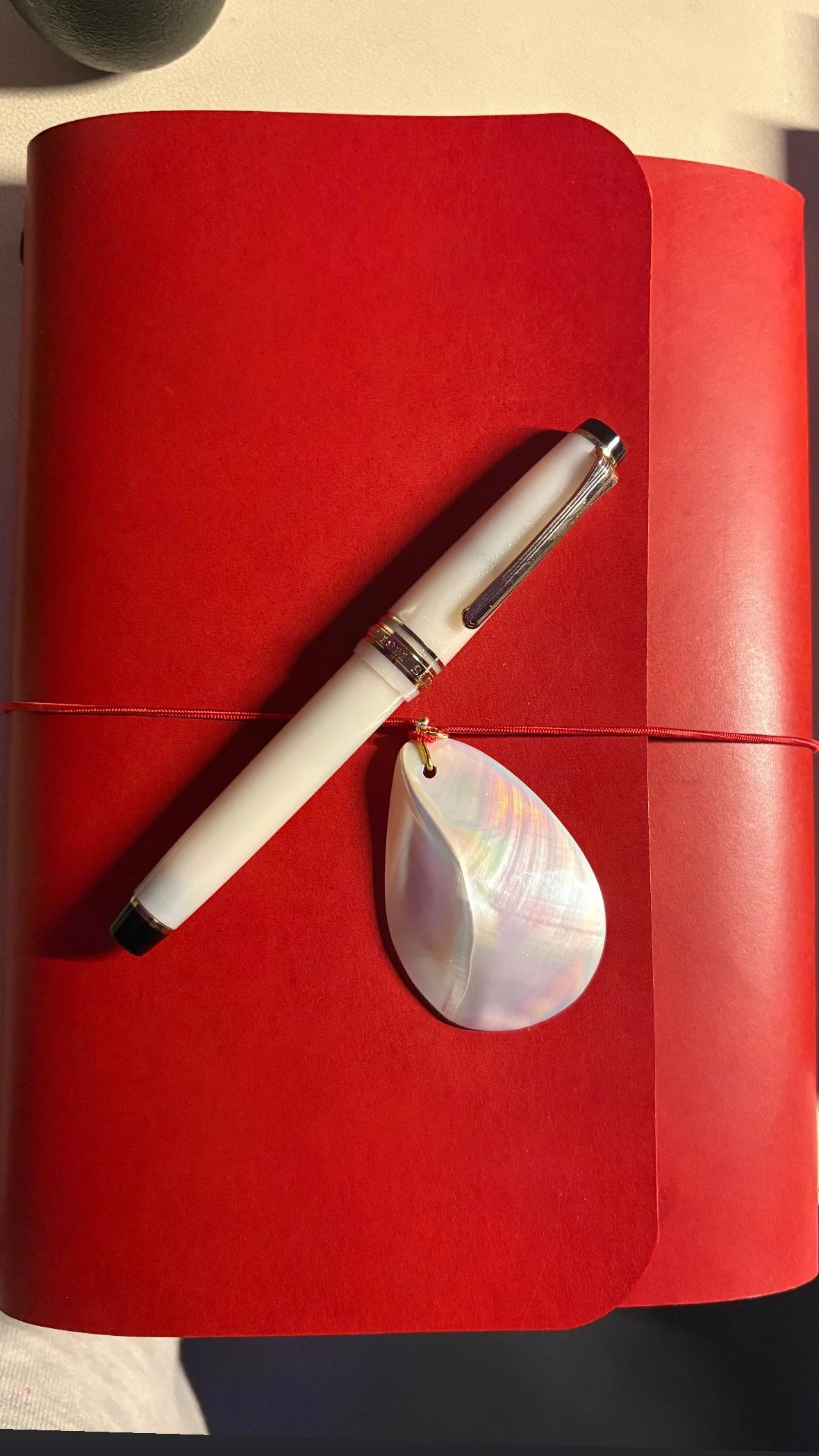
Over time, the soft covers of my journals began to fray and warp, and I realized that every Record needed a home worthy of what it holds. I wanted an object that was both functional and meditative in essence, carefully assembled by someone who has an eye for quality and detail. This is how I arrived at the folio from Sting & Snout Bindery. What drew me to it was an immediate and intuitive response to two colours that struck me with the force of something both visually arresting and emotionally inevitable: Langyao red (郎窑红) paired with a pearlescent white. Only later, once the folio was assembled, did the cultural and symbolic resonances reveal themselves, and they turned out to be extraordinarily coherent.
Langyao Red is one of China's most prized traditional glazes, named for the Lang Kiln, where it was first developed in the eighteenth century under Qing dynasty’s ceramic superintendent Lang Tingji. The uniqueness of this glaze is that it draws its colour from copper and is fired at temperatures approaching 1300°C. The conditions required are so exacting, atmosphere and heat held in precise, unforgiving balance, that successful pieces were genuinely rare. A folk saying of the era captures this perfectly: "If you want to become poor, try firing Langyao Red."
At its deepest, the colour is extraordinary: mirror-bright, jade-smooth, red as fresh blood. The glaze has a crystalline richness to it, luminous and saturated, like the arrested scarlet of newly congealed ox blood, almost violent in its radiance. The journal folio indeed would carry the distilled lifeblood of my experiences.
In Chinese tradition, red is the colour of yang energy: fire, vitality, the sun, a declaration of power and sincerity. It carries the characters for unwavering loyalty and devotion in its visual etymology. Mother-of-pearl belongs to an entirely different cosmological register: in Chinese lore, a symbol of immortality and power, but also of the lunar feminine, of the ocean’s interior, believed to harness the energy of the moon and the water, to heighten intuition and protect against darkness. But beyond their individual symbolisms, the two materials exist in a tension that is almost elemental.
The leather is warm and animalic, terrestrial, carrying the heat of a living creature, the hide of something that traversed the earth and grazed under the sun. The mother-of-pearl is cool and ethereal, formed in the lightless interior of a shell at the bottom of the sea, built up over time in iridescent layers of nacre that refract light rather than absorb it. One is the earth. The other is water. One is opaque, saturated, urgent; the other is luminous, shifting, impossible to fix. The vibrancy of the red is balanced softly by the luminosity of the white, passion held in tension with purity, excess with restraint, the material with the transcendent. Two things that should cancel each other out and instead make each other more fully themselves.
The red cord from which the charm is suspended is not incidental. It is a cord of connection in East-Asian lore: of fate, a quiet insistence that things are meant to find each other. My thoughts finding their way to paper, my friendships formed across continents and years and entirely improbable circumstances, and the experiences that have shaped me into the person who would choose, with great deliberateness, a crimson folio and a mother-of-pearl charm and call the whole object a reliquary.
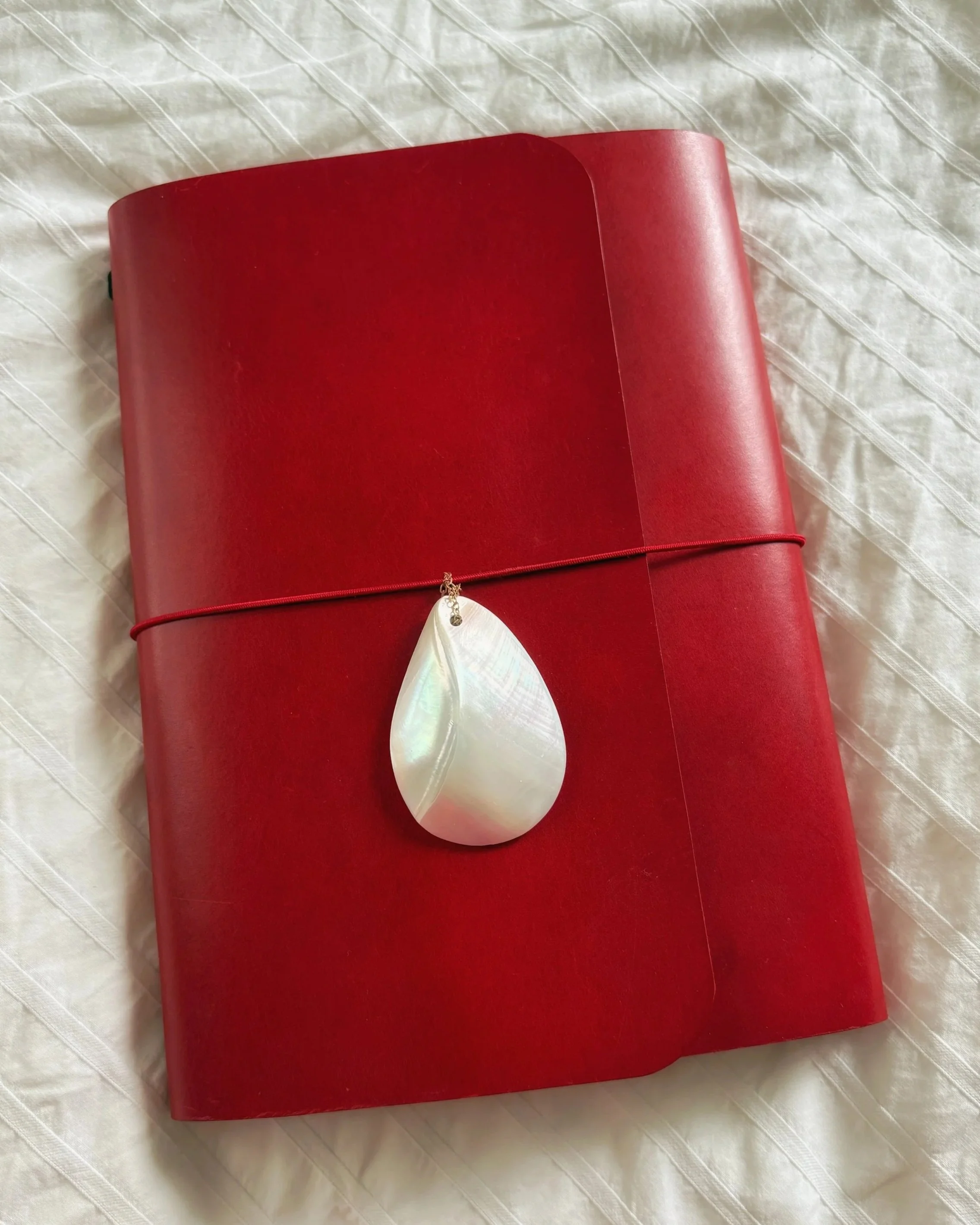
The leather’s provenance is Buttero from Conceria Walpier, a Tuscan tannery that produces calf leather through vegetable-tanning methods, and I chose it over Minerva Box deliberately. I wanted an understated, elegant calf leather, and Walpier’s Buttero is exactly that. Minerva Box, a superb leather that is used to make Hermès bags, produced by Badalassi Carlo, is softer and more malleable, with a slightly pebbled texture that I did not want, and its patina comes quickly, too quickly for what I wanted. I preferred the smooth, unbroken immensity of Buttero, which is stiffer and more structured, its patina earned over time through sustained handling, the way devotion accumulates rather than arrives. I wanted a folio that would become more itself gradually, that would carry the evidence of use without surrendering its original character. There is something in this that mirrors what I want from the practice it holds.
The charm I asked for specifically: mother-of-pearl rather than pearl, because mother-of-pearl has more complexity in its surface, more colour, more internal variation, more depth to visually savour. A pearl is singular and complete, but mother-of-pearl is iridescent, shifting, structurally intricate, allegorical, I think, of a life being lived well. I wanted the folio to read simultaneously as a classical Chinese relic and an Art Nouveau object, every element organic and warm, from the colour to the luminosity. The cover itself is a vast expanse of red, no embellishments, no tooling, nothing to interrupt it, and then, punctuating it like a considered pause in a sentence, the mother-of-pearl teardrop suspended from a red cord on a 14-karat gold-plated chain, which I sourced and clipped. The folio is named Reliquary: a word that arrived only after everything else was in place, and that named not just the object but the ritual of consolidating a life through writing and ephemera.
Residue: The Organizer
Because Record is so inward-oriented, because it is essentially me and how I see the world, I found myself wanting something that would remind me of how the world sees me. Something to pull me out of my own head when the writing had taken me too far inside it. This is how the organizer insert came to be what it is, and why it too earned a name: Residue. A reliquary within the Reliquary, a curated collection of objects that constitute the outside world pushing back.
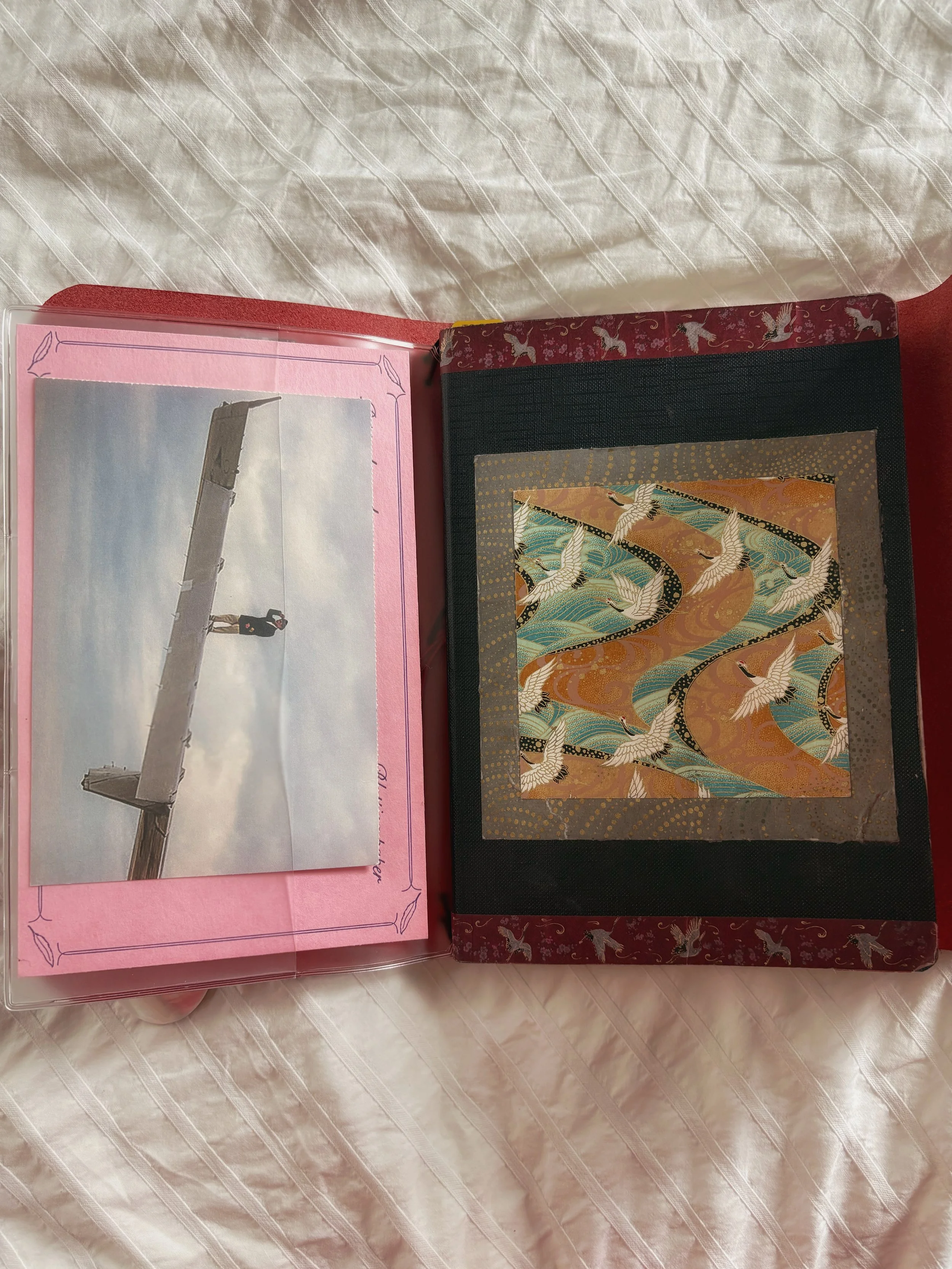
I filled it slowly, over time, with objects that each carry a specific weight. A piece of pink blotter paper and a Shitajiki, both functional, sit alongside things that are not functional at all and are more important for it. An origami crane given to me with a furoshiki I purchased in 2018 when I first arrived in Canada. Cranes are the motif I chose for the cover of the journal nested inside the folio, knowing that in Japanese folklore, they are a deeply rooted symbol of longevity, healing, and wish fulfilment. The convergence felt too right to be incidental.
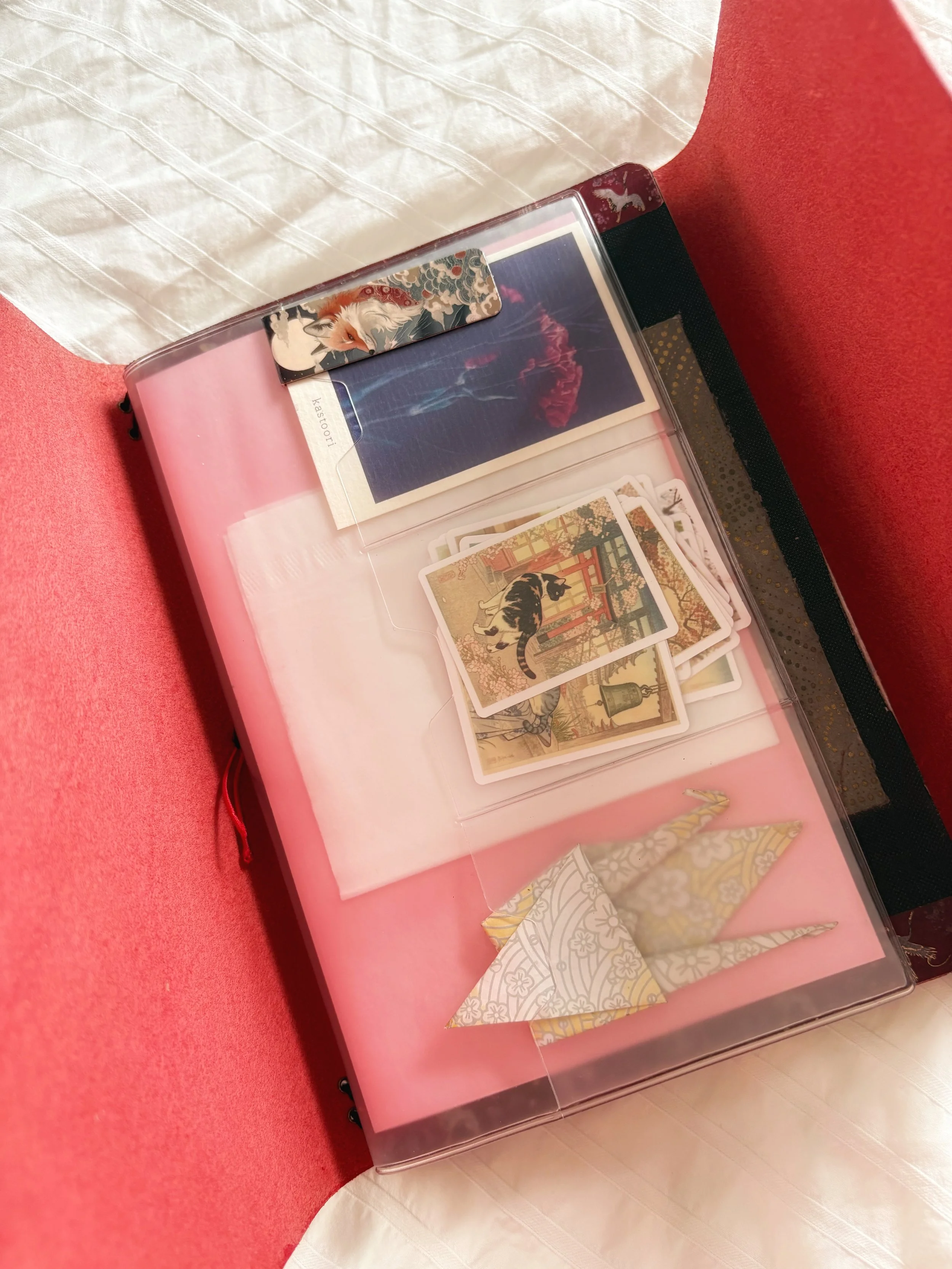
A visiting card from my curatorial years, whose cardstock color, thickness, width, and orientation I chose and watched being cut, designed in collaboration with a friend who was a visual designer. I had loved a photograph she had taken of a flower and wanted it as the face of the card. We have since fallen out of touch. The card remains.
A postcard of a scene from Tripoli Cancelled by Naeem Mohaiemen, who read my review of the film and wrote to me because he loved it. The postcard arrived in a yearly retrospective catalog book from the gallery representing him as a direct consequence of the writing, which means it is itself a form of record, the world responding to the witness. A museum ticket from the Bharat Kala Bhavan, where I went in 2023 to see Nicholas Roerich’s paintings, Roerich being one of my favourite artists, a painter whose work exists at the intersection of the spiritual and the elemental in a way I find quietly sustaining, whose painting of the Himalayas, tinged in pink and lavender, I wake up to every morning.
Then there are the things that are entirely about people. A polaroid of me with my first PhD friend, the only one who has remained equally constant inside and outside of academia, which is a rarer thing than it sounds. A photograph of me with a young man I met in December 2022, who became a younger brother almost immediately. A Christmas card from my Chinese sister, whom I met entirely by chance in my apartment complex in 2022 and with whom I became 高山流水, gāoshān iúshuǐ, high mountain and flowing water, with a speed that neither of us had anticipated. A postcard from a debonair classmate from my master’s years who shared my European Romantic sensibility so completely that the correspondence felt less like an exchange and more like recognition. And a letter written to me in Copperplate cursive by a friend I made when I was a teaching assistant at Ashoka University, juggling that role alongside my master’s degree, a letter that is, among other things, evidence that some friendships form in conditions of pressure and hold anyway.
These objects span India to Canada, different walks of life, and different points of arrival. They are the proof that the world orients itself toward me with affection, which is not always easy to remember when one is writing pathologically at two in the morning.
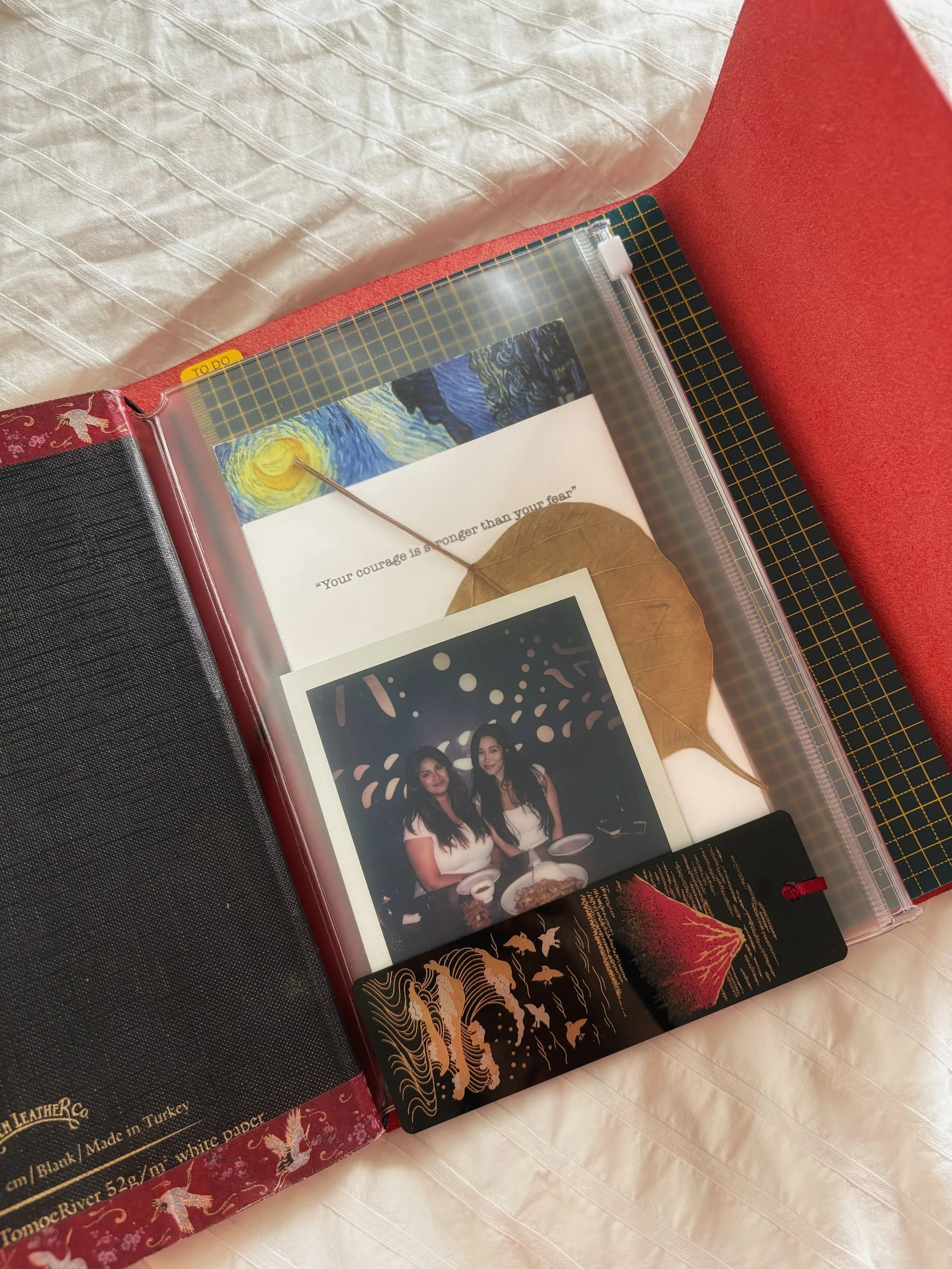
Among these objects is a pressed leaf from a Bodhi tree in Varanasi in 2023, itself grafted from the original under which the Buddha attained enlightenment. I knew its significance before I picked it up, which is why I picked up several. One I kept and another I carried back to Canada for my Chinese sister, my zhīyīn (知音), who is Buddhist. The leaf is not a religious object for me in any doctrinal sense. It is a relational one. It belongs in Residue because it is the most literal record I have of carrying something from one place to another for someone I love.
Finally, a black lacquer bookmark with shimmering ink depicting Mount Fuji, gifted by a Japanese friend I first met in Goa in December 2012, when he was an exchange student visiting India. He returned in 2017 and brought me the bookmark, amongst many other portable wonders of Japan. We have stayed in touch since. It marks my place in Record, between the written and the unwritten, between what has already been set down and what is still to come.
Resonance: The Summation
I had set out, at the beginning of all this, to construct a better writing system, something more intentional and architecturally considered than what I had before. After some experimentation and deliberation, I realized that no such construction was necessary. The 400-page tomes I had been filling all along for the last decade were already a perfect ecosystem of emotion, discharge, clarity, and creativity. It did not need to be improved upon. It needed only to be housed, honoured, and accompanied by the right objects.
This is what the Reliquary holds: a continuous interior record written in five inks on paper that takes the light differently depending on the hour, and a curated collection of objects that constitute the outside world pushing back. The writing goes inward. The objects bring me back out. Neither replaces the other. Neither is sufficient without the other. The Reliquary contains both, darkening slowly with use yet luminous from within, witness to my interior life and companion to its unfolding.