the systemization of flair: how contemporary football lost its unpredictability
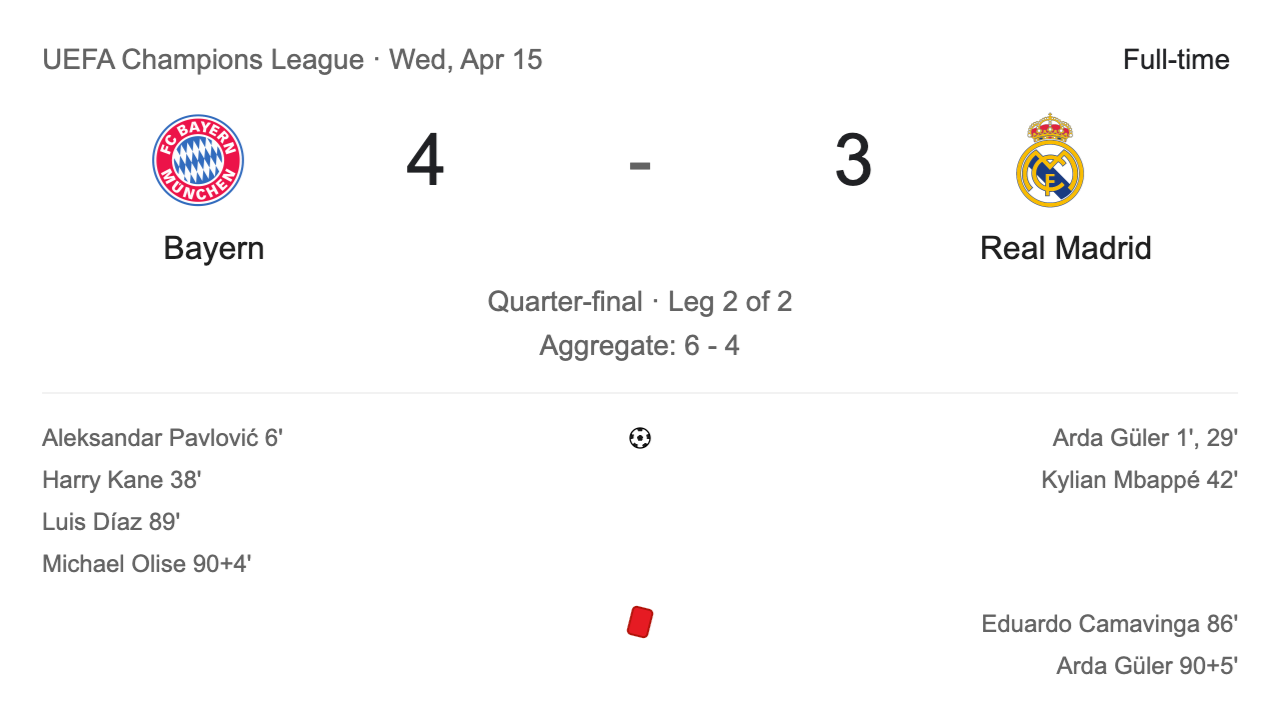
Champions League quarter-final second leg at the Allianz Arena, April 15, 2026
I began as an AC Milan fan at ten years old. Not the Milan of today, diminished and searching, but the Milan that felt inevitable. That team moved as if certainty had been written into the geometry of its play. The Milan derbies of the early 2000s were legendary because they embodied something deeper than skill: two fundamentally different worldviews colliding. Under Carlo Ancelotti, Milan fielded what may have been the most exquisite defensive unit in football history. Paolo Maldini, Alessandro Nesta, Jaap Stam, and Cafu were not merely defenders. They were architects of negation, artists of precision. Yet Milan attacked with creativity: Shevchenko’s hunger, Kaká’s intelligence, Gattuso’s aggression, and the unpredictable brilliance of players whose gifts could not be fully systematized.
Across the city, Inter Milan offered a colder symmetry: Júlio César’s anticipatory calm, Maicon’s surging force, the austere authority of Lúcio and Walter Samuel, Javier Zanetti’s tireless constancy, Esteban Cambiasso’s geometric mind, the rupture of Dejan Stanković and Sulley Muntari, and Wesley Sneijder’s measured vision threading it all. At the center stood Zlatan Ibrahimović, not a striker, but an axis around whom everything converged. Each movement resolved into something sudden and exact. When these teams met, it felt like philosophy made flesh, two different answers to the eternal question of how to play the game.
In May 2007, at the San Siro, Milan demolished Manchester United 3-0 in the Champions League semi-final second leg. This match still exists in memory as Milan’s perfect game. Kaká opened the scoring. Clarence Seedorf and Filippo Inzaghi followed. Manchester United had won the first leg 3-2 and arrived in Milan with hope. They departed utterly dismantled. This was not a contest decided by marginal superiority. It was a masterclass, a demonstration of football as an art form. This kind of performance has become rarer, though not impossible to witness.
Over the past fifteen years, football has not declined in quality but transformed entirely in character. Excellence and unpredictability now exist in growing tension. Something significant has been lost, not in competition but in possibility itself.
The Erosion of Domestic Certainty
Somewhere over the past fifteen years, so gradually it was easy to miss, the game began to feel different. The domestic leagues that once defined European football have become structurally imbalanced. The Premier League, long celebrated as the most unpredictable arena in world sport, now operates within narrowing margins. While individual results still fluctuate, the distribution of resources increasingly predetermines which clubs can sustain excellence over time. Financial power exerts a quiet, cumulative pressure across seasons.
Manchester United’s trajectory is perhaps the most revealing. Under Sir Alex Ferguson, United represented something almost transcendent, not merely a team but an institution capable of transforming talent through system and philosophy. Ferguson could identify overlooked players and cultivate them into world-class competitors. His genius was organizational, an alchemy of continuity and control. Post-Ferguson, United has struggled not from lack of investment but from the absence of that coherence. Resources remain vast, but without a unifying structure, they dissipate rather than accumulate.
Serie A was reshaped by Calciopoli, while La Liga’s recent instability shows how fragile dominance can be when built on financial excess without a sustainable structure. Across leagues, the pattern is constrained possibility, a narrowing field of outcomes that makes sustained surprise harder.
The Closing of Space
When I watch modern football now, what strikes me first is compression. Space no longer appears as something given but something fought for, constructed, and rationed. The high press, intensified and systematized most visibly by Jürgen Klopp and adopted widely since, ensures that time on the ball is relentlessly contested. This escalation has moved space away from the open expanses where improvisation once thrived and into narrower corridors of rehearsed movement and pre-structured overloads.
This is a rational evolution. Coordinated pressing proved effective, so it became universal. The result is a more tactically intricate game, yet also more bound. Kaká in 2007 embodied improvisation. Jude Bellingham today operates within a finely tuned system of movement and timing. Both are brilliant, but the nature of their freedom differs fundamentally. Between them stands the era of Lionel Messi and Cristiano Ronaldo—two players who, for nearly fifteen years, made individual genius look systemic in its consistency. Their dominance was itself a kind of unpredictability: you knew they would decide matches, but never how, and that is how they came to be known outside of the space of football. That era has closed, and nothing has replaced it. Exceptions persist, of course. A Mohamed Salah dribble or a Lamine Yamal moment can still rupture the structure and remind us of raw individual genius.
Two Models, Two Philosophies
It is worth being precise about which forces have most shaped this transformation, because the standard account tends to flatten what are in fact two quite different things. Jürgen Klopp's pressing model and Pep Guardiola's possession model are regularly cited together as twin engines of modern football's evolution, but they represent fundamentally opposed philosophies—and their effects on the game have not been equivalent.
Klopp's football is aggressive and, crucially, risk-tolerant. The high press accepts that it might be beaten, that transitions will be chaotic, that the space behind the defensive line is a genuine vulnerability chosen in service of something more rewarding. It demands players capable of real individual decision-making under pressure, because the system does not insulate them from disorder—it throws them into it. There is something almost courageous in how Klopp-influenced football is played: the willingness to commit bodies forward, to accept the possibility of the counter, to treat the ball as something worth winning back rather than something never to be surrendered. This is how football should be played. It is also, almost by definition, difficult to replicate without the right players, which is part of what makes it honest.
Guardiola's model proceeds from a different logic entirely. Its animating principle is the elimination of risk through the elimination of uncertainty. The ball is controlled so completely that the opposition is denied not just space but time, not just time but the psychological experience of being in the game. Passing lanes are pre-structured, player movement is choreographed, and possession is treated as an end in itself rather than a means to something more dangerous. The result is often extraordinary in its precision. But it is a different kind of beauty: mathematical rather than spontaneous, one that impresses more than it moves. The deeper problem lies in what happens when this model propagates downward. What proliferates is not the quality that requires Guardiola and his particular players, but the caution. Across European football, teams now maintain possession by large margins as a strategy in itself. Lateral passing, reluctance to commit forward, an almost philosophical aversion to losing the ball: these have become the dominant aesthetic of the modern game, not from an ambition to attack, but from an ambition not to be attacked.
Uncertainty persists, but it emerges in narrower spaces and shorter intervals, no longer ambient but produced. What modern football has done is not to eliminate unpredictability, but to reorganize it—displacing it from the individual moment into the architecture of the system itself. What we experience as loss may, in part, be a shift in perception: unpredictability remains, but in forms less immediately legible to the spectator. Modern football has transformed into something more tactically conservative, redistributing unpredictability into transient events—moments of pressing collapse, transitional rupture, and micro-error that replace the sustained openness of earlier eras.
Risk, Commitment, and the Performance of Passion
Maldini’s sliding tackles were commitment made visible: a willingness to risk the body in service of the moment, and Nemanja Vidić, as Robin van Persie once said, would quite literally put his head where others feared to put their feet. That visceral spectacle has diminished. VAR has heightened scrutiny, rendering every challenge subject to retrospective precision. Tactical evolution plays a role as well. Pressing structures reduce the need for last-ditch defending, while possession systems minimize chaotic duels. Clubs, protecting increasingly valuable assets, have rationalized risk. A mistimed challenge is now not just an error but a potential financial liability.
Commitment still exists. It is expressed more in positional discipline and collective movement than in theatrical physical sacrifice. The loss, however, is perceptual. The immediacy of visible risk has given way to something quieter and more controlled.
The Athleticization of Football and What It Has Cost
A familiar defence of modern football is that the players are simply better—more athletic, more physically prepared, the product of a more sophisticated global talent pipeline. The first part is true in a narrow sense. Sprint data and physical output have increased. But athletic capacity and footballing intelligence are not the same quality, and the dominance of the former has come partly at the cost of the latter.
This is not a matter of individual decline but of structural priority. Modern club academies optimize for physical output because the tactical models that dominate the game demand exactly those qualities. When clubs scout and develop accordingly, they produce players shaped for athletic function within a pre-set system rather than for the kind of individual technical and cognitive development that produces genuine footballing intelligence. The talent is not absent. It is deprioritized before it can mature.
Players like Ronaldinho, Kaká, Robinho, and the young Adriano came up in environments—often literally the streets— where individual problem-solving was the only available tool, which also led to a lot of dribbling and freestyling. No tactical framework was handed to them, and they learned to read the game because reading the game was survival. The modern academy environment installs the system first and the individual second, producing players of real technical consistency and physical proficiency, but also a narrower football mind: one optimized for execution within a structure rather than for the improvisation the game once demanded and rewarded. Ajax is perhaps the clearest illustration. An academy that once was a petri dish for players to nurture genuine creative autonomy—whose understanding of space and movement was self-generated rather than installed—now increasingly produces positionally disciplined players who are excellent within pre-set structures and less equipped outside them. This is not a failure of talent. It is a failure of what talent is being asked to become.
European Competition: Diluted and Stratified
Real Madrid now embodies modern consolidation, the strategic concentration of elite talent. Kylian Mbappé joins Jude Bellingham, Vinícius Júnior, and Rodrygo in an attacking constellation that would once have seemed excessive. Emerging players like Arda Güler add further refinement, while managerial continuity under Carlo Ancelotti provides coherence. Even transfer speculation reflects this gravitational pull.
This consolidation has hollowed out European competition. The Champions League’s shift from a 32-team group stage to a 36-team league phase has weakened narrative coherence and multiplied matches, largely to generate revenue. The addition of the Conference League has further stratified the continent into clear hierarchies. The possibility of a passionate, well-organized underdog achieving genuine European success has grown rarer.
The Paradox at the Centre of Guardiola's Genius
There is a paradox worth naming in Guardiola's reputation as the game's great systems thinker. For all the geometric sophistication of his models, each has ultimately been organized around a single player. Barcelona was built for Messi. Manchester City, in its current configuration, is built around Erling Haaland. The system provides the structure; the singular axis provides the meaning. One would argue that this is also how Mourinho was utilizing Ibrahimovic, but the latter was a dynamic player who had the freedom to deploy his tactical intelligence as and when the game flow changed. Remove Messi from that Barcelona, and the architecture loses its rationale—the tiki-taka possession model was always, at some level, a delivery mechanism for the one player whose individual genius could unlock what the system alone could not.
Erling Haaland represents a different version of the same dependency, and a more revealing one, because the qualities he brings are almost exclusively physical. He is a finishing instrument of extraordinary precision, but the system has to do the thinking for him rather than with him. When the structure is disrupted—when City are pressed early, when transitions are chaotic, when the game does not proceed according to its pre-set logic—Haaland disappears from matches in a way that earlier elite strikers did not. Shevchenko, Inzaghi, Raúl, Totti: these were players who manufactured their own moments in open, less structured environments, whose intelligence was reactive rather than positional. They read the game and responded to what appeared. Haaland operates in clarity and executes within it. His intelligence is real but narrow, optimized for the particular conditions the system creates and considerably less equipped when those conditions break down. He is, in this sense, less a footballer than a function of the system—the logical endpoint of what happens when a tactical model systematically replaces individual intelligence with structural instruction.
2013: The Moment Everything Systematized
Around 2013, several forces converged. The high press became widely understood and replicated. Data analytics turned from novelty to standard. VAR discussions intensified. Before this, football retained a more spontaneous narrative and a greater degree of uncertainty. After systems proliferated and tactical philosophy at the top level grew increasingly homogenized. The Klopp-influenced pressing models meant elite teams began playing in fundamentally similar ways, even if surface styles differed. The idiosyncrasy of truly divergent approaches, Ancelotti’s Milan versus Mourinho’s Inter, became rarer. In 2026, Liverpool and Manchester City may look superficially different but operate within a narrowed tactical vocabulary.
A Moment of Refreshing Rupture
Two days ago, on April 15, Bayern Munich defeated Real Madrid 4-3 in the Champions League quarter-final second leg at the Allianz Arena. The aggregate score finished 6-4 in Bayern’s favor, a result that felt like a rare interruption in expectation. Bayern had not eliminated Real Madrid since 2012. The match delivered seven goals and constant drama. Arda Güler opened the scoring for Real Madrid with a clinical finish after a rare error from Manuel Neuer. He later added a superb free-kick. Kylian Mbappé equalized with a composed finish, and Vinícius Júnior continued to threaten with his pace and skill. Eduardo Camavinga received a red card in the closing stages, leaving Real Madrid with ten men.
Bayern responded with character. Aleksandar Pavlović and Harry Kane gave them the lead. Then came the late explosion. Luis Díaz struck in the 89th minute to restore Bayern’s advantage. In the fourth minute of added time, Michael Olise produced a moment of magic, curling home the winner. The Allianz Arena erupted. It emerged from volatility, from the accumulation of moments that could not be fully anticipated or contained. This is how football once more frequently felt: unresolved, unstable, and open until the final whistle.
It is worth being honest, though, about what this result does and does not prove. A 4-3 aggregate scoreline in a knockout tie is evidence that unpredictability persists—that no outcome is entirely predetermined, that individual moments can still rupture structural expectation. It does not disprove the larger argument. Bayern's breakthrough is striking precisely because it is exceptional, a deviation from the pattern rather than evidence against it. The structural forces that I have tried to describe: the consolidation of resources, the homogenization of tactical vocabulary, and the narrowing of what football asks its players to be, remain largely intact. The match was beautiful because it felt like something recovered, not something normal. Exceptions confirm rules. This was an exception. For once, unpredictability was not contained within narrow intervals but expanded to shape the match itself. The match did not restore what had been lost, but it offered a glimpse of it.
The Chessboard of Contemporary Football
Contemporary football possesses genuine brilliance. Athletes are fitter and more technically proficient than ever. The coordinated execution of complex tactical systems, eleven bodies moving in service of a strategic idea, is genuinely sophisticated. Pep Guardiola’s Manchester City, at their best, represent a mathematical kind of excellence. What we have witnessed, however, is the refinement of a particular skill set that players often enter the academy with, rather than the expansion of their overall game. Matches become increasingly managed, and players more specialized—excelling within defined roles, but less frequently required to improvise beyond them. The result can resemble a chessboard: movement is precise, coordinated, and purposeful, but bounded by structure much like chess pieces carefully navigating on a tightly controlled chessboard, thus lacking the free-play for tactical brilliance and courage that former players had the opportunity to exercise. Sophistication and emotional engagement are not the same. A well-executed system impresses. An unpredictable match, where anything might happen, moves us. Modern football often asks us to admire the former.
Football has not declined in quality; it has transformed in character, now more tactically sophisticated and systematically coherent. These are real achievements. But it has narrowed in spirit and lost something irreplaceable: creativity—which has the capacity to surprise—the space for unscripted individual expression, the visible physicality of commitment, and the narrative unpredictability that once generated deeper emotional stakes. In chasing perfection through system and data, we have gained precision at the cost of poetry.
Today, elite matches have often become elegant comparisons of execution: which team pressed more effectively? Which executed its system with more precision? The result can be impressive, even beautiful in its own right. But for those of us who remember nights like the 2007 San Siro demolition, the genuine possibility of divergent philosophies prevailing over one another, something vital feels missing. We watch a sport superior in almost every measurable way, yet we have lost something ineffable. Perhaps we cannot have both the poetry of unpredictability and the unambiguity of excellence at the highest level.
The Milan derbies were special not because the football was always technically superior, but because something genuine was at stake. Two genuinely different approaches collided, and either could prevail. That kind of openness, where excellence could take multiple forms, has been systematically reduced. Domestic leagues have lost it through the consolidation of power. European football has surrendered more of it through stratification.
Yet moments like Olise’s curling winner in the dying seconds—raw, unscripted, electric—prove that the game’s wild heart still beats. Perhaps that is all one can ask for now: not the restoration of what was, but the occasional, unrepeatable moment that escapes the structure entirely and reminds us what football once promised.
Bayern now advances to face Paris Saint-Germain in the Champions League semi-final, with the first leg on April 28th. In a season marked by the inevitability of the already powerful, for once, the outcome did not seem predetermined by structure, depth, or institutional weight. The match did not restore what has been lost or resurrect the Milan derbies, but it certainly displayed beauty and soul in moments of passion and pressure amid institutional excellence earned through cultivation, academy development, and system, rather than mere acquisition. It is not the same. It cannot be. But it is something. And in 2026, sometimes something is enough to hope for.