For Xinwei: The World She Opened, Softly Like a Dream
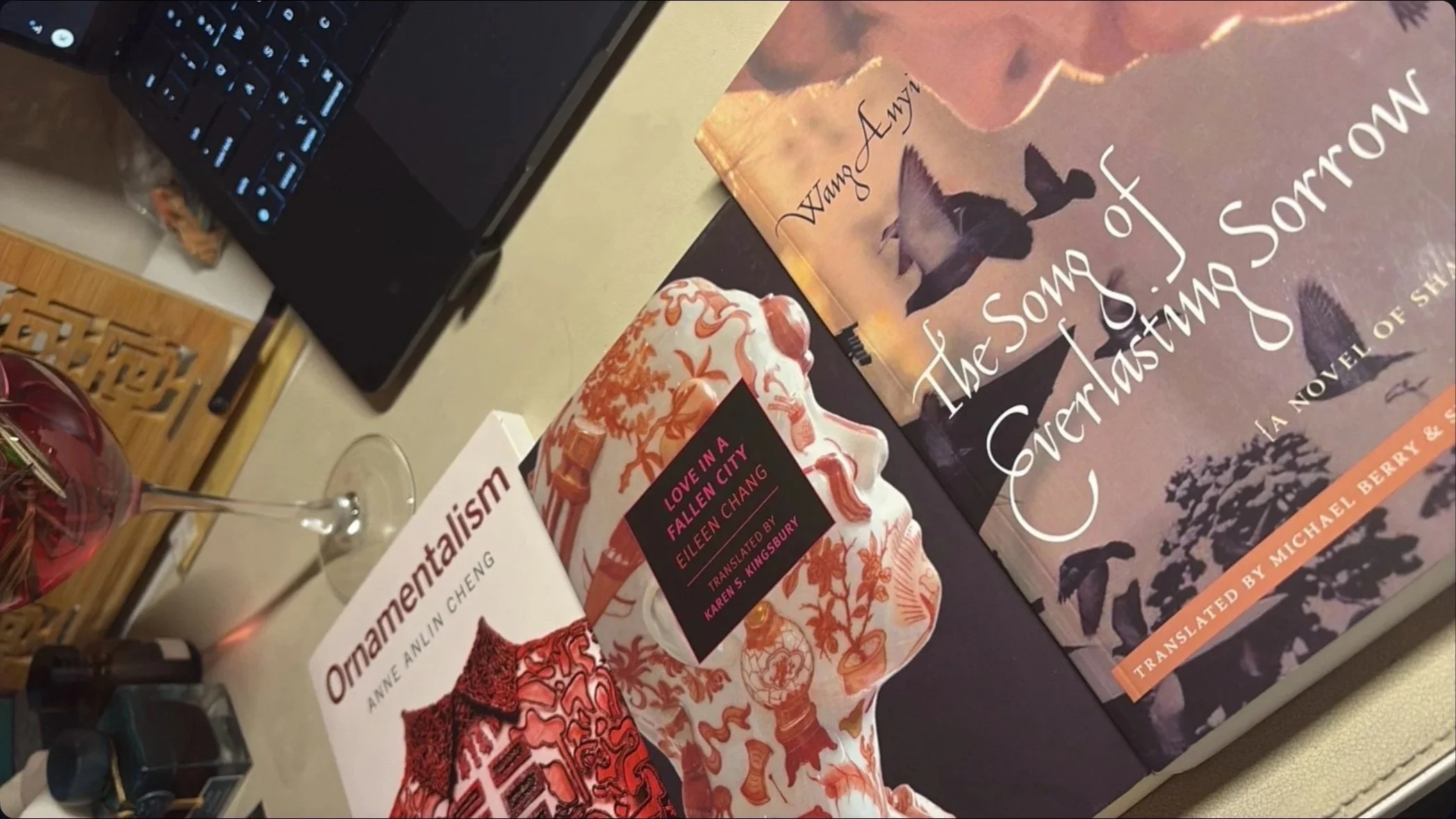
a photo from my study on the day I undertook this immersive project
There are moments when affection does not remain contained within the boundaries of the person toward whom it is directed. It expands outward, quietly, almost imperceptibly, until it begins to gather an entire world around itself.
When one loves a person deeply—in my case, Xinwei, my Chinese sister—there is often a quiet misunderstanding that follows in explanation. She is not my sister by blood. We are not bound by lineage or legal kinship. And yet the bond is, in every meaningful sense, deeper than anything biological description can hold. It belongs to another category entirely: chosen, lived, and sustained through a kind of recognition that precedes language. It is from within this form of closeness that this syllabus first began to take shape.
That closeness produces a certain epistemic desire. Not the desire to possess knowledge, and not even the desire to explain, but something closer to attentiveness: a wish to understand the textures of the world that shaped her, as though proximity to her cultural and aesthetic inheritance might bring one closer to a more complete form of seeing.
This movement is not translation. It is a discipline of proximity without collapse.
Over time, it began to converge with something already central to my intellectual life: a sustained investment in aesthetics not as decoration, but as structure. I have been drawn to how surfaces organize perception, how beauty shapes attention, and how form carries meaning where language reaches its limit. In my doctoral work, this concern has repeatedly surfaced through literature, film, and visual culture, particularly around questions of migration, identity, and cultural translation.
What follows is a continuation of that work, but also a reconfiguration of it.
It is not a university syllabus, though it borrows its architecture. It is not a reading list, though it contains one. It is a constructed field of curiosity: a way of arranging texts, films, lectures, and visual histories so that one can begin to inhabit a world before fully understanding it, and in doing so, let understanding arrive from within experience rather than before it.
At its center is a single, unstable question:
How does femininity survive through surface?
Not surface as superficiality, but surface as structure, strategy, and aesthetic intelligence.
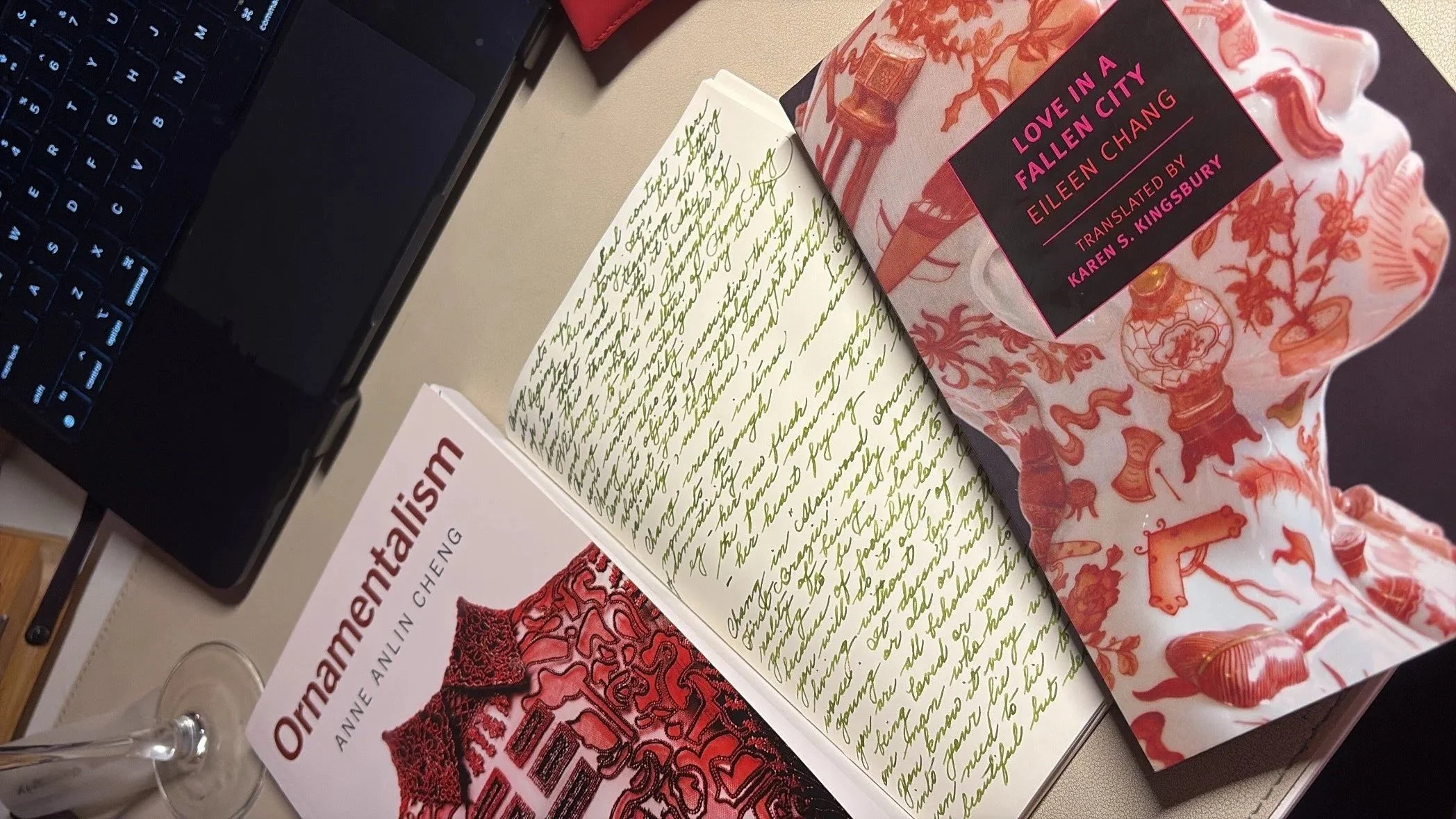
notes from my study
SURFACES OF SURVIVAL: A SYLLABUS ON CHINESE AESTHETICS, FEMININITY, AND VISUAL FORMI. FICTION — SHANGHAI, MEMORY, AND THE GRAMMAR OF SURFACE1. Eileen Chang — Love in a Fallen City
A novella collection set in wartime Shanghai and Hong Kong, where intimacy unfolds through gesture, clothing, and silence. Love is inseparable from survival, and emotional life is always mediated through performance and restraint.
Read alongside Anne Anlin Cheng and Antonia Finnane from the beginning.
2. Wang Anyi — The Song of Everlasting Sorrow
A sweeping historical novel following a woman’s life in Shanghai across decades of political transformation. Identity here is not interior essence but accumulation: objects, spaces, habits, and time itself.
Read after Chang + Cheng + Wu Hung Lectures 1–2.
II. THEORY — ORNAMENT, BEAUTY, AND PERCEPTION3. Anne Anlin Cheng — Ornamentalism
A foundational theoretical work arguing that Asian femininity has historically been constructed as ornament—visible, aestheticized, and structurally constrained. Ornament becomes both limitation and a mode of survival.
4. Antonia Finnane — Changing Clothes in China: Fashion, History, Nation
A history of Chinese dress from dynastic tradition through nationalist modernity, with the qipao as its central object. Fashion here is not frivolous: it is the site where the female body, national identity, and political transformation converge on the surface of a garment. The material and historical grounding for Cheng's theoretical argument.
Read in parallel with Ornamentalism.
5. Elaine Scarry — On Beauty and Being Just
A philosophical meditation on beauty as a force that reorganizes perception outward. Beauty is not passive; it trains ethical attention and expands the viewer’s relation to the world.
Read after initial immersion in Chang and Cheng.
III. ART HISTORY — STRUCTURE, MATERIAL, AND VISUAL LOGIC6. Lothar Ledderose — Ten Thousand Things: Module and Mass Production in Chinese Art
A study of Chinese art as modular system: meaning emerges through repetition and recombination of discrete units—a structural lens for understanding Chinese aesthetic production.
7. Michael Sullivan — The Arts of China
A broad historical overview of Chinese art across dynasties. Used as a navigational map rather than sequential reading.
8. Carol Michaelson — Chinese Art in Detail
A close-looking guide to individual artworks. Trains attention toward material specificity and visual patience.
9. Wu Hung — Lectures on Chinese Art (FREE)
A major theoretical reorientation of Chinese visual culture. Art is understood as a producer of historical time rather than a reflection of it.
Watch in order:
· Chinese Art and Dynastic Time — Part I
https://www.youtube.com/watch?v=AadA5IKhjbs
· Chinese Art and Dynastic Time — Part II
https://www.youtube.com/watch?v=pkG7gJZQs5Q
· In the Name of Art: Destruction and Reconstruction
https://www.youtube.com/watch?v=EnPEJ9xJkiE
Best placed after beginning Chang and Cheng, and before moving fully into Wang Anyi.
IV. FILM — SURFACE, RITUAL, AND TEMPORAL AESTHETICS 10. Hou Hsiao-hsien — Flowers of Shanghai
https://archive.org/details/989pa.com-.-flowers.of.-shanghai.-1998.-bd-1080-p.-x-264.-aac (FREE)
A visually dense courtesan world structured entirely through ritual, implication, and surface choreography.
11. Zhang Yimou — Raise the Red Lantern
https://archive.org/details/raise.-the.-red.-lantern.-1991.1080p (FREE)
A stylized household drama where hierarchy is expressed through architecture, repetition, and colour.
12. Wong Kar-wai — In the Mood for Love
https://www.bilibili.tv/en/video/2044432809 (FREE)
A study in restraint and emotional repetition. Desire is never completed, only circulated through gesture, costume, and space.
V. DRAMA — POWER, VISIBILITY, AND STRATEGIC LIFE13. The Story of Ming Lan
https://www.viki.com/tv/35895c-the-story-of-ming-lan?qId=0c316eef18a43c9f84c7ee7e23e2b62f#episodes (FREE)
Domestic intelligence as survival strategy within family hierarchy.
14. Empresses in the Palace
https://youtube.com/playlist?list=PLIx8QniXH-rElLyjzNMSOXSTbOKsDShyu&si=Y3JQAugSOp2r8GuV (FREE)
The imperial harem as a total system of visibility, where femininity is structured through competition, restraint, and encoded gesture.
15. Nirvana in Fire
https://www.viki.com/tv/22943c-nirvana-in-fire#episodes (FREE)
Political legitimacy constructed through narrative, reputation, and indirect action.
16. Ming Dynasty 1566
https://youtube.com/playlist?list=PLyED3III7lHMXbM4pd-YX6VW1JBkm4e0V&si=laV4RiTSN6SPwG2j (FREE)
Austere governance where ornament is stripped away, and institutional structure becomes visible in its bare form.
ORDER OF ENGAGEMENT (SUGGESTED RHYTHM, NOT RULE)Phase I — Entry· Love in a Fallen City (start)
· Ornamentalism (parallel)
· Changing Clothes in China (parallel with Ornamentalism)
· Flowers of Shanghai (parallel)
· Wu Hung Lecture 1
Phase II — Theoretical emergence· Continue Ornamentalism
· Wu Hung Lecture 2
· Raise the Red Lantern
Phase III — Expansion into duration· The Song of Everlasting Sorrow
· In the Mood for Love
· On Beauty and Being Just
Phase IV — Structural horizon· Wu Hung Lecture 3
· Ming Dynasty 1566
· Sullivan + Michaelson as reference
Always ongoing· The Story of Ming Lan
· Nirvana in Fire
CLOSING REFLECTION:
 ON INHABITING A WORLD
This project does not begin from understanding. It begins from curiosity that has not yet decided what it must become.
There is a way of thinking that arrives too quickly, that tries to resolve before it has learned how to stay inside what it encounters. This syllabus resists that impulse. It is built on the assumption that perception must sometimes precede comprehension—that one must inhabit a world as fully as possible before one can begin to interpret it, and that understanding is most meaningful when it emerges from within lived proximity rather than being imposed in advance.
What forms here is not a system but a crucible: a space where difference is not immediately resolved, but allowed to remain active long enough to be experienced as form.
The practice that emerges is closer to inhabitation than analysis. Reading becomes a way of living inside structures of meaning until they begin to reveal themselves from within. Watching becomes a mode of dwelling inside time, gesture, and surface. And understanding, when it arrives, does so slowly—almost as a consequence of having stayed rather than having concluded.
This is not a curriculum in the institutional sense.
It is a way of living with curiosity long enough for it to become a world.
And within that world, surfaces are not endpoints of perception, but thresholds through which life becomes legible while still remaining partially unknown.
Reading Access Note
Some materials in this syllabus are available through open-access lecture platforms, institutional archives, and licensed educational media.
Wu Hung’s lecture series is freely accessible online via institutional and museum-hosted platforms.
Most books listed are published academic or literary works distributed through publishers, libraries, and licensed digital collections. Full texts are generally not available in open-access form, but may be accessed through libraries, second-hand editions, or institutional ebook systems.
This syllabus is not structured around ease of access, but around sustained engagement with works as they circulate through academic, literary, and cultural institutions.
Viewing & Listening
Wu Hung Lectures — Available freely on YouTube via the National Gallery of Art and institutional channels.
Films — Hou Hsiao-hsien, Zhang Yimou, and Wong Kar-wai films are available via licensed streaming platforms, film archives, and institutional collections depending on region.
Television Dramas — The Story of Ming Lan, Empresses in the Palace, Nirvana in Fire, and Ming Dynasty 1566 are available via licensed streaming platforms (including Viki and official uploads where regionally available).
Note on Textual Use
This syllabus does not follow a formal academic citation system. It is structured as a reading environment rather than a scholarly apparatus.
Texts are engaged as sustained fields of attention across literature, theory, film, and visual culture rather than as discrete objects of reference.
The world does not end here. It continues in reading, in looking, and in the slow recognition of forms that return in different guises.
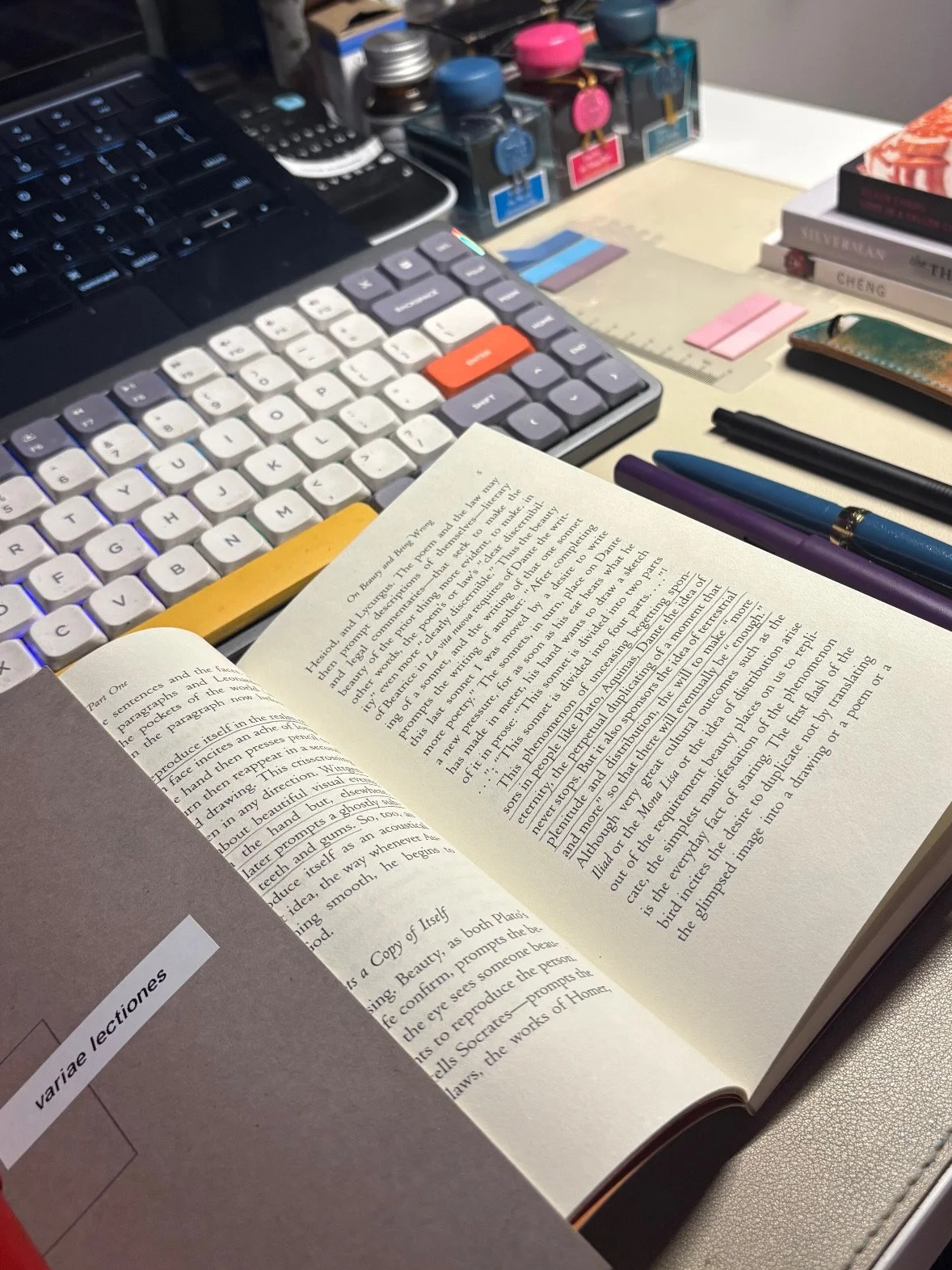
readings from my study