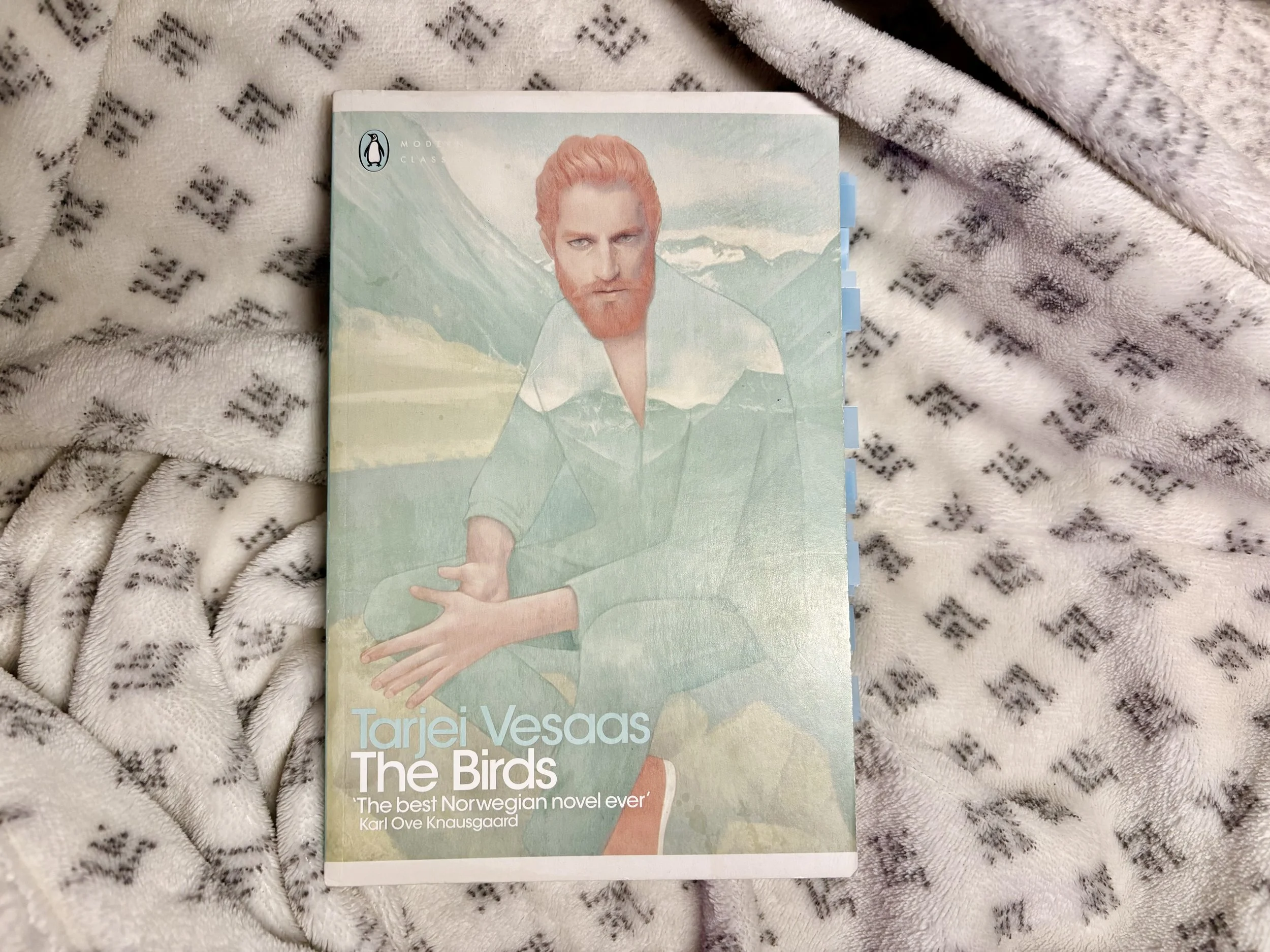
Tarjei Vesaas's The Birds: On the Sovereignty of the Inarticulate
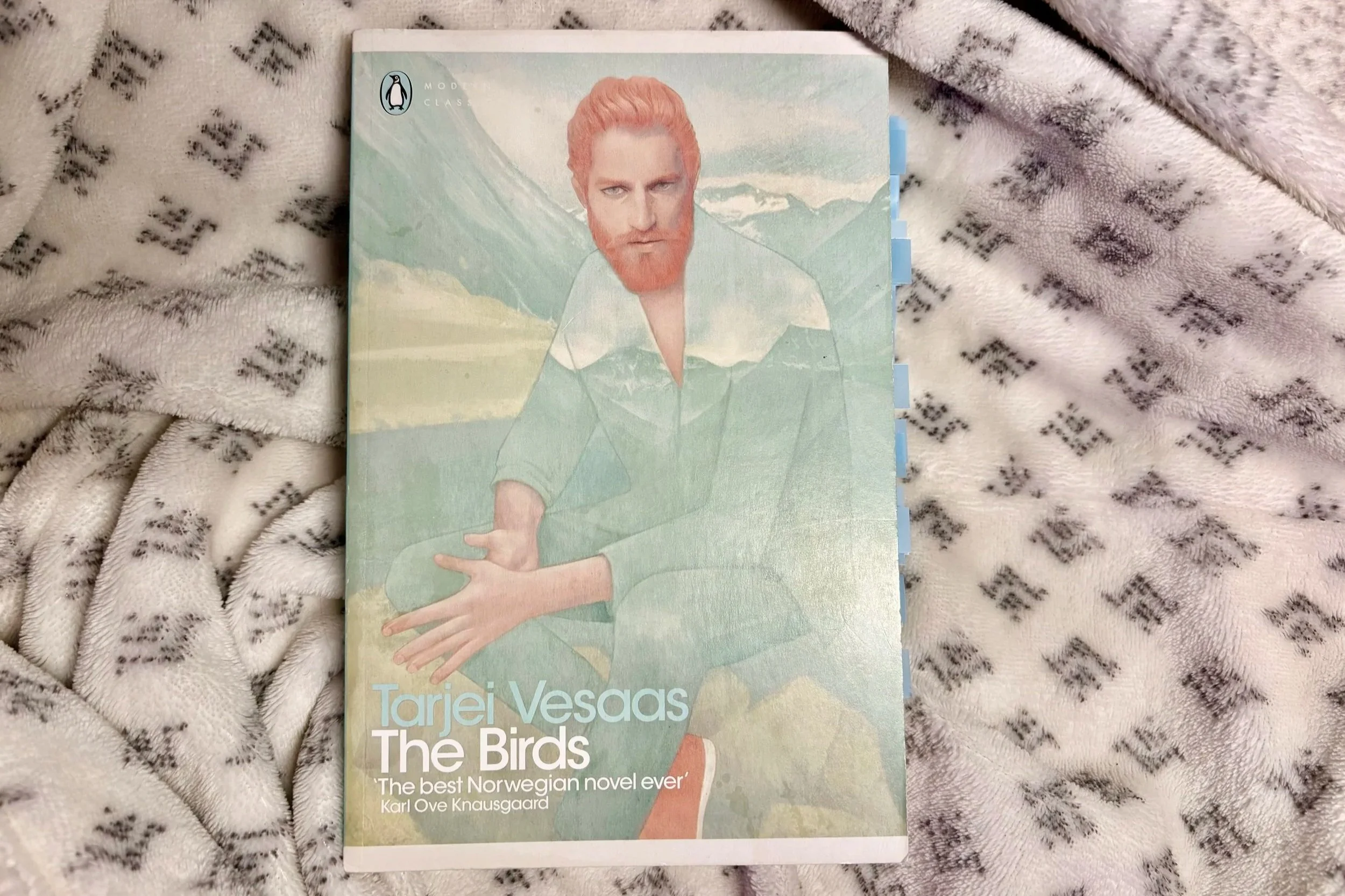
There is a bird that flies over Mattis only once. He watches it cross the sky above the forest, and something shifts in him permanently: a visitation, a sign, though a sign of what he cannot say. This is Mattis's condition: to receive meaning in full, and to be unable to pass it on. The world arrives to him as pure significance, continuously, and he stands inside it the way a person stands inside a cathedral, aware that something is being said, undone by the not-quite-knowing of what.
The woodcock comes and goes by a path only Mattis can see. Between them, there is a language without words, which is to say, the only language Mattis has ever been fluent in. When the bird is shot by a young fowler passing through, it dies in Mattis's hands. But before it goes, it looks at him. Vesaas renders this moment with a quietness that is almost unbearable: in the bird's dying gaze, there is recognition, the acknowledgement of equals, of two creatures who have understood each other across the silence that separates all living things. It is the most intimate moment in the novel. It is also the saddest, because we understand, as Mattis perhaps does not fully, that this is the only such moment he will ever have.
He tells Hege, his sister, that the bird was sovereign. That it belonged to itself. In a novel full of things Mattis cannot say, this is perhaps the most precise thing he ever articulates, and he articulates it about a bird, because the world of humans has never offered him the vocabulary to say it about himself.
To read Mattis is to be in the presence of a particular kind of mind, one that Wordsworth would have recognised, if not been able to explain. Wordsworth understood that there are human beings for whom the natural world is not backdrop but address, not scenery but interlocutor. His poets and wanderers move through landscape as though it speaks directly to them, bypassing the mediating apparatus of culture and education, and social legibility. Mattis is such a figure, but where Wordsworth's visionaries eventually find their tongue, find the spots of time, find the poem waiting on the other side of experience, Mattis finds only the experience itself, complete and entire, with no passage out into language. He is Wordsworth in a body and mind that the world has decided are wrong: a bear, one might say, since bears, too, have been observed to pause before a landscape, to sit with the beauty of a thing without needing to consume or explain it. The perception is intact. Only the translation is missing. And what is lost in that missing translation is not meaning but mediation: Mattis's relationship to beauty is not naïve or diminished but prior, more elemental, less processed by the apparatus of culture that both enables and falsifies articulation. He perceives before he can name, and the naming never comes, and so the perception remains raw and renewable in a way that is both gift and wound.
And this missing translation is not a deficiency in Mattis. It is a deficiency in the available language. What Mattis sees and feels is not less than what a poet sees and feels; it may in fact be more, because it is unmediated, unprocessed, still raw with the newness of first encounter. Every morning, the world remakes itself for him. Every bird, every ripple on the lake, every exchange with another person arrives with the freshness of something never seen before. This is the child's relationship to reality, not naïve, but prior, before the categories have closed over experience and made it manageable and dull. The cost of this openness is that the pain is equally unmediated. Every small cruelty lands as a first cruelty. Every exclusion is felt with the full force of something that has never happened before, because for Mattis, it never has.
The village Mattis inhabits has no place for a man who cannot be measured in labor. This is not cruelty so much as structure: the community organises itself around what a person can produce, carry, build, and bring in from the fields. Value is transactional, legible, and exchangeable. And Mattis, who can read the flight path of a woodcock with the precision of a scholar, cannot split wood without making a spectacle of his own inadequacy. His body, which is an instrument of such delicate perception, is useless in the economy that surrounds him. This is his particular humiliation: not that he is unloved, but that love in this world is inseparable from utility, and he has none to offer.
What makes Vesaas's rendering of this so devastating is its subtlety. Mattis is not openly mocked. He is managed. The exclusions are quiet, the condescensions gentle, the transactions conducted with a politeness that is somehow worse than contempt because it refuses him even the dignity of acknowledged conflict. Vesaas enacts this formally: at the moments of highest tension, when an exchange between Mattis and another person reaches its emotional crescendo, the dialogue is cut. The scene ends. We are returned to Mattis's interior, bruised and bewildered, unable to reconstruct exactly what just happened or why it hurts as much as it does. This is not a narrative accident. It is the novel's most precise formal decision, to place the reader inside Mattis's experience of the world's withdrawals, to make us feel the truncation rather than merely observe it.
Hege loves him. This is never in doubt. But love, too, operates within the structures available to it, and the structure available to Hege and Mattis is one of dependency: she works, she provides, she manages the world on his behalf, and Mattis knows this with a clarity that torments him. His pride is not vanity. It is the last sovereign territory he possesses. To be kept by his sister is to be reduced, in the village's economy of worth, to something less than a man. And Mattis, who declares a woodcock sovereign, who understands instinctively that every living thing belongs to itself, cannot bear the arithmetic that makes him belong to someone else's labour and patience and love.
Jørgen arrives the way the world always arrives for Mattis: without warning, without the courtesy of preparation. He comes across the lake, which has always been Mattis's territory, his one domain of competence and peace. The oars are Mattis's instrument, their motion clean, linear, traceable, leaving marks on the water that are legible even as they dissolve. There is order in rowing. There is a correspondence between effort and result that the rest of Mattis's life refuses him. On the lake, he makes sense.
Jørgen carries an axe. This is not incidental. Where the oar moves through a yielding element, tracing its passage in soft parallel lines, the axe meets resistance and splits it. It is an instrument of rupture, of the non-linear, of force applied to a world that does not give way gracefully. Jørgen is competent in all the ways that matter to the village: he works, he builds, he provides. And so he replaces him. Not violently, not even unkindly, but with the quiet totality of the inevitable. Jørgen's axe displaces Mattis's oar. The linear world that Mattis has carefully, painstakingly inhabited, the world of repetition and order and things that mean what they appear to mean, is supplanted by a world that moves in a different rhythm entirely, one whose logic Mattis cannot follow or anticipate.
What happens to Mattis after Jørgen's arrival is a kind of diminishment that the novel renders with almost unbearable precision. He is not cast out. He is made peripheral, which is worse, because it happens inside the home he has always shared with Hege, in the relationship that has been the one constant of his life. Hege and Jørgen do not mean to reduce him. They are simply living, making a life together, and Mattis has no place in its grammar. He is managed again, as the village has always managed him: with gentleness, with patience, with a care that does not see him. He is spoken to as one speaks to a child, and Mattis, who has always understood more than he can say, understands this too. The man who declared a woodcock sovereign is treated as though he cannot be trusted with his own fate.
And so he lashes out, in the only register available to him: not argument, not confrontation, but gesture, symbol, the language of the body and the natural world that has always been his mother tongue. He swallows red toadstools; he courts danger with the desperation of someone who has run out of other ways to be seen. These are not the actions of a man who has lost his reason. They are the actions of a man who has lost his only audience, who has realised that the one person whose recognition sustained him can no longer see him clearly, because another person now stands between them.
There is a moment in Tolstoy’s Anna Karenina when Anna steps toward the train, and Tolstoy tells us she does not want to die. This is the sentence that changes everything about how we read her ending: not as self-destruction but as the last available form of self-assertion. She has been made invisible by the world's withdrawal of recognition, by Vronsky's cooling attention, by a society that has closed its doors so completely that she can no longer locate herself in anyone's gaze. The train is not chosen. It is what remains when every other form of being seen has been exhausted.
Mattis goes to the lake the way he has always gone to it—toward the one realm that has never found him wanting, never measured him against a standard he could not meet. Nature has always been his true home. The woodcock knew him there. The water knows him there. In the natural world, he is not inept or burdensome or peripheral; he is simply a living thing among living things, received without condition.
But this time the lake is also a gamble. What Mattis wants, beneath the gesture, is to survive it—to return to Hege having almost not returned, and in that almost, to reinstate what Jørgen's arrival has quietly erased: his own irreplaceability. He places his life in nature's hands because he cannot bear to place it in his own or in theirs. He knows he may not come back. He accepts this the way one accepts the terms of a wager one cannot afford not to make. But he desperately, privately, wants to live. Nature is the only force he trusts enough to decide.
This is what separates him from Anna Karenina and makes his ending in some ways more heartbreaking than hers. Anna steps toward the train with the terrible finality of someone who has exhausted every door. Mattis steps into the lake still hoping. The gamble is still open. He has not given up on being seen—he has made one last, ruinous bid for it, and entrusted the outcome to the only world that has ever been kind to him.
But Vesaas does not let us rest in this. The tragedy is not only that Mattis dies. It is that Hege, like Vronsky, will misread what has happened, will grieve without fully understanding what she has lost, or what her life with Jørgen cost Mattis. She will never know that in his last act, Mattis was thinking of her completely, staking everything on her love. The beloved always misreads the final act because the final act is written in a language they were never fluent in. Mattis spent his whole life trying to be understood by someone who loved him and could not quite reach him. In the end, he makes one last statement in his own tongue, and it will be received, as everything he ever said was received, imperfectly, from a distance, through the distorting medium of a world that had already decided what he was.
This is the sorrow that does not lift. Not the death itself, but the gap it reveals: the space between two people who love each other and cannot, finally, speak the same language. Mattis knew this gap better than Hege did. He lived inside it his whole life. The woodcock knew it too, in those last moments in his palm, and looked at him anyway, equal to equal, sovereign to sovereign, before the silence came.
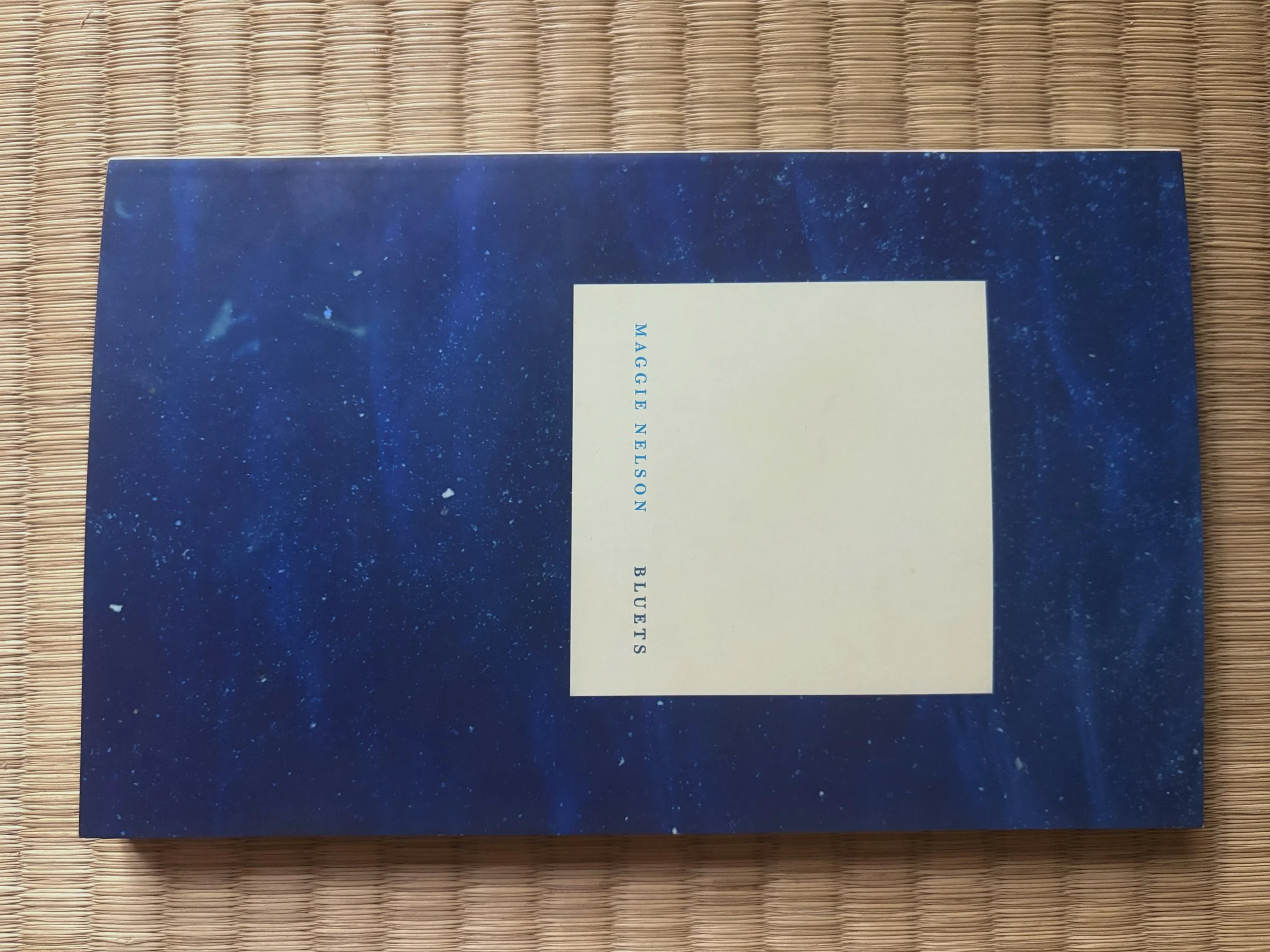
Bluets by Maggie Nelson: Assertion Without Demonstration
Bluets arrives numbered like a philosophical treatise—240 propositions, Wittgensteinian in architecture if not in execution. The form promises systematic inquiry into blueness across its perceptual, historical, and emotional registers. What it delivers is closer to a personal encyclopedia assembled by mood, where chromatic observation, erotic memory, and borrowed aphorism accumulate without quite cohering into argument.
The fragmented structure invites an obvious comparison: Barthes's A Lover's Discourse, where discontinuity is not a formal weakness but the argument itself: each fragment performing the broken, recursive logic of desire. Nelson attempts something structurally similar, but where Barthes makes the form do genuine philosophical work, she allows it to become permission for association without pressure. The gaps between propositions in Bluets are filled not by productive silence but by mood, and the accumulation that results feels less like a method than an evasion of one.
Her central gamble—that desire and grief and color are not merely analogous but continuous, that to be saturated by blue is structurally akin to being undone by a person—is not without interest. But she repeatedly asserts this identity rather than demonstrating it, and the prose rarely applies enough pressure to make the connection feel inevitable rather than wished for. The rawness she cultivates is perhaps deliberate, and it occasionally disarms; more often, it reads as tonal inconsistency, sentiment dressed as vulnerability.
And yet, one sentence justifies the read. "Blue is something of an ecstatic accident produced by void and fire." It does what the surrounding 239 propositions largely cannot—it stands alone, compressed and cosmologically serious, carrying both the theological weight of ecstasis and the materialist logic of color's physical origins. It needs no apparatus. That Bluets can reach this register at all makes its more indulgent passages harder to forgive, and its missed potential the more acute.
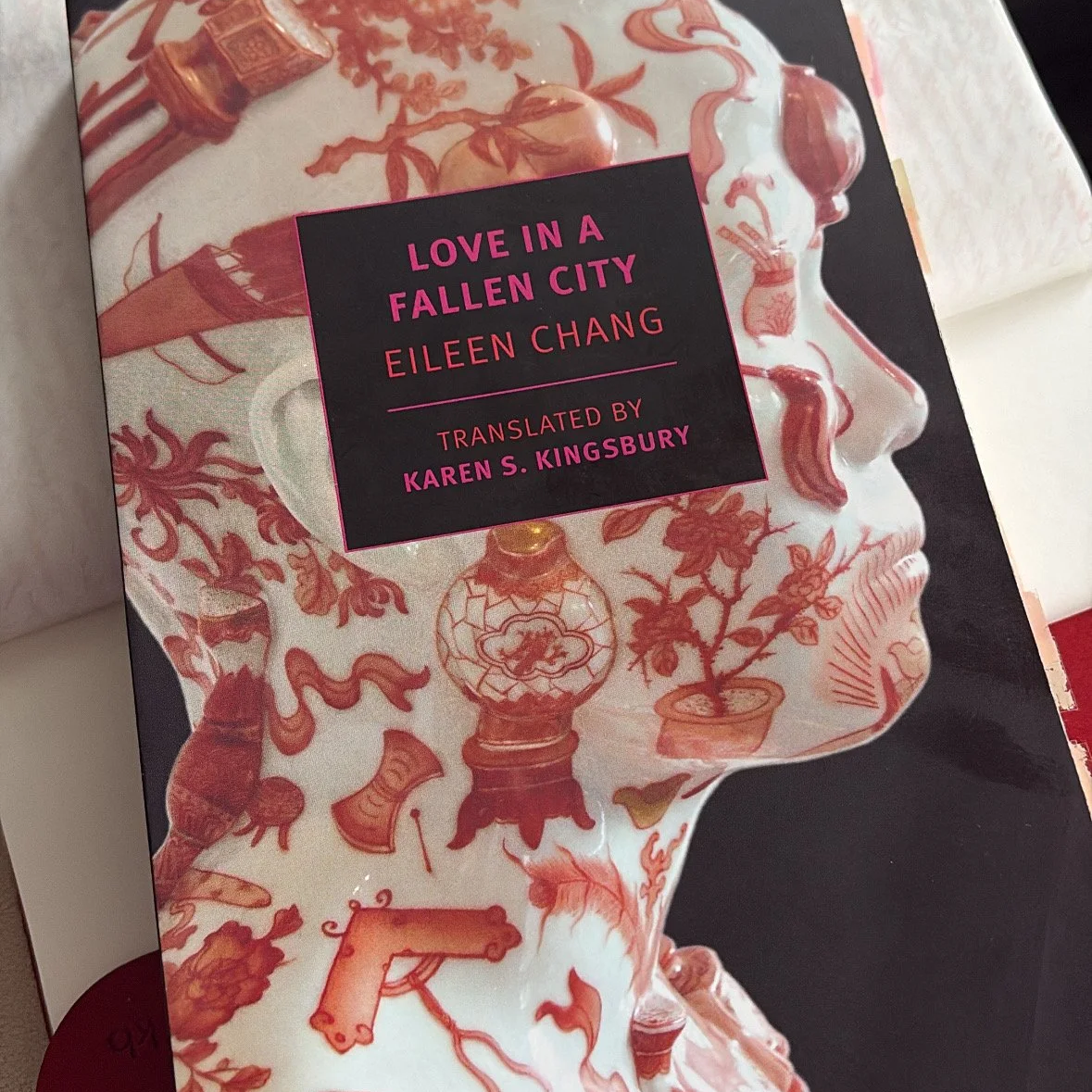
Beautiful and Unreal: On the Weight of Surfaces in Eileen Chang's Love in a Fallen City
Eileen Chang, Love in a Fallen City. Translated by Karen S. Kingsbury. NYRB Classics.
There is a kind of prose that does not announce its intelligence. It does not reach for abstraction, does not pause to explain its own moves. It simply observes, with such precision, such calibrated attention, that the observation itself becomes argument. Eileen Chang writes this way. Her sentences are spare without being thin, lyrical without being indulgent, and encyclopaedic in the way that only writing rooted in genuine social knowledge can be: not the encyclopaedia of research, but of having looked, very carefully, at the world one has actually lived in.
Love in a Fallen City, the NYRB Classics collection of Chang's short fiction translated by Karen S. Kingsbury, gathers the stories she wrote in her twenties in occupied Shanghai: stories set between Shanghai and Hong Kong, two cities she knew from the inside. They are, on the surface, stories about women: about desire and marriage, about the economic logic of love, about the gap between what a woman knows and what she is able to do with that knowledge. But Chang is not a polemicist. She does not argue. She sets a stage, teaches you its rules, its social grammar, its unspoken hierarchies, and then lets you watch what happens when people try to live inside those rules with full human feeling. The tragedy is never announced. It accumulates.
Before Chang begins a story, she builds a world. The outfits, the apartments, the particular social rituals of a dinner party or an afternoon visit: these are not background detail but the primary matter of her fiction. They tell you who has power and who is performing it, who belongs, and who is calculating their belonging. In "Aloeswood Incense: The First Brazier," Weilong arrives in Hong Kong from Shanghai as an outsider to the colony's social world, and Chang uses her unfamiliarity as a precise narrative instrument: we learn the rules of this world at exactly the pace Weilong does, which means we understand the trap at the same moment she does. Not before. Not after. This is one of Chang's characteristic methods, the staging of social knowledge as a form of dramatic irony that is never quite irony, because the reader is too implicated in the world being constructed to stand outside it.
What makes Chang exceptional is that she can move from the design on a matchbox to the wet streets of Hong Kong to the precise interior of a woman's longing, and the transition feels not like a shift in register but like the natural continuation of a single attention. The material world and the inner life are not separate territories in her fiction. They are the same territory. A woman's skin, the cut of her sleeve, the way she carries herself entering a room: these carry meaning in Chang's prose the way gesture carries meaning in life, immediately, legibly, and beyond the reach of what any of the characters can quite articulate. Anne Anlin Cheng's Ornamentalism offers a useful framework here: Cheng argues that the Asian female body in colonial modernity was constituted as surface, as ornament, readable, decorative, perpetually available for the gaze of others, and that this ornamental logic shaped not only how such women were seen but how they learned to inhabit themselves. Chang's fiction does not illustrate this argument. It precedes it. Her women are acutely, exhaustingly conscious of how they appear, how they are read, what it costs to be beautiful, and what it costs more to stop being.
The bonsai comes to mind, though Chang never uses the image herself. Her women are pruned and shaped to resemble something full-grown, exquisitely formed, socially legible, aesthetically compelling, without ever being permitted to grow to their natural capacity. Their beauty is inseparable from their containment. Yet Chang refuses to make victims of them. They are agents within their constraints, sometimes brilliantly so.
Liang Tai-tai, Weilong's aunt in "Aloeswood Incense: The First Brazier," is perhaps Chang's most precise portrait of what female sovereignty looks like when the only available field is a constrained one. She is regal, coiffed and bejewelled, untouchable by the travails of life, moving through her own household with the composure of a woman who has long since secured her domain. That composure is the achievement. It is the visible proof of calculations made early and clearly: that beauty is a depreciating asset, that sentiment is a liability, that independence must be purchased, and the price is a certain willingness to be ruthless about how you live. She is not a villain. She is a woman of the world who has played the only game available to her with exceptional skill and won. What Weilong finds both repellent and, gradually, impossible to dismiss is the recognition that her aunt's logic is not wrong. That is the horror, not of corruption, but of comprehension.
And everyone in this world comprehends. Chang's women calculate. Her men calculate too. What makes her vision so unsparing is that the terms of the transaction are fully visible to all parties, and the transaction continues regardless. There is no innocence to appeal to, no revelation that might change the arrangement. In the title story, Liuyuan and Bai Liusu circle one another with an awareness so complete that their negotiation reads almost as a form of respect: two people of equal intelligence and unequal leverage, playing a game both of them can see. The tragedy is not that one deceives the other. The tragedy is that clarity, in Chang's world, is no protection against anything.
Chang is an associative thinker, in the manner perhaps of Proust and Dostoevsky, and she anchors abstract states to the concrete particulars of a life: the smell of a room, a fabric discontinued, the way afternoon light falls on a particular street in a particular city in a particular decade. Her nostalgia is vivid without being sentimental. She evokes the Shanghai of the 1930s and 40s and the Hong Kong of the colonial moment not as lost paradises but as fully inhabited worlds, rendered through the grain of daily life, in which everything is already in the process of becoming something else. Adolescent infatuation is sketched in a few deft strokes but with alarming accuracy. The specific ache of wanting someone's attention while knowing, clearly, that you should want something else: Chang maps this with the kind of precision that reads less like fiction than like recognition.
What she understands with particular sharpness is how capitalism and the natural world are woven into the same fabric in her fiction. A tiled floor, a bolt of imported fabric, the sound of rain on a shophouse roof: all carry the same aesthetic charge. There is no romantic outside in Chang's prose, no nature untouched by the commodity logic that governs her characters' lives. Beauty is never innocent in her fiction. It is always already entangled with economics, with power, with the specific history of who gets to be beautiful and what that beauty costs and earns. And yet she renders that entangled beauty with full feeling—and this is what prevents her from being merely a satirist. The wet streets are genuinely beautiful. The clothes are genuinely lovely. Chang does not ask you to refuse the pleasure of surfaces. She asks you to see, at the same moment, what those surfaces are doing.
She belongs with Austen in her acerbic social intelligence, with Eliot in the generosity and density of her descriptive prose. But Chang goes somewhere neither of them quite reaches. Austen's irony still contains the possibility of the right marriage as genuine resolution. Eliot mourns foreclosed potential but retains something ameliorative in her grief. Chang removes the amelioration. Her world does not offer a better arrangement just around the corner. The plight of women in these stories is not a problem awaiting a solution but a structure, woven so thoroughly into the texture of daily life that it has become, for her characters, simply the condition of being alive. You can see it clearly. You can name it precisely. You can watch it operating on you in real time. None of this exempts you from it.
To read Eileen Chang is to encounter a writer who did not write about this condition from the outside, theorizing it at a safe critical distance. She wrote from inside it, with the knowledge that comes from having lived inside a particular social skin, from having been, herself, a woman of exceptional intelligence in a world that knew exactly what to do with female beauty and had far less use for female intelligence. That knowledge is in every sentence. It is why the prose feels, even now, less like historical fiction than like a hand placed on your arm: a gesture of recognition, from someone who has already been exactly where you are standing.

Pruned Memory and Miniaturized Life in Bonsai
Bonsai by Alejandro Zambra, Fitzcarraldo Press
"On those nights, the bedroom turned into a self-driving bulletproof carriage feeling its way through a beautiful and unreal city." — Bonsai
This sentence was the single most beautiful and memorable line I encountered in Bonsai by Alejandro Zambra. It reads like a metaphor for youth itself: reckless and vital, hurtling forward with no particular destination, seemingly impervious to the cares of the world. Yet youth, like a summer night, is fleeting. The carriage keeps moving, but eventually the illusion of invulnerability collapses.
The novella announces its ending in the very first sentence. By doing so, Zambra shifts the axis of the narrative away from suspense and toward emotional tension. What matters is not what happens, but how individuals arrive at loneliness, disillusionment, performance, and the quiet erosion of intimacy.
Emilia and Julio are introduced almost arbitrarily, as though their names themselves are character templates. Zambra is not concerned with specificity in the conventional realist sense. What he constructs instead is a portrait of two people who could be anyone—lives shaped by aesthetic performance, failed intimacy, existential drift, and emotional isolation: the recognizable contours of postmodern existence.
Unlike Sweet Days of Discipline, Bonsai never grants us access to its emotional interior. This may be because Zambra privileges ideas over psychological immersion. His characters often function less as fully embodied individuals and more as vessels through which philosophical and literary questions are explored. The emotional distance of the novella feels deliberate. The third person narration maintains a wry, consistent distance—we observe Julio and Emilia rather than inhabit them. Julio and Emilia rarely experience themselves directly; instead, they mediate themselves through literature, through aesthetic rituals, through performance. Their intimacy is real but filtered. They love through books, through references, through shared acts of reading.
Their reading sessions reveal literature functioning as a social instrument. It becomes camouflage, seduction, confession, and vulnerable intimacy all at once. Through books, they construct versions of themselves. They learn not only how to perform identity within the world, but also how to perceive the world through the diaphanous lens of literature.
The novella unfolds like a lucid fever dream composed of fragmented vignettes. Divided into five sections, Bonsai subtly echoes the five-act structure of classical drama, yet it refuses traditional dramatic chronology. Rather than exposition, climax, and catastrophe, the sections mirror stages of human life itself: youth, emotional formation, adulthood, memory, and decline. The narrative does not escalate so much as attenuate. Life is not dramatized but pruned.
This pruning becomes central to the philosophical architecture of the novel. The prose is elliptical and recursive, circling memory rather than progressing cleanly through it. The presence of In Search of Lost Time by Marcel Proust within the novella is therefore deeply significant. If Proust expands memory into monumental scale, Zambra performs its inversion. Bonsai miniaturizes memory. What might have become a sprawling four-hundred-page novel is instead a work of lapidarian compression. Yet both writers are concerned with the same impossible task: recovering life through art.
Zambra deepens this recursion by folding his own novella back on itself. His Bonsai concerns two lovers whose relationship is compressed into miniature literary form; Julio, in turn, writes his own novel titled Bonsai, likewise centered on two lovers. The mirroring is deliberate and destabilizing. Julio unconsciously replicates the very structure that contains him. In doing so, Zambra suggests that stories reproduce themselves across lives and texts, each version becoming a pruned reflection of another.
The effect is almost vertiginous. The reader encounters a novel about a man writing a novel that resembles the very novel being read. This recursive doubling reinforces one of the novella's central anxieties: that literature may never be fully original, but instead emerges from endless acts of repetition, imitation, memory, and transformation.
Julio's novel is not born from pure invention. It emerges from fragments. It is an amalgamation of his memories of Emilia, and the vague literary premise mentioned to him during his interview for a transcription job. This associative tension reaches one of its most ironic expressions through "Tantalia," which is both the name of the second part of the novella as well as a fictional story discussed within it, attributed to Macedonio Fernández. In the story, a couple purchases a plant to symbolize their love, only to realize that when the plant dies, their love will die as well. Julio and Emilia, while together, reject the story out of fear that the same fate awaits them. Ironically, none of the intimacies they experience throughout their lives prove more enduring than an ordinary plant. Somehow, this residual influence of "Tantalia" makes its way into Julio's Bonsai.
Julio's work is therefore assembled from borrowed ideas, remembered intimacies, and emotional residue and his attempt to write Bonsai becomes part of this recursive structure. The novel folds back into itself, blurring the boundary between lived experience and authored narrative. Writing becomes an act of self-construction: a way of remembering, reshaping, and re-inhabiting the intimacies and selves that have already vanished.
This lack of originality troubles Julio. The finished novel never feels entirely his own, and he seems unable to take genuine pride in it. Yet this anxiety surrounding authorship becomes central to the novella's meditation on literary identity. Can a work assembled from imitation, memory, and fragments still possess authenticity? Julio's work is therefore deeply mimetic—assembled from borrowed ideas, remembered intimacies, and emotional residue, it suggests that all acts of writing inevitably emerge from prior texts, prior loves, prior selves.
The metaphor of the bonsai gains yet another layer. Dissatisfied with the novel and unconvinced of its authenticity, Julio turns to cultivating a bonsai as he recognizes that the two acts are fundamentally alike. Both require patience, shaping, restraint, and deliberate reduction. Both involve pruning excess to preserve form. Neither creates life from nothing; instead, each disciplines existing material into something fragile, miniature, and controlled.
What Julio does not yet know is that Emilia has already died. When he learns of her death, he does not return home to the bonsai that has not yet seen the light of its first day. The gesture that was meant to mirror writing and love—patient, preserving, deliberate—is abandoned at that moment, displaced instead by a very long taxi ride home. It is possibly the novella's quietest and most devastating image of existential futility: a life tended in miniature, perhaps left to die before it ever fully begins.
The bonsai performs a dual task. As a plant, it outlives love—inverting the logic of "Tantalia," where the plant and love were fated to die together. As a novel, Bonsai paradoxically preserves the very love it could not sustain in life. It did not last in Julio's life but it certainly did through his novel, Bonsai—albeit pared down and miniaturized into art.
The novella's final image returns us to the carriage of this essay’s opening. Julio spends his last thirty thousand pesos on a taxi ride to nowhere—no destination, no music, no answers. The reckless, vital momentum of youth has become pure directionless motion. And perhaps that is the quiet tragedy at the heart of Zambra's novella: that memory, literature, and love all attempt to preserve life while inevitably reducing it in the process.
Annotations: A System for Reading with the Hand
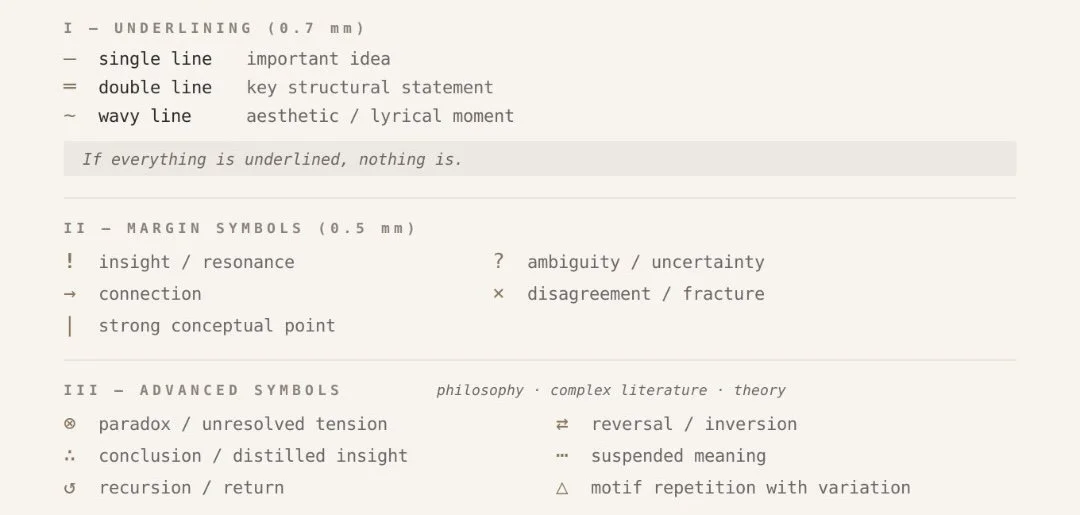
my annotation system
note: a download link is available at the end of the piece.
Some notes on a pencil-based annotation practice — what it marks, what it withholds, and why restraint is the point.
Sticky tabs are not enough. They mark that something mattered without recording why, and after a while the book becomes a forest of coloured flags with nothing behind them.
It took a long time to understand that the deeper problem with annotation was not a lack of system — it was too much eagerness. The impulse to mark everything that catches the eye, to make visible every flicker of recognition. The page becomes a mirror of attention rather than a record of thought. What you are left with is not a reading; it is a performance of reading. Most systems err toward comprehensiveness. This one does not.
The system I use now began from a different premise: that marking should be active thinking, not passive response. That the hand should serve understanding, not document enthusiasm. Two pencils, a small set of symbols, and a principle about silence. The marks matter less than the decision not to mark. The aim is to annotate efficiently, but also emotively — to move through a text without thinking about the system, and still come out the other side having thought.
What follows is the system as I practice it — written out for anyone who finds themselves with a similar problem: too many underlines, not enough thinking.
Tools
What Goes in the Hand
I — Underlining (0.7 mm)
Attention Anchor
Use sparingly.
| ― | single line — important idea |
| ═ | double line — key structural or thematic statement |
| ~ | wavy line — aesthetic or lyrical moment |
If everything is underlined, nothing is.
II — Margin Symbols (0.5 mm)
Instant Thinking
Core set only.
| ! | insight / resonance |
| ? | ambiguity / uncertainty |
| → | connection — within or across texts |
| × | disagreement / fracture |
| | | strong conceptual point |
III — Advanced Symbols
For Dense Texts Only
Reserve for philosophy, complex literature, theory.
| ⊗ | paradox / unresolved tension |
| ⇄ | reversal / inversion |
| ∴ | conclusion / distilled insight |
| ⋯ | suspended meaning / intentional openness |
| ↺ | recursion / return |
| △ | motif repetition with variation |
IV — Reading Arc
Chapter-Level Tracking
At chapter start — top corner, 0.5 mm
| → | development |
| ↺ | return / recursion |
| ⊗ | tension introduced |
| ⋯ | ambiguity dominant |
At chapter end — 2 to 4 lines maximum
| Ask: | What changed? |
| What stayed unresolved? | |
| What stood out? |
V — Text Types
Switching Modes
Literary Fiction
feeling in motion
Philosophy / Theory
argument structure
Hybrid / Essays
translation between modes
VI — Global Rules
The Most Important Part
- Not every page needs annotation
- Silence is part of meaning
- Do not over-symbolise
- Prefer fewer, sharper marks
- Let some ideas remain unmarked
VII — Two-Pencil Logic
The Actual System
0.7 mm
Structure Layer
- underlining
- chapter markers
- emphasis
0.5 mm
Thinking Layer
- symbols
- marginal notes
- arc tracking
You are not marking everything you understand.
You are marking what changes how you understand.
A printable annotations key card is available above for reference.