Tarjei Vesaas's The Birds: On the Sovereignty of the Inarticulate
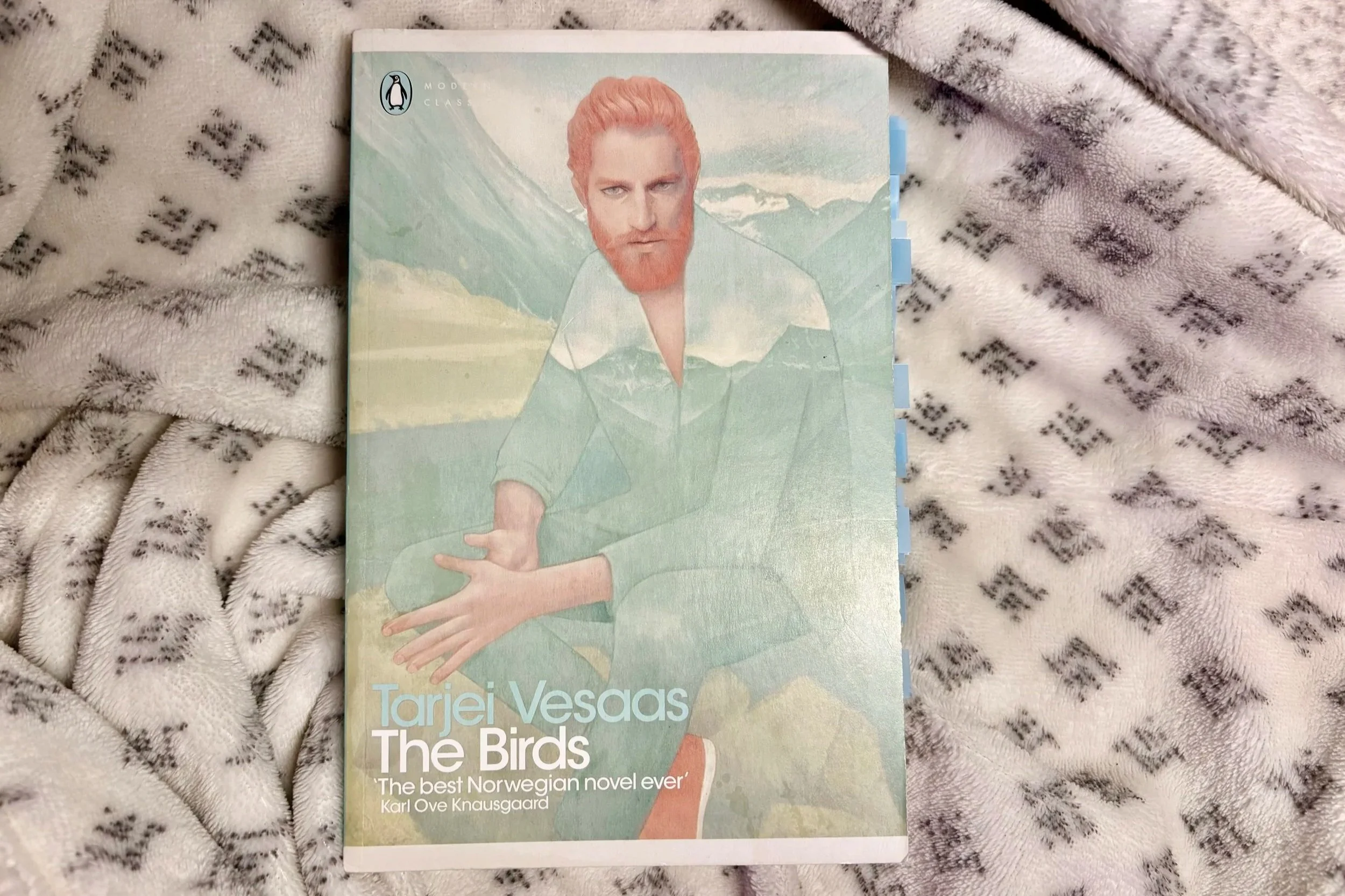
There is a bird that flies over Mattis only once. He watches it cross the sky above the forest, and something shifts in him permanently: a visitation, a sign, though a sign of what he cannot say. This is Mattis's condition: to receive meaning in full, and to be unable to pass it on. The world arrives to him as pure significance, continuously, and he stands inside it the way a person stands inside a cathedral, aware that something is being said, undone by the not-quite-knowing of what.
The woodcock comes and goes by a path only Mattis can see. Between them, there is a language without words, which is to say, the only language Mattis has ever been fluent in. When the bird is shot by a young fowler passing through, it dies in Mattis's hands. But before it goes, it looks at him. Vesaas renders this moment with a quietness that is almost unbearable: in the bird's dying gaze, there is recognition, the acknowledgement of equals, of two creatures who have understood each other across the silence that separates all living things. It is the most intimate moment in the novel. It is also the saddest, because we understand, as Mattis perhaps does not fully, that this is the only such moment he will ever have.
He tells Hege, his sister, that the bird was sovereign. That it belonged to itself. In a novel full of things Mattis cannot say, this is perhaps the most precise thing he ever articulates, and he articulates it about a bird, because the world of humans has never offered him the vocabulary to say it about himself.
To read Mattis is to be in the presence of a particular kind of mind, one that Wordsworth would have recognised, if not been able to explain. Wordsworth understood that there are human beings for whom the natural world is not backdrop but address, not scenery but interlocutor. His poets and wanderers move through landscape as though it speaks directly to them, bypassing the mediating apparatus of culture and education, and social legibility. Mattis is such a figure, but where Wordsworth's visionaries eventually find their tongue, find the spots of time, find the poem waiting on the other side of experience, Mattis finds only the experience itself, complete and entire, with no passage out into language. He is Wordsworth in a body and mind that the world has decided are wrong: a bear, one might say, since bears, too, have been observed to pause before a landscape, to sit with the beauty of a thing without needing to consume or explain it. The perception is intact. Only the translation is missing. And what is lost in that missing translation is not meaning but mediation: Mattis's relationship to beauty is not naïve or diminished but prior, more elemental, less processed by the apparatus of culture that both enables and falsifies articulation. He perceives before he can name, and the naming never comes, and so the perception remains raw and renewable in a way that is both gift and wound.
And this missing translation is not a deficiency in Mattis. It is a deficiency in the available language. What Mattis sees and feels is not less than what a poet sees and feels; it may in fact be more, because it is unmediated, unprocessed, still raw with the newness of first encounter. Every morning, the world remakes itself for him. Every bird, every ripple on the lake, every exchange with another person arrives with the freshness of something never seen before. This is the child's relationship to reality, not naïve, but prior, before the categories have closed over experience and made it manageable and dull. The cost of this openness is that the pain is equally unmediated. Every small cruelty lands as a first cruelty. Every exclusion is felt with the full force of something that has never happened before, because for Mattis, it never has.
The village Mattis inhabits has no place for a man who cannot be measured in labor. This is not cruelty so much as structure: the community organises itself around what a person can produce, carry, build, and bring in from the fields. Value is transactional, legible, and exchangeable. And Mattis, who can read the flight path of a woodcock with the precision of a scholar, cannot split wood without making a spectacle of his own inadequacy. His body, which is an instrument of such delicate perception, is useless in the economy that surrounds him. This is his particular humiliation: not that he is unloved, but that love in this world is inseparable from utility, and he has none to offer.
What makes Vesaas's rendering of this so devastating is its subtlety. Mattis is not openly mocked. He is managed. The exclusions are quiet, the condescensions gentle, the transactions conducted with a politeness that is somehow worse than contempt because it refuses him even the dignity of acknowledged conflict. Vesaas enacts this formally: at the moments of highest tension, when an exchange between Mattis and another person reaches its emotional crescendo, the dialogue is cut. The scene ends. We are returned to Mattis's interior, bruised and bewildered, unable to reconstruct exactly what just happened or why it hurts as much as it does. This is not a narrative accident. It is the novel's most precise formal decision, to place the reader inside Mattis's experience of the world's withdrawals, to make us feel the truncation rather than merely observe it.
Hege loves him. This is never in doubt. But love, too, operates within the structures available to it, and the structure available to Hege and Mattis is one of dependency: she works, she provides, she manages the world on his behalf, and Mattis knows this with a clarity that torments him. His pride is not vanity. It is the last sovereign territory he possesses. To be kept by his sister is to be reduced, in the village's economy of worth, to something less than a man. And Mattis, who declares a woodcock sovereign, who understands instinctively that every living thing belongs to itself, cannot bear the arithmetic that makes him belong to someone else's labour and patience and love.
Jørgen arrives the way the world always arrives for Mattis: without warning, without the courtesy of preparation. He comes across the lake, which has always been Mattis's territory, his one domain of competence and peace. The oars are Mattis's instrument, their motion clean, linear, traceable, leaving marks on the water that are legible even as they dissolve. There is order in rowing. There is a correspondence between effort and result that the rest of Mattis's life refuses him. On the lake, he makes sense.
Jørgen carries an axe. This is not incidental. Where the oar moves through a yielding element, tracing its passage in soft parallel lines, the axe meets resistance and splits it. It is an instrument of rupture, of the non-linear, of force applied to a world that does not give way gracefully. Jørgen is competent in all the ways that matter to the village: he works, he builds, he provides. And so he replaces him. Not violently, not even unkindly, but with the quiet totality of the inevitable. Jørgen's axe displaces Mattis's oar. The linear world that Mattis has carefully, painstakingly inhabited, the world of repetition and order and things that mean what they appear to mean, is supplanted by a world that moves in a different rhythm entirely, one whose logic Mattis cannot follow or anticipate.
What happens to Mattis after Jørgen's arrival is a kind of diminishment that the novel renders with almost unbearable precision. He is not cast out. He is made peripheral, which is worse, because it happens inside the home he has always shared with Hege, in the relationship that has been the one constant of his life. Hege and Jørgen do not mean to reduce him. They are simply living, making a life together, and Mattis has no place in its grammar. He is managed again, as the village has always managed him: with gentleness, with patience, with a care that does not see him. He is spoken to as one speaks to a child, and Mattis, who has always understood more than he can say, understands this too. The man who declared a woodcock sovereign is treated as though he cannot be trusted with his own fate.
And so he lashes out, in the only register available to him: not argument, not confrontation, but gesture, symbol, the language of the body and the natural world that has always been his mother tongue. He swallows red toadstools; he courts danger with the desperation of someone who has run out of other ways to be seen. These are not the actions of a man who has lost his reason. They are the actions of a man who has lost his only audience, who has realised that the one person whose recognition sustained him can no longer see him clearly, because another person now stands between them.
There is a moment in Tolstoy’s Anna Karenina when Anna steps toward the train, and Tolstoy tells us she does not want to die. This is the sentence that changes everything about how we read her ending: not as self-destruction but as the last available form of self-assertion. She has been made invisible by the world's withdrawal of recognition, by Vronsky's cooling attention, by a society that has closed its doors so completely that she can no longer locate herself in anyone's gaze. The train is not chosen. It is what remains when every other form of being seen has been exhausted.
Mattis goes to the lake the way he has always gone to it—toward the one realm that has never found him wanting, never measured him against a standard he could not meet. Nature has always been his true home. The woodcock knew him there. The water knows him there. In the natural world, he is not inept or burdensome or peripheral; he is simply a living thing among living things, received without condition.
But this time the lake is also a gamble. What Mattis wants, beneath the gesture, is to survive it—to return to Hege having almost not returned, and in that almost, to reinstate what Jørgen's arrival has quietly erased: his own irreplaceability. He places his life in nature's hands because he cannot bear to place it in his own or in theirs. He knows he may not come back. He accepts this the way one accepts the terms of a wager one cannot afford not to make. But he desperately, privately, wants to live. Nature is the only force he trusts enough to decide.
This is what separates him from Anna Karenina and makes his ending in some ways more heartbreaking than hers. Anna steps toward the train with the terrible finality of someone who has exhausted every door. Mattis steps into the lake still hoping. The gamble is still open. He has not given up on being seen—he has made one last, ruinous bid for it, and entrusted the outcome to the only world that has ever been kind to him.
But Vesaas does not let us rest in this. The tragedy is not only that Mattis dies. It is that Hege, like Vronsky, will misread what has happened, will grieve without fully understanding what she has lost, or what her life with Jørgen cost Mattis. She will never know that in his last act, Mattis was thinking of her completely, staking everything on her love. The beloved always misreads the final act because the final act is written in a language they were never fluent in. Mattis spent his whole life trying to be understood by someone who loved him and could not quite reach him. In the end, he makes one last statement in his own tongue, and it will be received, as everything he ever said was received, imperfectly, from a distance, through the distorting medium of a world that had already decided what he was.
This is the sorrow that does not lift. Not the death itself, but the gap it reveals: the space between two people who love each other and cannot, finally, speak the same language. Mattis knew this gap better than Hege did. He lived inside it his whole life. The woodcock knew it too, in those last moments in his palm, and looked at him anyway, equal to equal, sovereign to sovereign, before the silence came.