Annotations: A System for Reading with the Hand
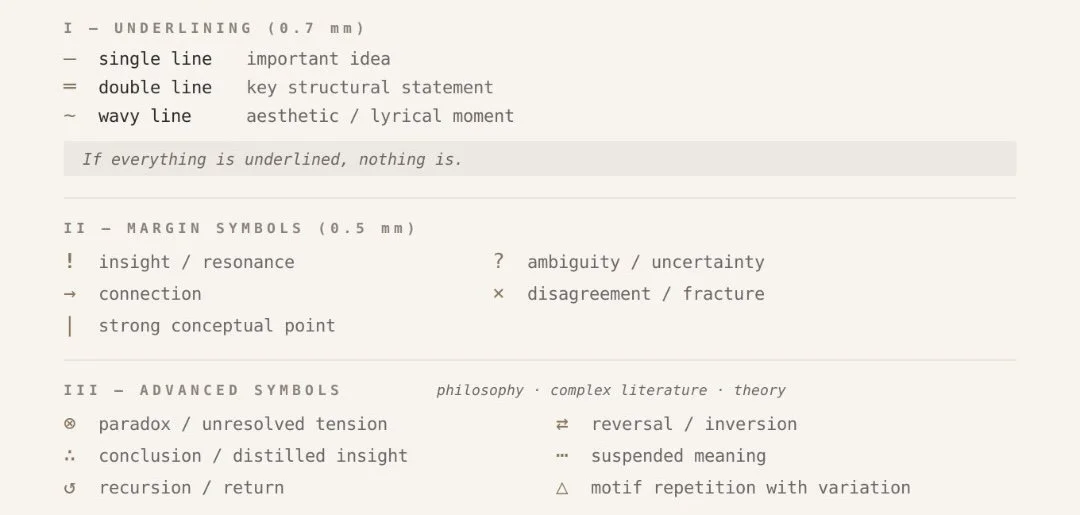
my annotation system
note: a download link is available at the end of the piece.
Some notes on a pencil-based annotation practice — what it marks, what it withholds, and why restraint is the point.
Sticky tabs are not enough. They mark that something mattered without recording why, and after a while the book becomes a forest of coloured flags with nothing behind them.
It took a long time to understand that the deeper problem with annotation was not a lack of system — it was too much eagerness. The impulse to mark everything that catches the eye, to make visible every flicker of recognition. The page becomes a mirror of attention rather than a record of thought. What you are left with is not a reading; it is a performance of reading. Most systems err toward comprehensiveness. This one does not.
The system I use now began from a different premise: that marking should be active thinking, not passive response. That the hand should serve understanding, not document enthusiasm. Two pencils, a small set of symbols, and a principle about silence. The marks matter less than the decision not to mark. The aim is to annotate efficiently, but also emotively — to move through a text without thinking about the system, and still come out the other side having thought.
What follows is the system as I practice it — written out for anyone who finds themselves with a similar problem: too many underlines, not enough thinking.
Tools
What Goes in the Hand
I — Underlining (0.7 mm)
Attention Anchor
Use sparingly.
| ― | single line — important idea |
| ═ | double line — key structural or thematic statement |
| ~ | wavy line — aesthetic or lyrical moment |
If everything is underlined, nothing is.
II — Margin Symbols (0.5 mm)
Instant Thinking
Core set only.
| ! | insight / resonance |
| ? | ambiguity / uncertainty |
| → | connection — within or across texts |
| × | disagreement / fracture |
| | | strong conceptual point |
III — Advanced Symbols
For Dense Texts Only
Reserve for philosophy, complex literature, theory.
| ⊗ | paradox / unresolved tension |
| ⇄ | reversal / inversion |
| ∴ | conclusion / distilled insight |
| ⋯ | suspended meaning / intentional openness |
| ↺ | recursion / return |
| △ | motif repetition with variation |
IV — Reading Arc
Chapter-Level Tracking
At chapter start — top corner, 0.5 mm
| → | development |
| ↺ | return / recursion |
| ⊗ | tension introduced |
| ⋯ | ambiguity dominant |
At chapter end — 2 to 4 lines maximum
| Ask: | What changed? |
| What stayed unresolved? | |
| What stood out? |
V — Text Types
Switching Modes
Literary Fiction
feeling in motion
Philosophy / Theory
argument structure
Hybrid / Essays
translation between modes
VI — Global Rules
The Most Important Part
- Not every page needs annotation
- Silence is part of meaning
- Do not over-symbolise
- Prefer fewer, sharper marks
- Let some ideas remain unmarked
VII — Two-Pencil Logic
The Actual System
0.7 mm
Structure Layer
- underlining
- chapter markers
- emphasis
0.5 mm
Thinking Layer
- symbols
- marginal notes
- arc tracking
You are not marking everything you understand.
You are marking what changes how you understand.
A printable annotations key card is available above for reference.