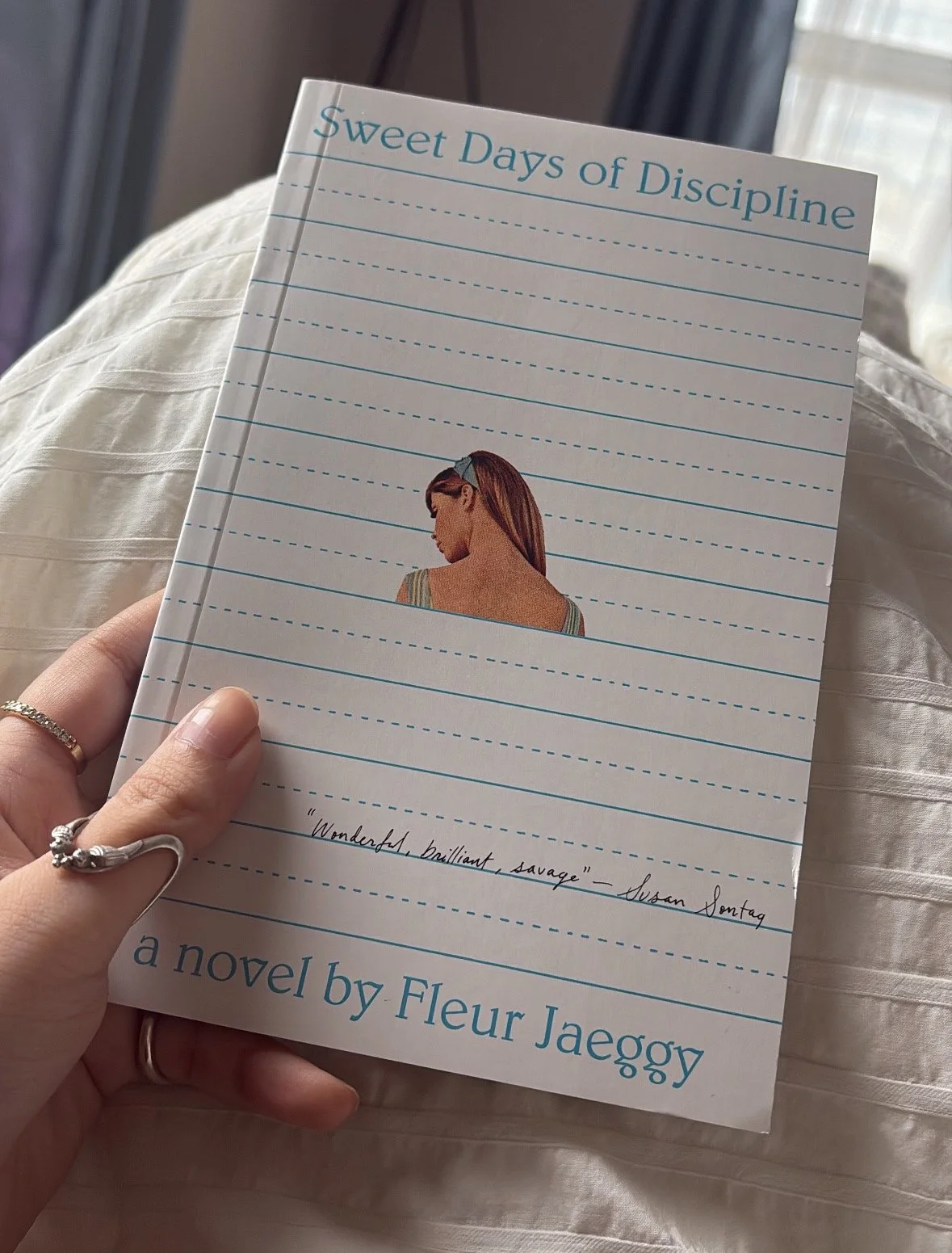
The Architecture of Worship: On Fleur Jaeggy's Sweet Days of Discipline
There is a particular kind of longing that does not announce itself. It does not arrive with the vocabulary of desire or the grammar of need. It exists, instead, as a condition: something load-bearing, something that holds the self upright precisely because it has nowhere to go. Fleur Jaeggy's Sweet Days of Discipline is a book written entirely inside this condition, and it is one of the most formally perfect articulations of it that I have encountered.
The novel is set in a Swiss boarding school in the 1950s, and its narrator is a girl in the grip of an obsession she will never name as such. The object of that obsession is Frédérique—precise, austere, magnificently indifferent to the world of other people—and the narrator's relationship to her is organized around a paradox that Jaeggy never resolves, because resolution would be a kind of lie. The closer the narrator draws to Frédérique, the more sacred the distance between them becomes. She has placed Frédérique on a pedestal so high, has consecrated her so completely, that to reach out and touch her would be to collapse the entire architecture of devotion she has spent herself building. The distance is not withholding. The distance is the worship.
This is what makes Jaeggy's prose so difficult to describe without diminishing it. The clinical detachment of the narrator's voice is not coldness. It is the form that adoration takes when it has been compressed beyond the point of expression: when all the unthought thoughts, the unverbalized feelings, the unrealized possibilities have been folded so tightly inward that they can no longer be distinguished from the self that contains them. The restraint in these sentences is pressurized. You feel the weight of everything being withheld, and that weight is the book's emotional center.
Jaeggy does not write sentences that expand to accommodate feeling. She writes sentences that constrict around it. The form enacts the repression, which means the style is not separable from the subject; they are the same gesture, the same held breath.
Frédérique herself is rendered with a sincerity that stops just short of full knowability, and this too feels right. She is not a projection exactly: she has a genuine soul, fiercely independent, quietly intense, constitutionally uninterested in the adulation of others. She lives at the level of ideas, and the social world around her is simply less real to her than the world of concepts and forms that she inhabits. Her gestures and her way of moving through the school carry an austerity that mirrors the precision of her inner life. She is not cold so much as oriented elsewhere, not withholding, simply looking in a different direction.
This is what makes her tragic in a way she would never feel as loss: not any failure of feeling, but a fundamental difference in orientation. Because the narrator's love was always silent, was never offered, never made itself available to be received or returned. It passed through Frédérique like light through glass. And so when Frédérique leaves, as she must, what the narrator loses is not only a person but the entire structure of selfhood that had been quietly organized around her. An inner architecture, painstakingly built, with no one inside it but herself.
The tragedy runs both ways, even if asymmetrically. The narrator loses the object of her devotion. Frédérique loses the one person who saw her with such consecrated, unwavering attention, and she may never have known or realized she had it. One grieves an absence. The other never learns that there was anything to grieve.
I have been thinking about why Jaeggy's restraint moves me in a way that other formally austere writing does not (like Orbital by Samantha Harvey), and I think it comes down to this: the silence in these pages is not empty. It is full to the point of breaking. There is a difference between prose that is quiet because it has little to say and prose that is quiet because it is holding something so large that any ordinary word would shatter under the pressure of containing it. Jaeggy belongs entirely to the second category. This is writing that knows exactly what it is not saying, and that knowledge vibrates in every omission.
It is, in this way, the literary equivalent of an icon: a surface of perfect composure behind which something vast and incommunicable resides. Which may be why the narrator relates to Frédérique exactly as one relates to an icon: with reverence, with the knowledge that touching would desecrate, with a longing that is most itself when least expressed.
Sweet Days of Discipline is known to be Jaeggy's finest work, and having arrived at it first, I find myself unwilling to rush toward anything else she has written. Some books ask to be held in isolation for a while. This is one of those books. The residue it leaves, that particular quality of pressurized silence, of feeling understood by a voice that barely raises itself above a whisper, is worth preserving, and worth returning to, when you are ready to feel it again.