Kokuho by Lee Sang-il: Art as an Act of Sacrifice and Consecration
There are barely any spoilers in this review.
After a hiatus of a couple of years, here I am, with another review of a film that I watched last night. This was a film that popped up on my Instagram feed as an advertisement, and I was intrigued. It seemed to be a film that had the same kind of emotional depth and grandeur as The Last Emperor and Farewell My Concubine. I don’t think I was wrong.
Kokuho is an aching, beautiful, cinematic epic. Lush with its costumes, dense with an artist's philosophy, and austere with its cinematography, this film pushes one to consider that a worthy artist's body can justly be called a "national treasure" (the title of the film in Japanese) precisely because the body becomes an archive of relentless training, discipline, and the pursuit to carry the tradition forward. At the same time, it also unravels the cultural lineage, the provenance of the tradition, so to speak, through heritage: inheritance through blood, obligation that the spirit of an artist demands, and even sacrifice. The tension between devotion to perfecting one's practice to make it an art form, which entailed a quiet erasure of the self, felt tragic and haunting.
Besides the personal and structural tragedies that occurred over the span of 50 years, my personal favourite Kabuki performance was the “Heron Maiden”, precisely because I see Kikuo (the protagonist) embody that role in his life without him even knowing it until the very end. What the man is to the female heron is what Kabuki theater is to Kikuo. There is a poignant foreshadowing of it in the early stages of the film, and it runs through in the form of fleeting yet tender moments.
The role’s emotional architecture: ephemeral beauty, loneliness, devotion, and ultimately a kind of graceful disappearance mirrors Kikuo’s arc almost eerily. The onnagata tradition already complicates embodiment: a male actor perfects femininity through discipline, not imitation but internalization. By the end, Kikuo does not perform the “Heron Maiden”; he has already lived her condition, poised between artifice and sincerity, visible yet unpossessed by himself.
That’s what makes the foreshadowing so poignant. Those early tender moments aren’t just character beats; they are rehearsals for an identity he will inhabit unconsciously. The tragedy, then, is not that he loses himself, but that he never realizes the exact moment the loss becomes irreversible. The performance reveals the truth of his life only at the very end, when recognition arrives too late to reclaim anything. In that sense, the film’s most haunting idea is that artistic perfection may require a form of ontological surrender: the artist survives, but only as a vessel through which tradition continues breathing.
The film reminded me of this particular chapter on the Noh mask in Laszlo Krasznahorkai's novel Seibo There Below, which explores the intricate, sacred, and meticulous process of crafting a Noh mask and using it as a central metaphor for the search for artistic perfection and the divine (I think that book would be a delightful companion to this film). The Noh mask chapter in Seiobo There Below functions as a metaphysical treatise disguised as craft writing: the mask is not an object but a threshold between the human and the divine, the mortal and the perfected gesture. Kokuho falls squarely within that same metaphysical lineage, where art is not expression but consecration.
What both works seem to suggest is that traditional art, in its most austere sense, is less about originality and more about purification. Each generation sands down idiosyncrasy, accident, ego until what remains is a distilled grammar of movement, voice, and presence that aspires toward something transpersonal. The artist does not invent; the artist refines, transmits, and ultimately dissolves into the form.
That is why the film’s melancholy feels so ethically serious. It refuses the modern myth that great art springs from authentic self-expression. Instead, it posits almost the opposite: greatness may require the gradual evacuation of the self so that the art form, older, heavier, more enduring, can inhabit the body fully. In that sense, the teacher–disciple dynamic becomes less pedagogical and more sacerdotal. Training is initiation; discipline is devotion; lineage is a metaphysical inheritance rather than merely a technical one.
Post viewing, the 50 years that spanned in Kokuho made me wonder what art is in the most traditional sense of the word. What the film visually renders is not simply the making of a master performer, but the forging of a vessel capable of carrying tradition forward. The tragedy is that such a vessel must often be sealed from ordinary human contingencies: intimacy, spontaneity, the freedom to fail or to live outside the role. The very qualities that make the art eternal render the artist fragile, almost ghostlike, within their own life.
The film is just as intense as it is melancholic and forbids any romanticization of the greatness of art or an artist. Sacrifice is a key component for forging something great and everlasting, and art is something much larger and heavier than the individual, an intangible legacy of refinement that is shaped by the crucible of the artist/teacher-artist/disciple dynamic.
And yet, there is also a quiet, unsettling question embedded in both Krasznahorkai’s Seiobo There Below and the film: if the perfected performance transcends the individual, does that transcendence justify the erasure that enabled it? Or is the cost itself the hidden subject of the work: the unspoken residue that gives the beauty its sacredness and ache?
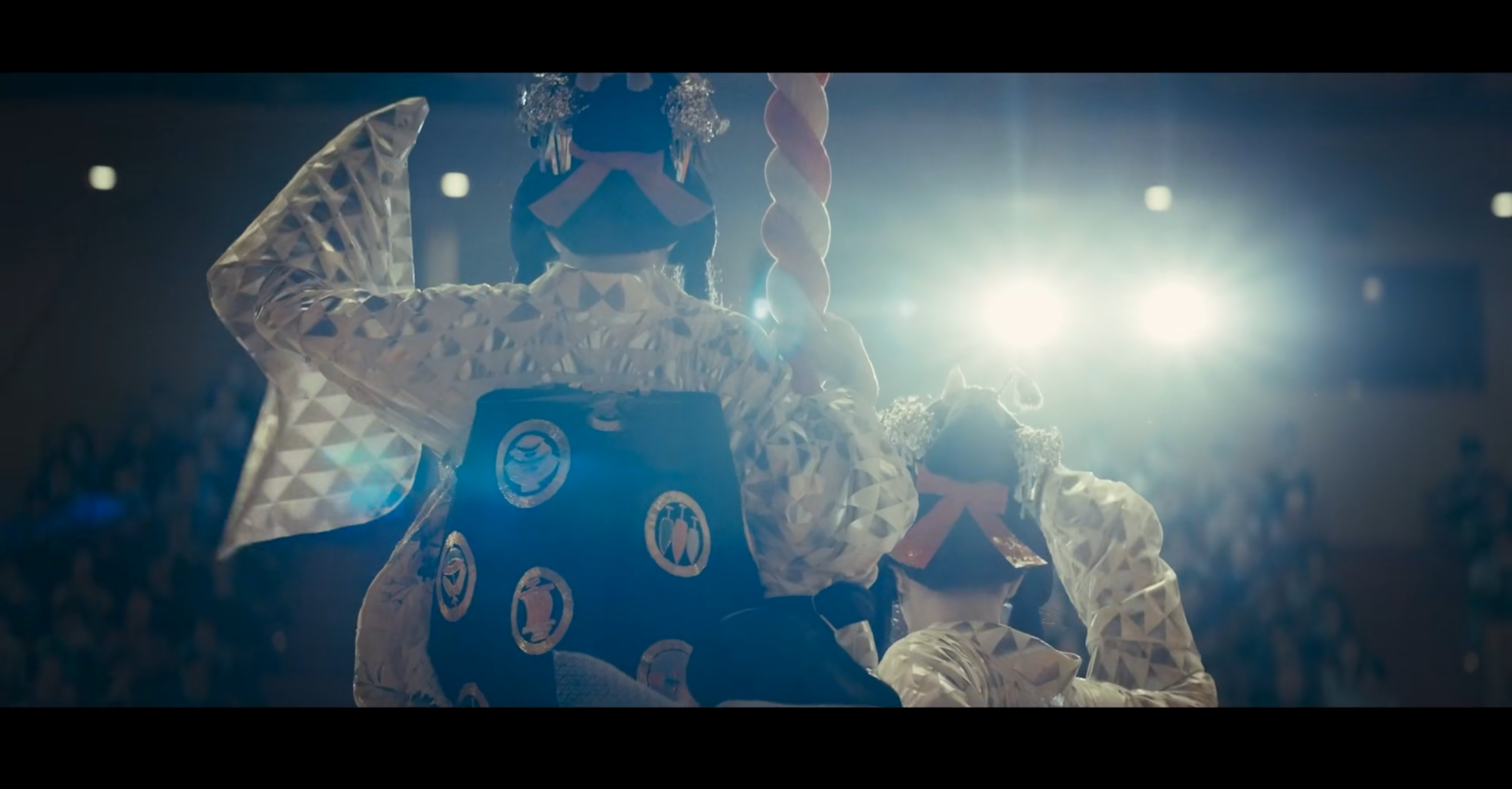
Still from Kokuho