The Aesthetics of Ethical Clarity and Phenomenological Precision in Satyajit Ray’s Devi

A still from Devi
I have often wondered what spirituality means to me, and whether it requires the crutches of religion or any formal structure at all. Lately, I have been exploring and refining my own private understanding of spirituality, observing how it takes shape in the quiet interior spaces of thought and feeling. This inquiry led me back to a film that had lingered in my mind for some time: Devi by Satyajit Ray. The film examines religious dogmatism through a moral and intimate lens. It is luminous, focused, and restrained, yet it does not feel as layered as the cinema of Andrei Tarkovsky, though that may equally be an exposure of my own limitations as a viewer. The ideas of blind faith, religious dogmatism, and the deification of the young daughter-in-law, Doyamoyee (Merciful One), are presented with striking clarity. The film pares everything down to the essentials, and precisely because of this focus, it becomes vivid, arresting, and almost unbearably intimate.
A scene near the end of the film becomes fertile ground for reflection on faith. It invites us to investigate the semantics of belief and faith. Ray illustrates belief as a threshold that still entertains skepticism and seeks proof, whereas faith dispenses with anything that could dismantle its internal coherence. Devi situates these two modes along a spectrum that stretches from skepticism to blind faith and shows how individuals inhabit different positions along it without ever dictating an answer. The film allows this tension to breathe, neither condemning nor endorsing, but quietly observing how fragile and persuasive faith becomes when reinforced by authority and circumstance. It is only at the very end that a definitive moral verdict is passed, yet it sits uneasily within the final image of Doyamoyee running and disappearing into the misty fields.
Yet the film does not urge one to question life itself or the way one lives it, which is why it does not feel as spiritually expansive as Tarkovsky. Perhaps that is precisely why it feels so beautiful and sharp, but also slightly flat to me. This is less a criticism than an admission of my own inclination toward a different kind of cinema. Tarkovsky expands the frame until existence itself becomes the subject, whereas Ray compresses the frame until one specific human situation becomes unbearably clear. Tarkovsky opens outward into the cosmos, while Ray tunnels inward into a moral nucleus. In that sense, Tarkovsky appears to work in the cinema of metaphysical inquiry, while Ray works in the cinema of phenomenological precision. And yet, Ray’s realism does not exclude metaphysical unease; rather, it produces it indirectly, by revealing how ethical distortions emerge within ordinary life.
Ray’s artistic sensibility lies in his extraordinary cinematographic intelligence and his gift for isolating quietly symbolic shots. His deployment of the gaze is particularly fascinating. We witness Doyamoyee through the eyes of others: her father-in-law’s worship, her husband’s helplessness, and her sister-in-law’s skepticism. These shifting perspectives construct her identity more than she does herself. Ray’s use of natural lighting and restrained chiaroscuro heightens these moments of reckoning as Doyamoyee becomes increasingly isolated, both physically and emotionally, from the world around her.
The narrative and psychological progression is scaffolded through Ray’s deep strategic intelligence in camera work. He often bypasses elaborate equipment and heavy rigging, choosing minimal means to preserve realism. There is a quiet ingenuity in this restraint. He moves toward focus rather than scope, pocketing moments where something emotionally significant is unfolding and allowing the viewer to inhabit them intimately, very much like the intimacy one feels in the films of Wong Kar-wai. In this sense, Ray resembles a portrait photographer, capturing interior states and delicate human interactions, while Tarkovsky resembles a landscape photographer, expanding outward into vast spiritual terrains.
Ray is not trying to make us question life itself. He is trying to make us confront one precise human delusion so thoroughly that it becomes undeniable. That focus is why Devi feels simple, but the simplicity is surgical rather than reductive. He isolates a single phenomenon, the deification of a young daughter-in-law, and removes every distraction until the ethical clarity of the situation becomes inescapable. Tarkovsky, by contrast, deliberately diffuses clarity. His ambiguity is spiritual, while Ray’s ambiguity is ethical, though both ultimately unsettle the viewer’s sense of certainty.
Ray’s aesthetic leans decisively toward naturalism rather than the engineered visual traditions of European cinema. Unlike Ingmar Bergman, whose controlled lighting often produces a refined, allegorical sheen (think The Seventh Seal), Ray appears almost dismissive of overt aestheticization. His naturalistic lighting refuses easy symbolism and denies the comfort of visual cues that would mark events as mythic or thematic. What unfolds in Devi is terrifying precisely because it could happen in ordinary daylight, within an ordinary household, without any visual signal that it belongs to the realm of myth. It is as though he deliberately resists anything that might make the world feel stylized or self-consciously artistic, choosing instead to preserve the texture of lived reality. This restraint is not a limitation but a conscious artistic stance, an anti-romantic commitment to verisimilitude that paradoxically produces a quiet and unadorned elegance.
A master of blocking, Ray stages action in depth, using foreground, midground, and background, allowing characters to enter and exit within the same frame rather than relying on multiple angles. Coverage emerges through movement within the shot rather than through excessive cutting. This approach recalls the deep focus mise-en-scène associated with Orson Welles (think Citizen Kane), though Ray deploys it with a quieter and more observational intent. Where Welles often uses depth to express power and psychological architecture, Ray uses depth to preserve the continuity of lived reality. It feels less theatrical and more observational, as though the viewer is quietly present in the room rather than being directed toward meaning.
That is why Devi does not push one to question how to live life in a Tarkovskian sense. Instead, it asks a subtler and perhaps more unsettling question: how easily human beings sanctify power and vulnerability. It is less about the soul before God and more about the human tendency to manufacture gods out of those we can control. Ray seems intent on illuminating one specific human phenomenon with absolute clarity rather than opening out into overt metaphysical ambiguity. Not being layered in a Tarkovskian sense does not make him any less of an artist. It simply marks a different and deliberate artistic intention.
And yet, it is precisely this concentrated and almost surgical focus that makes Devi linger long after the screen goes dark. The film does not overwhelm us with cosmic questions but confronts us with the unpainted sculpted face of Kali (a fierce manifestation/avatar of the goddess Durga), unsettling us and inviting reflection on the fragility of belief and the ethical weight of human actions. In returning to the intimate world Ray constructs, we find ourselves contemplating not just the deification of Doyamoyee, but the ways in which we, too, create and worship illusions in our own lives. Devi illustrates the difficult recognition of how belief, power, and vulnerability intersect within the ordinary human heart. It does not offer closure or grand metaphysical answers, but it offers a quiet, piercing clarity about the moral landscapes we inhabit. It is in that clarity, so intensely focused and yet profoundly human, that Ray’s mastery and the film’s enduring power reside.
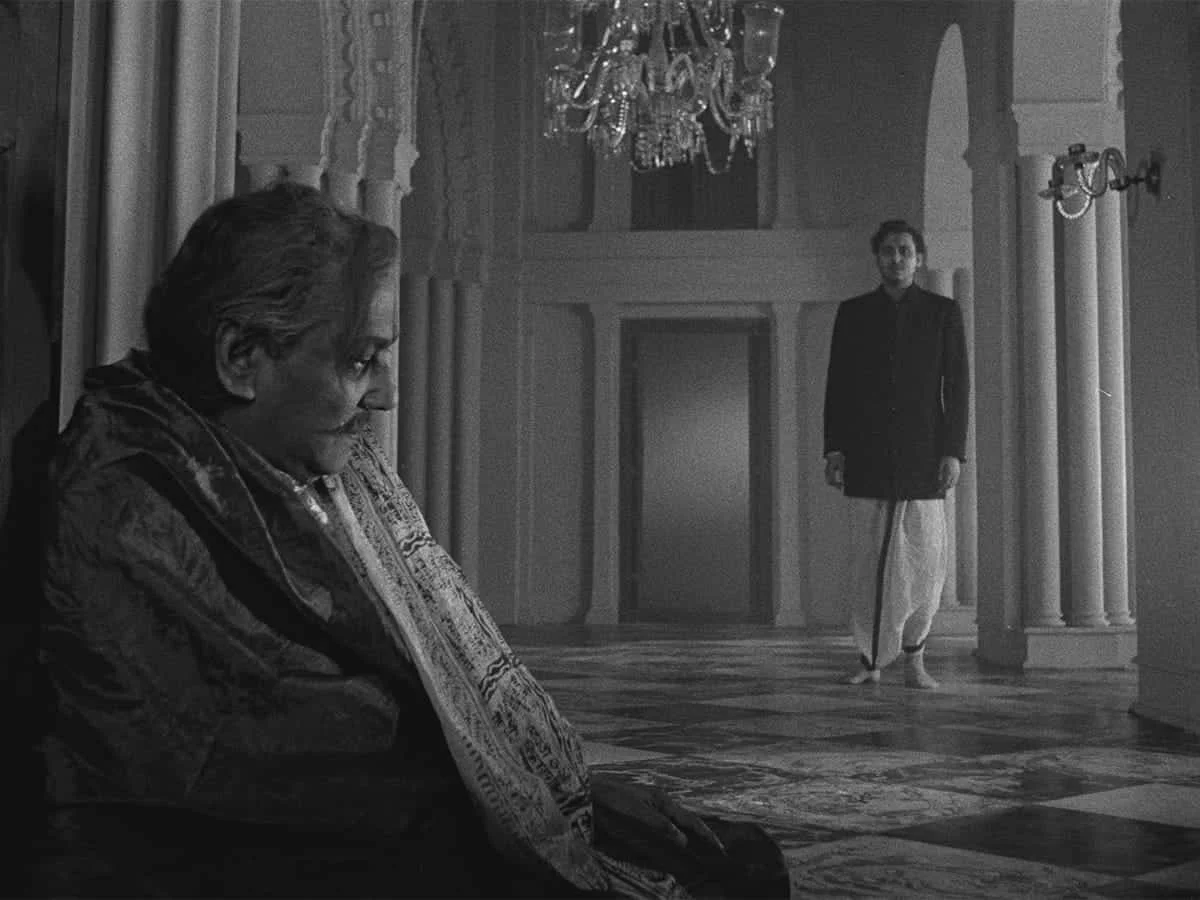
A still from Devi